

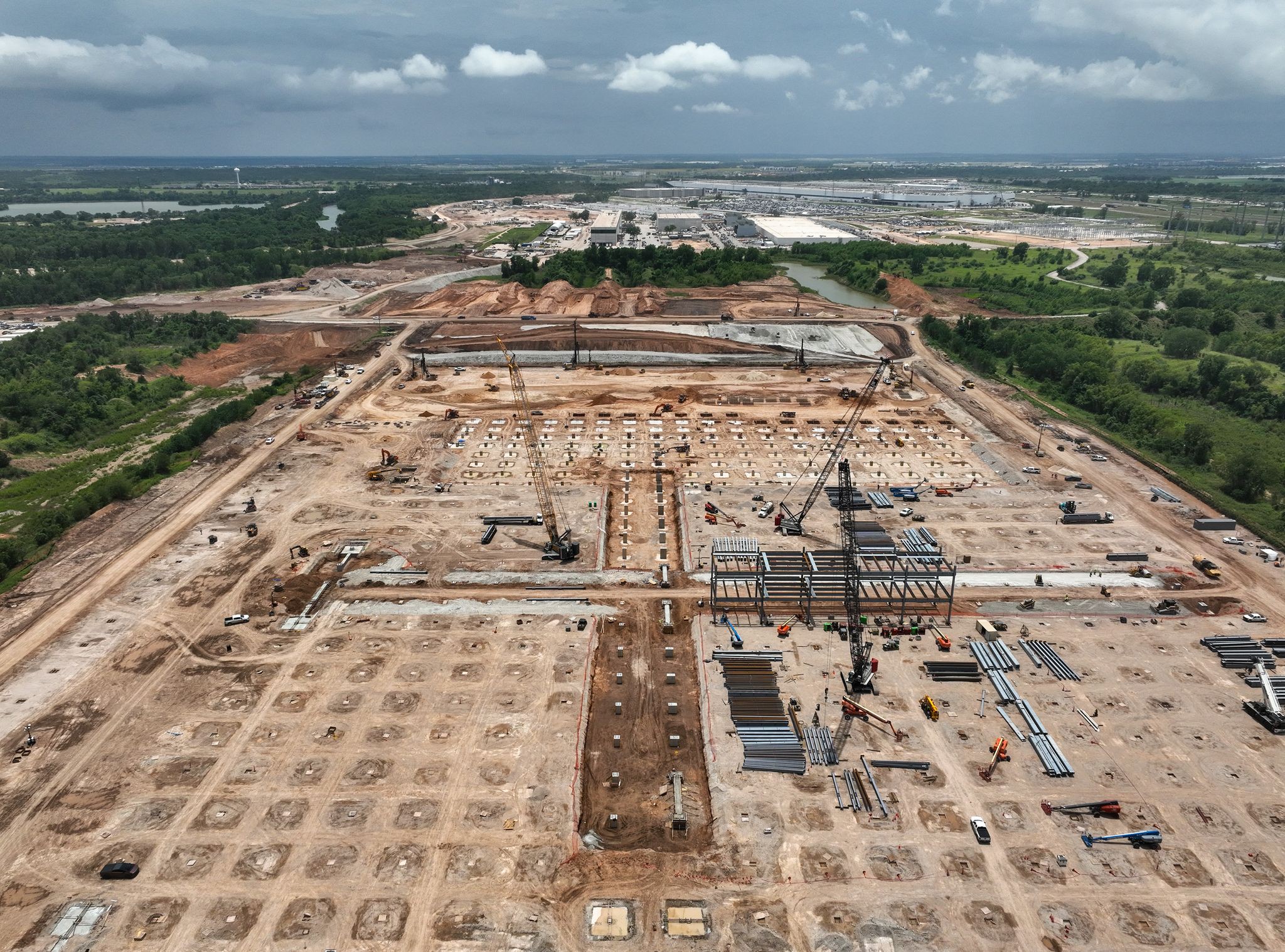
Construction work on the Optimus factory near Tesla’s Gigafactory Texas is seen on Monday, outside Austin. Tesla says the site will support production of future versions of its humanoid robot as the company expands its robotics ambitions. Jay Janner/Austin American-Statesman
Tesla Inc. has spent years pitching its humanoid robot as a product that could transform work. Now, new construction activity near Gigafactory Texas is offering a clearer look at an Austin-area site where future versions are expected to be produced.
In its first-quarter update, Tesla said it was carrying out site preparation work for Optimus, which the company says is designed to perform unsafe, repetitive or boring tasks, near its plant east of Austin. A steel structure is going up at an area designated for its newest production line.

The work underscores CEO Elon Musk’s push to position Tesla as an artificial intelligence and robotics company, not just an automaker. At the start of the year, Musk said Tesla would end production of the Model S and Model X at its Fremont, Calif., factory to make room for Optimus production, with Texas expected to produce the next generation of the robot.
The company’s robotics efforts were reiterated in late April, when the company said that preparations for its first large-scale Optimus factory in California would begin in the second quarter. The company has said it eventually hopes to produce 1 million robots a year on that line while preparing Gigafactory Texas for a next-generation line with an annual capacity of 10 million robots.
“I think Optimus will be our biggest product, not just Tesla’s biggest product, but probably the biggest product ever,” Musk said recently on a call with investors. “And I remain convinced of that conclusion.”
Takahiro and Hitomi Miyata and David Teran look at an Optimus robot on display at a pop-up event at Fareground Austin in downtown Austin during the South by Southwest Conference and Festivals on March 13, 2026. Jay Janner/Austin American-Statesman
Tesla currently has several Austin openings tied to Optimus, including roles focused on battery manufacturing, design and assembly quality. In a promotional video, employees working on the project said the robot “won’t even look like a robot. It’ll look like a human in a superhero suit.”
The company has also faced questions about how autonomous the robots really are. At Tesla’s 2024 We, Robot event, a Morgan Stanley analyst noted that Optimus robots appeared to rely on human remote operators while serving drinks, dancing and entertaining guests. Since then, Tesla has said Optimus can autonomously navigate its offices and labs and perform some factory tasks on its own.
Apart from Tesla, Austin is flush with firms working on deploying robots in a variety of settings.
In February, Apptronik Inc. raised more than $500 million in new funding, bringing its latest round close to $1 billion. The Austin startup, which partners with Google DeepMind and has had its Apollo robots used on Mercedes-Benz production lines, said the funding would help scale its production capabilities.
Austin-based Apptronik’s Apollo robot is 5 feet 8 inches tall and weighs 160 pounds. The artificial-intelligence humanoid robotics startup has now reached $5 billion in valuation. Provided by Apptronik
Austin’s Contoro Robotics, which builds robots that load and unload trailers and shipping containers, recently secured new investment that it said would help ramp up production. Diligent Robotics, another Austin company, designs robots to work alongside hospital staff in health care settings. The company was recently acquired by California-based Serve Robotics in a deal valued at $29 million.
Meanwhile, Musk rival and OpenAI CEO Sam Altman announced in late May that the company is hiring engineers to help program and manufacture robots.
“AI should be able to help people in the physical world,” Altman wrote. “In the short term, we are focused on robots to support skilled workers to build our future infrastructure; in the long term, we imagine everyone having a personal robot doing anything they need.”