

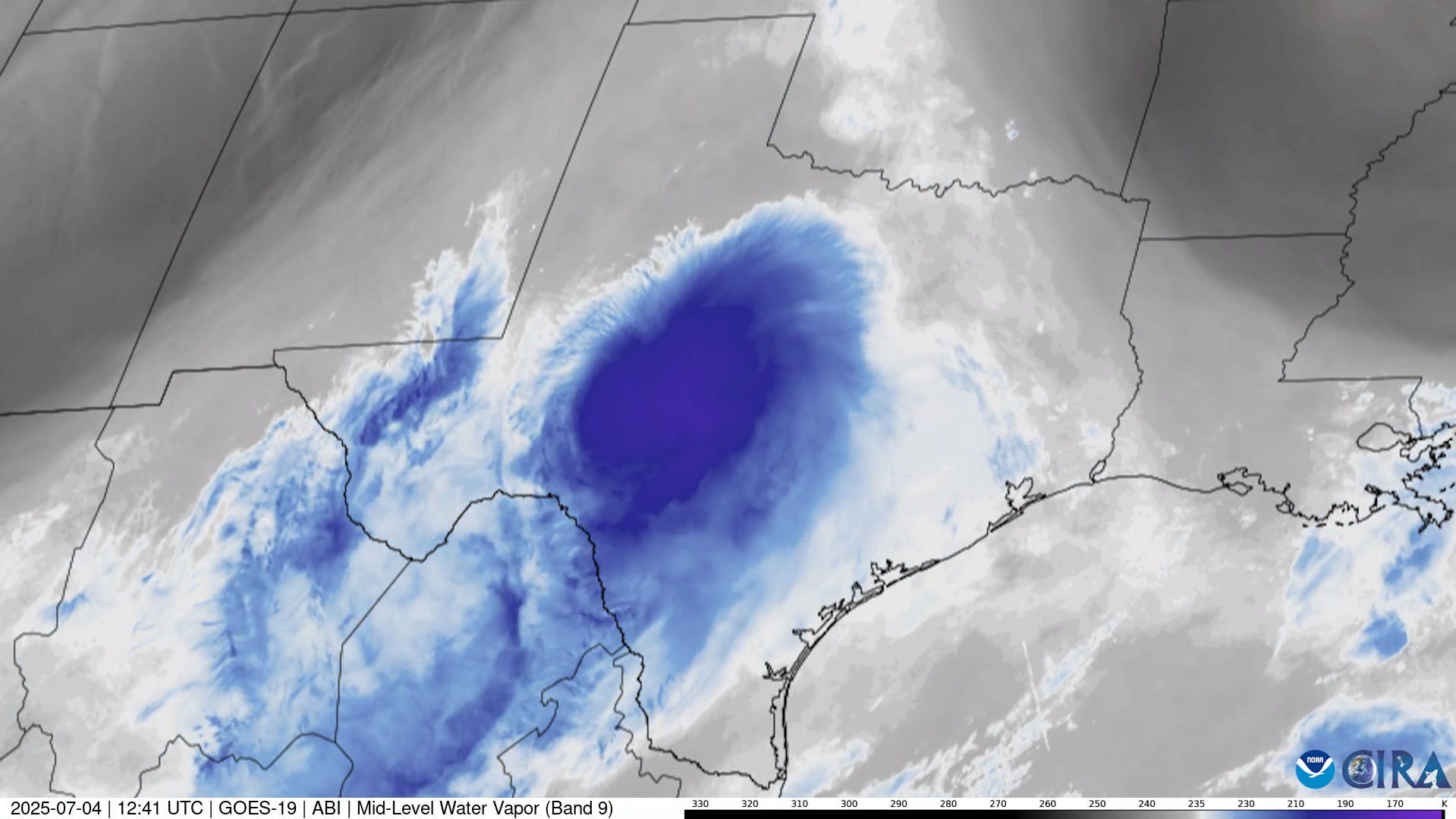
In the aftermath of the Texas Hill Country flooding, social media conspiracy theorists — and even a Georgia congressional candidate — are alleging that humans have manipulated the weather.
Kandiss Taylor, who is running for Georgia’s District 1 seat in the U.S. House, posted on X early Saturday: “Fake weather. Fake hurricanes. Fake flooding. Fake. Fake. Fake.” In another post that day she wrote: “This isn’t just ‘climate change.’ It’s cloud seeding, geoengineering, & manipulation,” she added. '“Fake weather causes real tragedy, that’s murder. Pray. Prepare. Question the narrative.”
Last October, in the aftermath of flooding caused by the remnants of Hurricane Helene, another Georgia congressional candidate, incumbent Rep. Marjorie Taylor Greene, R-Ga., raised similar accusations. Greene alleged that the federal government, then under President Joe Biden, steered hurricanes into Republican-leaning states in the Deep South.
Meteorologists at the time immediately pointed out that hurricanes possess such extraordinary amounts of energy — about 200 times the total electrical generating capacity of all humans on the planet — that it can’t even be reproduced by humans, much less be put under their control.
It’s the same with the Texas flooding disaster. As Houston broadcast meteorologist Travis Herzog posted on Facebook Sunday, “cloud seeding cannot create a storm of this magnitude or size.”
“In fact, cloud seeding cannot even create a single cloud,” Herzog wrote. “All it can do is take an existing cloud and enhance the rainfall by up to 20%. Most estimates have the rainfall enhancement in a much lower range.”
Even if any cloud seeding occurred, “it is physically impossible for that to have created this weather system,” he said.
“This is a matter of scale. If I blow out a candle with my breath, does that mean I can then go blow out a raging wildfire? It is the same with cloud-seeding,” Herzog concluded.
What is cloud seeding?
Although human-engineered hurricanes are impossible, real weather modification projects like cloud seeding, have been underway for decades in Texas and beyond. However, even the results of these efforts are fairly limited, like fractions of inches of rain per year.
The Texas Department of Licensing and Regulation, the state agency that administers the 1967 Texas Weather Modification Act to regulate the use of cloud seeding, says on its website that "there is no evidence that seeding causes clouds to grow substantially taller and produce unwanted effects (such as damaging winds, hail, and flash floods)."
How does cloud seeding work? To get rain, you need more than just moisture in the air: The microscopic water droplets in a cloud also need to attach to something else to condense into a raindrop and fall to the ground. Typically in nature, the water attaches to dust or salt particles, called cloud condensation nuclei, that are floating through the atmosphere.
Cloud seeding helps stimulate rainfall by injecting cumulus clouds — the most capable of generating heavy rainfall — with other materials to enhance precipitation, such as silver iodide or calcium chloride particles.
Bria DeCarlo, a former project meteorologist for the South Texas Weather Modification Association, told the Houston Chronicle last year that cloud seeding can seem unfamiliar or intimidating but “weather modification is a long-term water management strategy that has been proven to be effective for the drought-stricken areas across the United States and Texas,” DeCarlo said.
In Uvalde County in 2022, for instance, the South Texas Weather Modification Association found only an 0.89-inch increase in rain from cloud seeding. That may not seem like a lot, but it’s close to success for DeCarlo.
“Some years, we may only produce about half an inch increase or less,” DeCarlo said. “Hitting that inch increase is the benchmark for success. It’s really good. But any precipitation increase is good, especially down here.”
However, pilots are not allowed to seed clouds if the National Weather Service issued a flash flood or a severe thunderstorm warning, DeCarlo said. They will also suspend operations in an area that has already seen significant rainfall over a long period.
“If it’s been raining for weeks at a time, we will ease back off farmers in our community and suspend operations for a few weeks and pick it back up later so that their crop doesn’t get completely washed out,” DeCarlo said. “We don’t go up there and go crazy with the seeding and not listen to what anybody else has to say. We’re very involved with what the public has to say and with their needs and wants are, because that’s what we’re here for. We’re here to help.”