

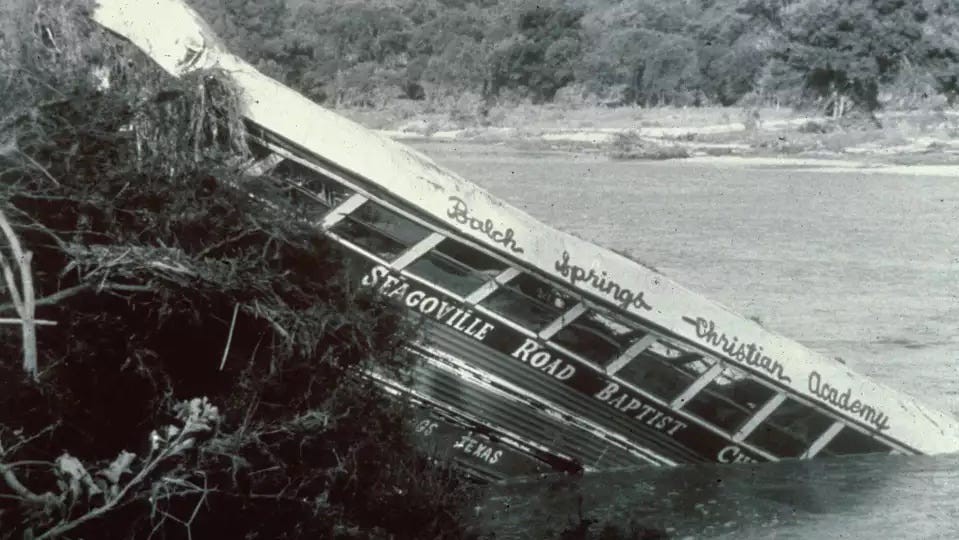
As the news from the Hill Country grows increasingly sorrowful, scores of lives have been lost due to catastrophic flooding, with many children among the victims. Flash floods are a recurring reality in Central Texas, shaped by its unique meteorological and geographic conditions. While history offers little solace to survivors, it can provide lessons for the future. This newsletter explores past Central Texas flooding, including a horrible 1987 flood involving campers, as well as other historical topics such as a Clovis-era artifact found on a Bolivar beach, a historic railway station in Beaumont, and the evolution of Montrose as Houston’s gayborhood.
Holiday tragedies: Flash floods and wildfires haunt Central Texas
Deadly natural disasters have struck Central Texas during many holidays. The Halloween floods on Onion Creek in 2013, the Labor Day wildfires in Bastrop in 2011, and the Memorial Day floods in 1981 are just a few examples. Tornadoes also devastated Jarrell on May 27, 1997, the day after Memorial Day. The 2015 Memorial Day weekend brought severe flooding, high winds, hail, and lightning across Central Texas. Now, the Fourth of July weekend floods on the Llano and Guadalupe Rivers have added to this tragic history, particularly due to the loss of children. While droughts are often associated with Texas, flash floods are equally definitive—and often more deadly. READ MORE AT STATESMAN.COM
Deadly Hill Country flood evokes memories of similar disaster in 1987
The recent flooding in Kerrville recalls a similar tragedy on July 17, 1987. A storm originating in Mexico dumped 11 inches of rain near the Guadalupe River’s headwaters in less than five hours, causing the river to rise 29 feet at Comfort. The Pot O’ Gold Christian camp was in the flood’s path, and while officials evacuated the site, a bus and van were engulfed by floodwaters, killing 10 teenagers. "The group was at exactly the wrong place at exactly the wrong time," a National Weather Service report stated. READ MORE AT THE SAN ANTONIO EXPRESS NEWS
Beach stroll turns into archaeological breakthrough on the Bolivar Peninsula
While searching for shark teeth near High Island’s "Lonely House," beachcomber Daniel Sawyer discovered a rare Clovis-era artifact. "I actually live about three hours away, but I like to go down to that area and Galveston to spend the day and beach comb, normally looking for sea glass, but I pick up anything that catches my eye," Sawyer told Chron. After sharing his find in a local Facebook group, experts identified it as the base of a Clovis point, a tool used by Paleoindian peoples over 12,000 years ago. READ MORE AT CHRON.COM
What Was That: At the Laurel Avenue train depot?
The historic train depot at 909 Laurel Ave. in Beaumont has been misidentified for years. While often called the Santa Fe Depot, it was actually the Texas and New Orleans passenger and freight station. The building, constructed around 1901, features a low-lying profile and overhanging hipped roof gables reminiscent of F.L. Wright’s Prairie houses. However, the actual Santa Fe Depot was located a block away. READ MORE AT THE BEAUMONT ENTERPRISE
How did Montrose become Houston's gayborhood? Thank Big Oil and cheap real estate.
Montrose has long been the heart of Houston’s LGBTQ+ community, a place where queer residents have lived, organized, and thrived. Before the 1950s, Houston’s LGBTQ+ spaces were scattered across downtown, Midtown, and Rice Village. However, the oil boom drove up prices, pushing queer businesses into Montrose, where arts and culture flourished and real estate was affordable. READ MORE AT THE HOUSTON CHRONICLE