

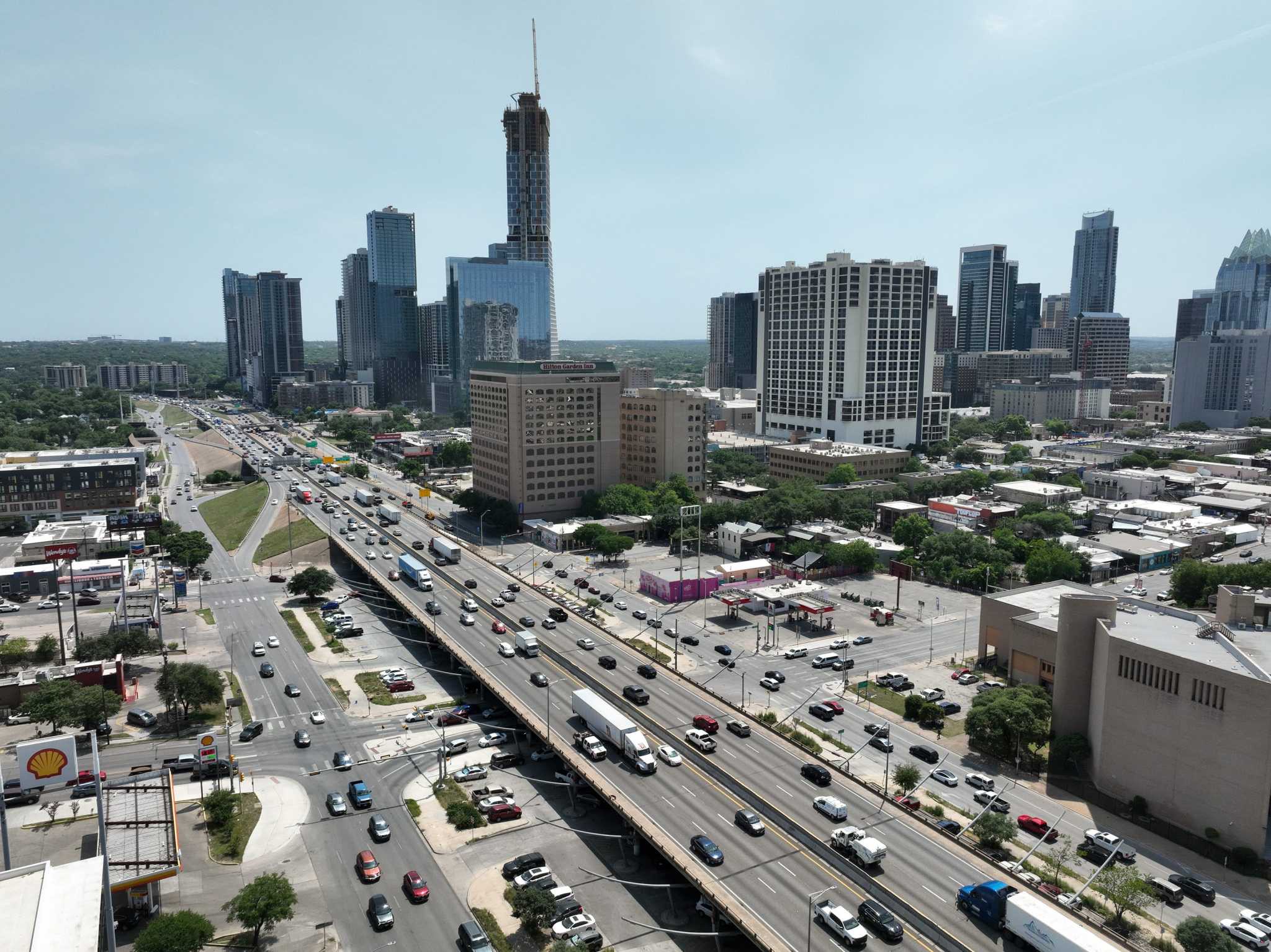
I-35 cuts through downtown Austin at 7th Street in this view looking south on Tuesday May 20, 2025, where the I-35 Cap and Stitch project could be built.
Jay Janner/American-Statesman
After weeks of rare infighting fueled by a major budget crunch, the Austin City Council on Thursday approved $104 million to pay for columns to support three large decks and two pedestrian bridges over parts of Interstate 35 near downtown.
While the 8-2 decision, with one abstention, was limited to funding for the support structures, it also served as a de-facto vote on the scope of the city's long-planned effort to physically reunite historically segregated East Austin with the heart of the city by covering a soon-to-be lowered I-35 with parks, walkways and other amenities. That's because the Texas Department of Transportation needs to know by month's end how many decks and bridges to account for as it prepares to lower and expand I-35 through Central Austin.
As previously envisioned, the project included six park decks and two pedestrian bridges. The revised plan approved Thursday accounts for three caps, from Cesar Chavez to Fourth streets; Fourth to Seventh streets; and 11th to 12th streets, as well as two 300-foot pedestrian bridges, or "stitches," near 41st Street along the Red Line train path.
The downsizing was the result of a major compromise.
Mayor Kirk Watson listens to Susana Almanza speak against the I-35 Cap and Stitch project at City Hall on Thursday May 22, 2025.
Jay Janner/American-Statesman
Ahead of the vote, the 11-member council was nearly evenly split on how many caps and stitches it should build. One camp had pushed for funding only two decks, citing the city's worsening financial outlook, while another camp had pushed for at least four.
Council Member Ryan Alter was in the latter group but voted in favor of the slightly downsized plan.
"What we ultimately approved is a significant investment and opportunity in not only bridging east and west, but creating meaningful spaces for people to come and enjoy," Alter told the American-Statesman after the vote.
Council Member Paige Ellis voted in favor, too, but only after her motion to pay for support structures for two caps and two stitches failed 5-6.
“This may feel like an episode of Family Feud, but we're all really fighting for the same green future,” she said.
The two 'no' votes came from Council Members Marc Duchen and Krista Laine. Council Member Mike Siegel abstained. All cited concerns with the cost of the project.
The Austin City Council hears public comments about the I-35 Cap and Stitch project at City Hall on Thursday May 22, 2025.
Jay Janner/American-Statesman
"The city of Austin is holding all of the financial risk of cost overruns when we all know they are coming," Laine said. "It's wild."
The city is facing a $33 million budget deficit and also expecting to lose a $105 million federal grant that would have paid for a large portion of one of the caps.
The total project cost, accounting for the reduced number of caps, was not immediately available Thursday. With all six caps and both stitches, the estimated price tag had been $1.4 billion.
The sentiments expressed during the public comment period mirrored the split on council.
Many residents and groups said they wanted columns for some or all of the caps funded, saying it was an investment for future generations of Austinites.
"This is one of those 'yes and' moments," said Jim Walker of the Cherrywood Neighborhood Association. "You're going to have to address the urgent needs and meet these big, multigenerational moments when they arise. They don't come very often."
But others weren't so sure. Several local advocacy groups and residents opposed the plan, saying that money was needed for other more immediate needs like affordable housing, similar to the concerns of the dissenting council members.
"This is not the time to put a down payment on a project that the people of Austin cannot afford," Barbara McArthur, a district 7 resident, said during public comment at Thursday’s meeting.
Thursday's vote could have included a commitment to pay for construction of the actual caps and stitches — not just the support columns. But TxDOT granted the city an extension until November 2026 as the agency will not bid out the project before then, TxDOT spokesperson Bradley Wheelis said in a statement.
That will give the city time to figure out how to pay for that part of the project. One possibility under consideration is including it in a 2026 bond package, an option that city leaders have been eyeing for a variety of capital projects.
Construction is estimated to begin in 2029.