

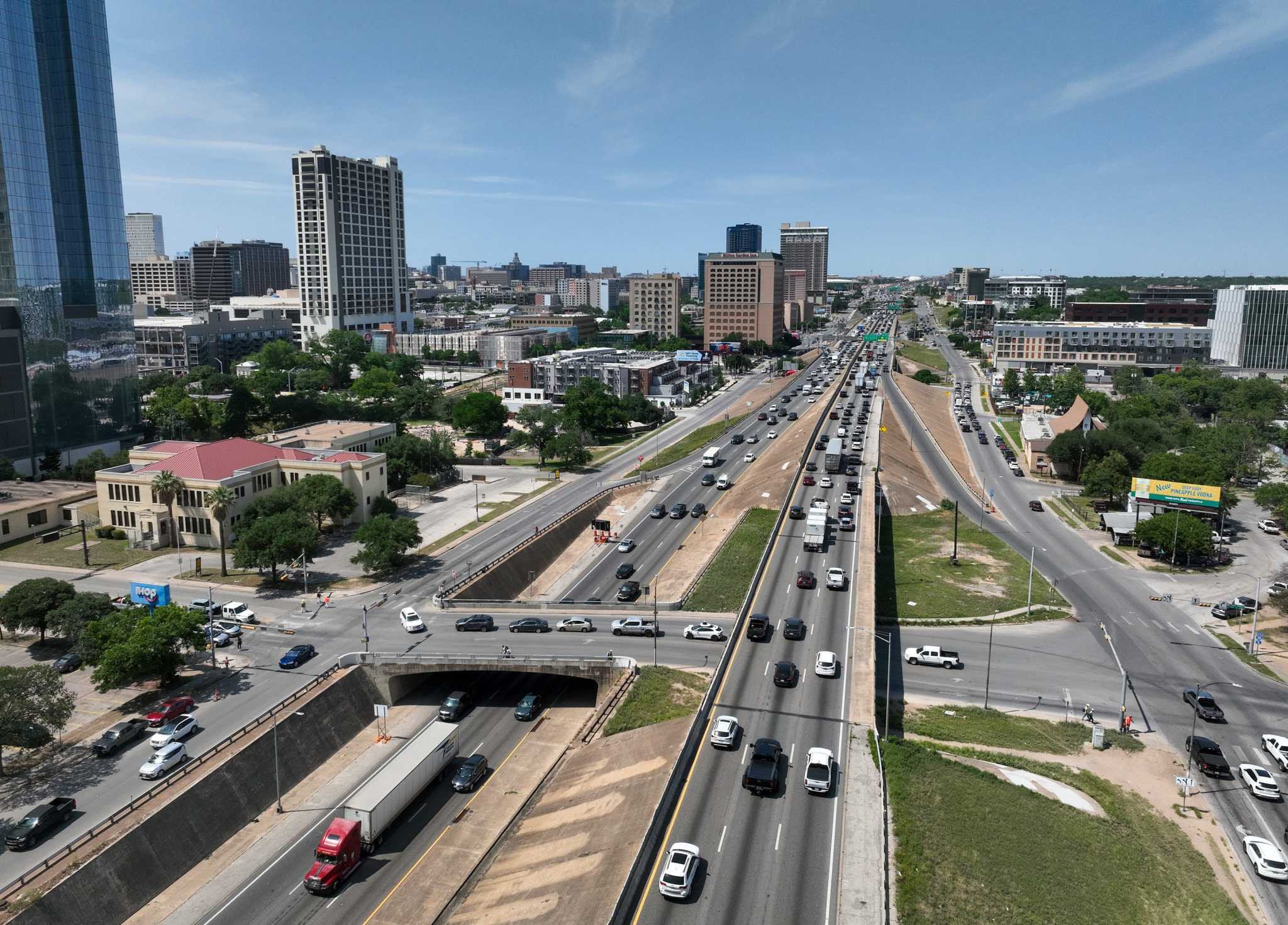
I-35 cuts through downtown Austin at Cesar Chavez Street in this view looking north on Tuesday May 20, 2025, where the I-35 Cap and Stitch project could be built.
Following years of planning and discussion, the Austin City Council on Thursday took its first major vote on a plan to cover sections of Interstate 35 in Central Austin with acres of parkland and walkways.
The primary goal of the so-called "Cap and Stitch" program is to reunite the historically segregated East Side with the city center while creating more space for recreation and tourism. The project began to take shape roughly five years ago after the Texas Department of Transportation announced plans to lower I-35 through downtown between Martin Luther King Jr. Boulevard and Holly Street as part of a massive expansion of the highway.
As originally envisioned, the plan called for installing six "caps," or park decks, and two pedestrian bridges, or "stitches," over the highway. But on Thursday the council voted 8-2, with one abstention, to support a scaled down version of the plan amid a major budget crunch and escalating construction costs.
At one point, the full plan was estimated to cost $868 million but that price later jumped to $1.4 billion. Read on to learn more about the new version of the plan, including how much it might cost and how long it will take to get done.
What did Austin City Council actually approve?
The City Council on Thursday approved $104 million to pay for columns needed to support three park decks that will span Cesar Chavez to Fourth Streets; Fourth to Seventh streets; and 11th to 12th streets. That money will also cover two, 300-foot-wide pedestrian bridges near 41st street along CapMetro Rail's Red Line.
While the decision was limited to funding for the support structures, it also served as a de-facto vote on the scope of the entire project. That's because TxDOT needed to know by month's end how many caps and stitches to account for as it finalizes plans to lower and expand I-35 through Central Austin.
The opportunity to build additional support columns — and caps — will not arise for many decades, according to the city, prompting local leaders to refer to the vote as a "once-in-a-generation" decision.
The city will now have until November 2026 to decide how many of the three caps and two stitches to build before TxDOT bids out the project, city leaders said at a work session Tuesday. Anything approved after that would be more expensive, they said.
What will the caps and stitches look like?
As Austin leaders crafted the plan, they frequently referenced similar project in two other cities: Klyde Warren Park in Dallas and Rose Kennedy Greenway in Boston.
Klyde Warren, a 5.4-acre park that covers a downtown section of the Woodall Rodgers Freeway, features plenty of trees, a large foundation, dog park and children's play area.
The 17-acre Rose Kennedy Greenway hosts a beer garden, food trucks, a wide array of plants, trees and shrubs, fountains and, like Klyde Warren, hosts several public events.
The renderings of the Austin project have a much similar feel: acres of green space with art and buildings over the highway. City leaders have said they want the decks to serve as both a destination for entertainment and other activities and a way to diminish the city's east-west divide.
With the main lanes of I-35 substantially lowered, the park decks will appear ground level.
What actually goes on top of the decks will be determined at a later date. City leaders will have to factor in construction costs of any potential amenities or buildings, as well as the cost of maintenance, which they project could be tens of millions every year.
The University of Texas is also considering building a cap between East Dean Keeton and East 15th Streets near the site of its future medical center. No city funds would go toward that project.
When will the park decks be built?
It depends.
The massive expansion of I-35 through Austin began last year and is anticipated to be completed in 2033. Construction on the support elements for the decks, and pedestrian bridges, is slated to begin in 2029.
But construction of the actual decks may not come for years or even decades.
That's because the city first needs to figure out how — and if — it's going to pay for them.
The council could have decide that on Thursday but TxDOT moved the deadline to November 2026 and promised the city it wouldn't charge them more for construction.
That will allow the city more time to identify funding, with possible sources including philanthropic donations and a 2026 bond package.
Construction is estimated to be completed in 2033, according to TxDOT, which will then issue a ten year halt on all I-35 construction, with the exception of the amenities on top of the caps, should any be built.
The next opportunity to build the decks would be after the 10-year moratorium is lifted in 2043, according to a city presentation.
How much will this cost?
The total estimated cost of the two bridges and three decks, including parks, amenities and any buildings, is $649 million, according to city figures and Council Member Ryan Alter, who provided the total cost of the bridges. City leaders have shown support for finding external money to pay for large parts of the project, including private donations.
The amount the city committed on Thursday to pay for the support elements for all five structures is $104 million. That will be paid for over several years using a state infrastructure loan, future debt or other funds identified by the city at a later date.
Many council members viewed this as a financial compromise. But Krista Laine, one of the two council members who voted 'no' on Thursday, expressed concerns about the city having to foot the bill for additional costs that arise during construction.
"The city of Austin is holding all of the financial risk of cost overruns when we all know they are coming," Laine said. "It's wild."