

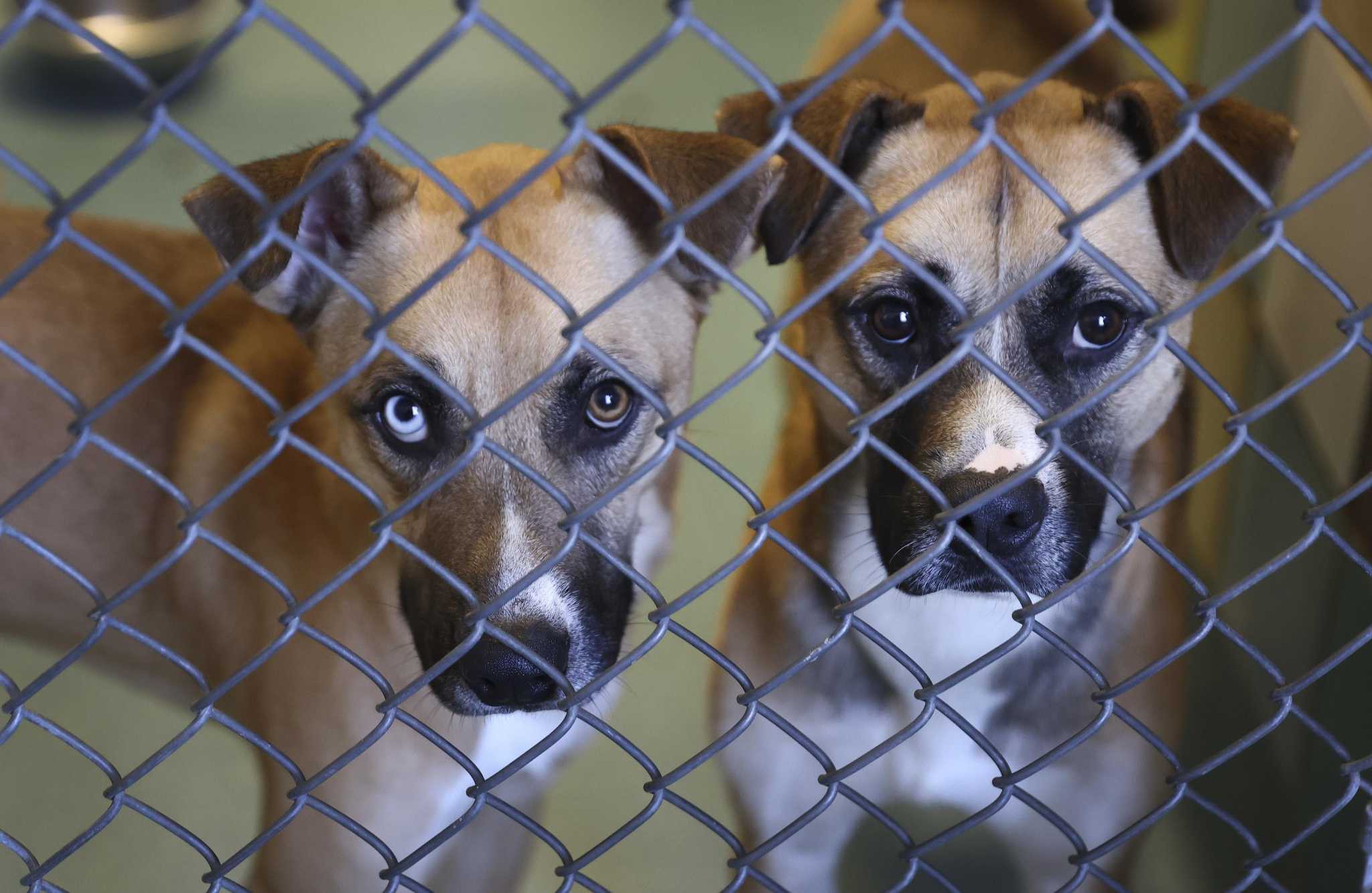
Vet tech Nichole Nocki feeds heart worm pills encased in food to dogs at the San Marcos Regional Animal Shelter last July.
Three dogs share Minnie Buckhaults’ office at the San Marcos Regional Animal Shelter.
They shouldn’t be there. The room isn’t designed to house animals, but the kennels are full, the overflow spaces are packed, and last week, there are roughly three dozen more dogs than the facility was built for.
Buckhaults, the shelter’s community engagement coordinator, said this has been the case for years.
The shelter has 93 dog kennels. Earlier this week, staff counted approximately 105 dogs on site and 26 more in foster homes. That’s roughly 130 dogs that will need a kennel as fosters return over the holidays. That leaves about 37 dogs without an “official” space.
Staff have responded by doubling up dogs in kennels, setting up crates in the lobby, the sally port and office corners never meant for animals.
At one point, Buckhaults said about 20 dogs were sharing kennels meant for a single animal.
“It’s not good for their health and safety,” she said. “They’re more at risk of disease when we’re putting them in places they’re not supposed to be.”
When people walk into the shelter, the overcrowding hits them before anyone says a word, Buckhaults said. Crates line the lobby. Dogs bark over each other, making it hard to hear staff at the front desk. Down the kennel rows, many runs hold two dogs instead of one.
“In my own words, it’s overwhelming,” Buckhaults said.
City officials say the shelter has taken in about 3,900 pets since January and has been over full capacity since summer 2022. It is the only animal intake facility in Hays County, serving all cities in the area.
In fiscal 2024–25, the shelter took in 4,416 live animals and had 4,041 outcomes, leaving 375 animals without designated space.
San Marcos Animal Shelter's ongoing capacity crisis
The shelter has been over capacity since 2022 — and the crunch hasn’t let up.
As an open-intake shelter, it accepts strays, animals picked up by animal control and owner surrenders.
“We don’t know if we’re going to get hit with one-dog days or 50-dog days. It’s completely up in the air,” Buckhaults said.
She doesn’t point to one cause, but a combination of factors:
- A fast-growing population in Hays County.
- “Rampant” pet overpopulation problem in Texas.
- Other Central Texas shelters at or over capacity.
Inside the shelter, overcrowding slows everything.
Staff arrive around 8 a.m. to start cleaning. Ideally, that work wraps up by late morning. With so many dogs, it often stretches into the afternoon.
Wednesdays are meant for deep-cleaning, enrichment and medical care, but limited staff and too many animals leave little time for anything extra.
The shelter has just over 20 employees. That's not enough, Buckhaults said, especially during a hiring freeze that’s left several positions vacant.
Foster homes have helped ease the burden. Texas State University students provide a steady stream of fosters, and at times up to 35 adult dogs have been in foster care, not counting puppies and kittens.
But that help ebbs during holidays and breaks.
“When there’s a holiday or a break, many of our animals will be coming back as our fosters travel,” Buckhaults said.
That, combined with continued intake, makes this week especially difficult: more dogs returning, more arriving, and still just 93 kennels.
Owner surrenders and euthanasia decision
Strays are the most common type of intake. But owner surrenders, Buckhaults said, create the most pressure because they often come with a deadline: moving, eviction, medical debt or behavioral issues.
“We try to give people resources to keep their pets when we can,” she said, pointing to training referrals, food pantries and rescue group support. “But we’re an open-intake shelter. At the end of the day, if they can’t keep the dog and there’s no other option, we’re where that dog ends up.”
In most cases, the shelter’s first options are adoption, fostering, rescue partners and out-of-state transports. But when the shelter is full, city officials say it raises the risk of disease and behavioral decline, especially for dogs that stay for months.
In those cases, euthanasia becomes the last resort.
National veterinary groups describe the process as sedation followed by a drug that halts brain function, typically quick and painless.
At San Marcos, dogs are added to the euthanasia list only after staff weigh behavior, health and time — and after trying foster, rescue or transport options. Aggression, repeated biting or severe kennel stress can also lead to inclusion on that list.
Earlier this week, four dogs — Daisy, Pete, Dulce and Reese — were on the list. By midweek, Dulce and Reese had been adopted. Daisy and Pete face euthanasia if not adopted by Tuesday, Nov. 18.
Only shelter in a county running out of options
For now, the San Marcos Regional Animal Shelter serves most of Hays County — but that will change.
San Marcos and Hays County leaders recently approved an agreement to end regional shelter services on Sept. 30, 2026. After that, the city will serve only San Marcos residents, and the county plans to open a separate facility.
Buckhaults said narrowing the intake boundary could help reduce overcrowding, but only if other shelters and services are in place.
So far, there’s no firm replacement. Hays County ended its partnership with Austin Pets Alive!, which had run a resource center to connect pet owners with training and support. Meanwhile, Austin Animal Center has repeatedly restricted intake to emergency-only cases due to its own capacity crisis.
That has left San Marcos fielding animals with Austin microchips or owners from Travis County.
“I think people see that we are one of the only shelters that have remained open intake,” Buckhaults said. “They will bring animals here even if they weren’t found in Hays County."
Some suggest the city should build more kennels. But Buckhaults said that isn’t a simple fix. The city has already added two kennel buildings — both filled almost immediately — and the shelter’s footprint has little room to grow.
"It’s just not feasible right now,” Buckhaults said. And more kennels alone would not fix what is fundamentally a flow problem: too many animals coming in, not enough going out.
How you can help
Staff urge residents to adopt, foster, donate or volunteer.
If you can adopt, Buckhaults asks people to start with Pete and Daisy before Tuesday.
The shelter is open 12 to 5 p.m. Sunday and Monday, and 12 to 7 p.m. on Tuesday.
For more information or view the at-risk list, please visit sanmarcostx.gov/atriskpets. Rescue partners may contact npascone@sanmarcostx.gov for pull requests.