

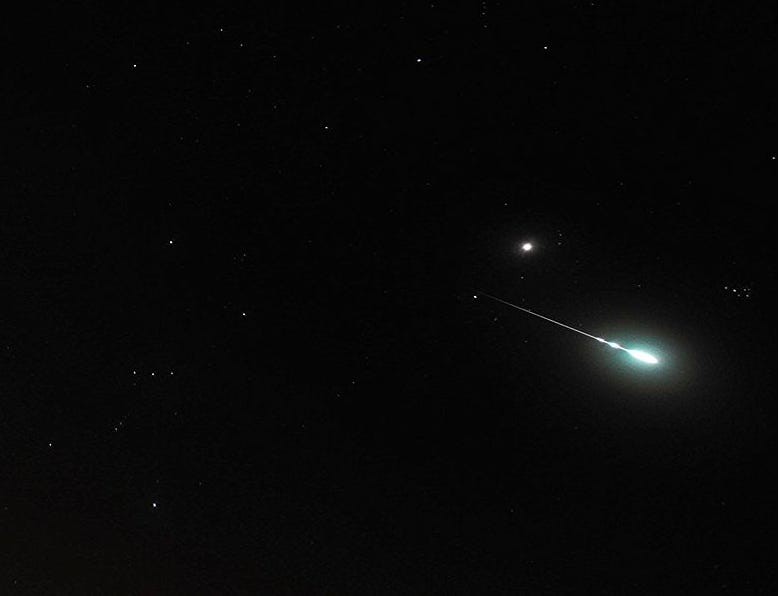
An unusually bright Geminid meteor on Dec. 12, 2012. Constellation Orion is on the left and the Pleiades star cluster at far right; Jupiter was in this part of the sky at the time and appears like a bright star above the meteor.
Beautiful, twinkling stars light up Central Texas skies every night, but this month is special — the Geminid meteor shower is putting on a show.
Spectators got more than they bargained for Tuesday night when a meteor suddenly shot through the darkness. Many Austinites captured the enchanting moment in photos and videos, which they shared on social media.
Viewers in Houston and Oklahoma City also posted photos and videos.
Some eyewitnesses online said the meteor appeared “metallic” and “green,” which NASA said is a common result of chemical reactions upon entering the atmosphere.
- Do you have photos or videos to share of last night's meteor over Austin? Email them to newstips@statesman.com and we might add them to this story or feature them on social media!
More meteors to come this week, weekend
The meteor spotted Tuesday was part of a larger shower, called the Geminid meteor shower, which will continue through the weekend and reach its peak on the evening of Saturday, Dec. 13. At that point, over 100 meteors are expected to fall every hour.
The Geminid meteor shower occurs annually in December, giving astronomy fans something to look forward to.
Weather forecast for stargazing
As the saying goes, “If you’re lucky, lightning might strike twice.” But in this case, it won’t be lightning — it could be a meteor streaking across the Texas sky.
Anyone stargazing on Wednesday and Thursday nights might get that chance, as clear skies and lighter winds will make for ideal viewing conditions. However, it will be chilly, with temperatures dipping into the 40s after midnight and falling to the upper 30s and low 40s by daybreak on Thursday.
Bundle up in you plan to stargaze tonight because temperatures will drop into the upper 30s and low 40s around daybreak.
Temperatures will be a bit warmer Thursday night, with lows only dipping into the low to mid-50s, but clouds will begin to creep back into the picture, especially east of Austin.
Clouds will bring to move in on Friday ahead of our next storm system.
During the peak of the Geminid meteor shower this weekend, a storm system and cold front will move in, bringing additional clouds and a slight chance of rain on Saturday and Sunday.
For the best viewing around Austin, try to get away from downtown light pollution and head to nearby Dark Sky communities such as Dripping Springs, Bee Cave, Jonestown, Horseshoe Bay, Liberty Hill, Fredericksburg, or Blanco.
After 9 p.m., look eastward to locate the bright planet Jupiter, which is currently within the constellation Gemini. The waning crescent moon will rise later in the night and may wash out some of the fainter meteors, so after moonrise around midnight, consider shifting your gaze westward to avoid the bright moonlight. The shower typically peaks between midnight and 2 a.m., when Gemini is highest in the sky.
Here are some general viewing tips:
- Find an area well away from street lights and the light pollution of cities.
- Come prepared for winter temperatures with a sleeping bag, blanket or lawn chair.
- Lie flat on your back with your feet facing the south and look up, taking in as much of the sky as possible.
- It should take less than 30 minutes for your eyes to adapt so that you can see streaking meteors.