

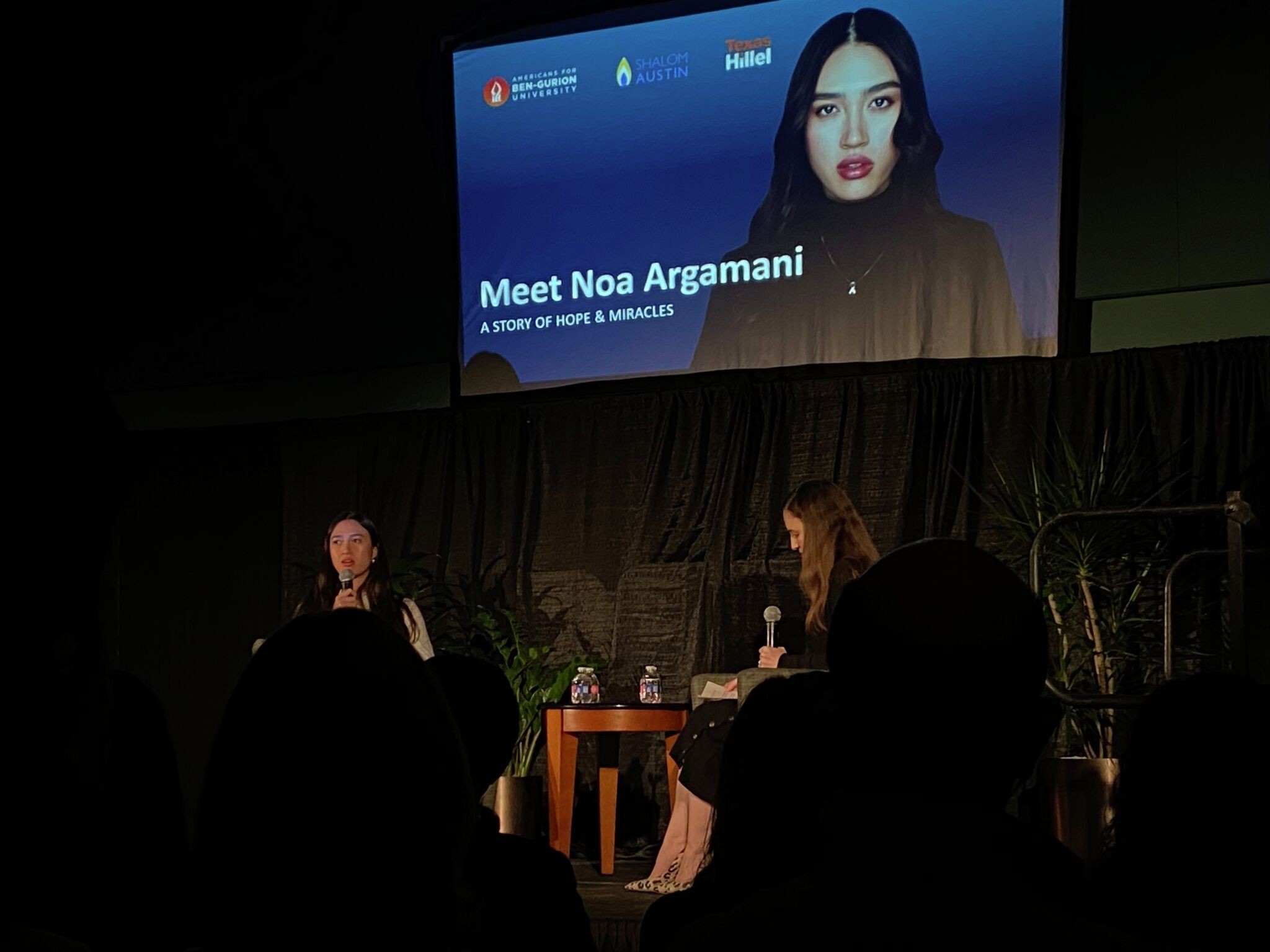
Noa Argamani — an Israeli hostage who was kidnapped on Oct. 7, 2023 and held in captivity for 245 days — spoke at Texas Hillel at the University of Texas on Monday, her sole appearance on a U.S. college campus.
In front of an audience of about 400 students, educators and Austinites, Argamani discussed her background, her studies at Ben-Gurion University, the Oct. 7 attack by Hamas and the months of captivity that followed. The conversation, guided by Texas Hillel Executive Director Rabbi Stephanie Max, traced Argamani’s account of the abduction, her survival in Gaza and her life since returning home.
"We never thought it could happen," Argamani said about the attacks. "Not in our country."
Capture and captivity
Argamani was a university student studying machine learning and AI when she, her boyfriend Avinatan Or and some friends decided to attend the Nova music festival. She recalled buying the tickets only 24 hours before the festival.
Argamani said they arrived around 4 a.m. When rockets began at 6:30 a.m., they treated it as routine — something residents of the area are used to — planning to stay by the car until the barrage passed.
As they tried to leave, gunmen began shooting at them on the road, she recounted. She was on a call with one of her friends who was driving in another direction. That friend screamed to her that he saw the attackers, then went silent; moments later, Argamani heard one of the militants shouting through his phone and realized her friend had been killed.
Their own car became stuck, forcing them to abandon it and hide for hours until they were found by Hamas, Argamani said. That moment was captured in the widely seen video of Argamani being separated from her boyfriend and taken away on a motorcycle before being brought into the tunnels in Gaza where she was held hostage.
During her time in captivity, she lived in confined conditions with little information about what was happening beyond the room she was held in, she said.
Argamani talked about being held alongside two other hostages — Yossi Sharabi, a father who was kidnapped in front of his wife and daughters, and Itay Svirsky, a life coach whose parents were murdered on Oct. 7. Those two were later killed while still in captivity, although their cause of death is disputed.
Argamani said she was held early on with two girls — 8-year-old Emily Hand and 12-year-old Hila Rotem — abducted in their Disney pajamas after a sleepover. While one of the girl's mothers was also in captivity, she was unable to communicate because of a disability, so Argamani became the girls' caretaker as they faced hunger and fear. The girls were released early on during the conflict as part of a Qatar-led hostage exchange deal. She said watching them finally go home after 50 days was the first moment she felt real joy while being held hostage.
Argamani’s message throughout the conversation centered on the need to keep telling the story of the Oct. 7 attacks, not only as a record of what happened to her, but as a warning about how quickly ordinary life can change.
She also emphasized resilience — not just her own, but that of her university and community. The event’s organizers echoed that theme, describing her presence as a reminder of "strength and determination to fight for the return of every hostage" and urging the audience not to "let the darkness win."
As she continues to process what happened, she told the audience she is working to finish her courses and graduate.
Speaking at UT
UT junior Barry Seitz said Argamani’s story felt unnervingly close to home: a student studying tech, going to a music festival close to your college, navigating college relationships — all details that made the attack feel less distant.
"It’s so relatable in one way," Seitz said, "but she’s experienced something none of us can imagine." Seitz said the most affecting moment for her was hearing how hostages built a sense of community in captivity, caring for one another in a place defined by fear.
Seitz said the past two years have reshaped Jewish life at UT, with Texas Hillel becoming a stabilizing force as students processed both global events. She called Texas Hillel a space where students could speak openly, learn and feel supported.
Max, the executive director, said the event reflected how the community has evolved since the Oct. 7 attacks. The early days, she said, were defined by "triage," supporting Israeli students and those who felt an immediate personal connection to the attack. Over time, Texas Hillel shifted from crisis response to broader education — hosting speakers, facilitating dialogue, and helping students understand the conflict while recognizing their relative safety on campus.
Monday’s turnout, she added, showed how deeply students remain engaged.
"Students could have been anywhere," Max said. "They chose to show up."
With this being the only U.S. university on Argamani’s itinerary, Max credited both the event’s existence and its success to UT taking "student sense of belonging very seriously." She said that that goal strongly aligns with Texas Hillel’s own goals. The event had a robust security procedure to ensure participant safety.