

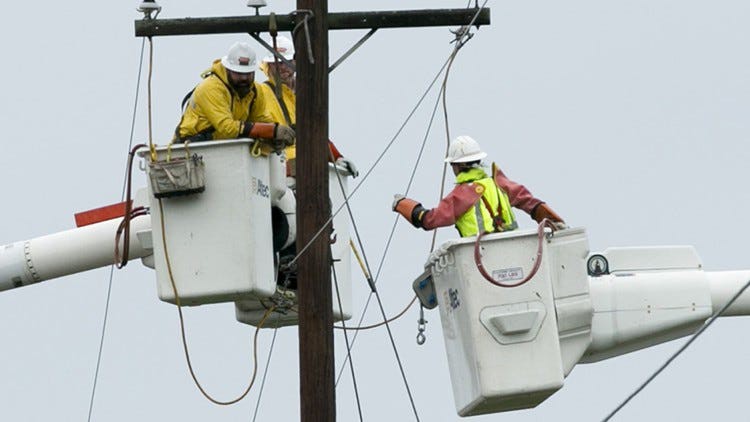
Austin Energy lineman Ken Gray works to restore power on West Alpine Road in South Austin during a winter storm on Wednesday February 1, 2023.
Austin Energy has released a sweeping, 10-year plan to strengthen the city’s electric grid, a move that comes in the wake of several catastrophic power outages that exposed weaknesses in the system and put the utility under intense public and political scrutiny.
The $735 million Electric System Resiliency Plan is the result of more than a year of stakeholder engagement, cost analysis and third-party studies of Austin Energy’s overhead and underground distribution system. One of those analyses determined that fully burying the city’s power distribution lines would cost an estimated $50 billion, making the widely-discussed solution financially impractical. Instead, the plan focuses on targeted upgrades designed to deliver the greatest reliability improvements for the lowest cost. Those upgrades involve hardening vulnerable infrastructure, improving outage detection and restoration, and preparing the grid for increasingly extreme weather.
Austin Energy crews work on power lines in Southwest Austin in 2016.
Vegetation management is also a central focus of the plan, reflecting findings that trees and limbs were a major driver of outages during recent storms. The utility plans to better align tree-trimming efforts with areas identified as highest risk.
“Over the last five years, we've had our three worst events in Austin Energy's history with regards to outages,” David Tomczyszyn, Austin Energy’s vice president of electric system engineering and technical services, said in an interview.
Tomczyszyn was referring to winter storms in February 2021 and February 2023 that caused widespread and prolonged power outages, as well as May’s freak “Microburst.” The utility had already been working on the resiliency plan when the latter storm hit.
“That reaffirmed the need,” Tomczyszyn said.
Lauren Madden unpacks her one-month-old daughter Mia’s things once they arrive at their home after being without power for a week on Thursday, Feb. 9, 2023, because of the winter freeze in Austin. The Maddens were among 1,487 Austin Energy customers still without power as of Thursday afternoon. Lauren and her husband Wales said being without power with a one-month-old and a 3-year-old was difficult to navigate.
The 2021 freeze and 2023 ice storm, in particular, prompted city investigations, leadership shakeups and sharp criticism over Austin Energy’s preparedness, communication and response.
In a news release announcing the plan, Austin Energy General Manager Stuart Reilly noted that the utility’s system “is at least twice as reliable” compared to statewide averages but added: “[T]here’s always room for improvement.”
In fiscal year 2026, the first year of implementation, Austin Energy plans to expand its circuit-hardening program, begin wildfire-focused upgrades in high-risk areas, inspect about 8,000 utility poles, replace dozens of underground cable segments and deploy new automated switches known as reclosers. Those devices can detect faults, briefly shut off power to clear temporary issues — such as fallen branches — and automatically restore service, reducing outage times.
Austin Energy provided a cost breakdown for the plan that includes:
- $340 million for vegetation management and wildfire mitigation
- $280 million for circuit hardening, pole inspection and automation
- $115 million for intelligent systems, grid analytics and a public dashboard tracking progress.
The 2026 budget recently approved by Austin City Council allocated about $60 million to the effort, according to the utility.
Utility officials said the plan is designed to evolve as conditions change, with investments guided by performance data and community input. While the utility acknowledged that some customers may experience temporary disruptions as upgrades are made, leaders said the long-term payoff will be fewer outages, faster restoration and a grid better suited to Austin’s future.
Donna Pauler talks to Austin Energy crew leader Zach Janowski about the plans to restore power to her neighborhood on Dorsett Road in northwest Austin on Monday February 6, 2023. Pauler said her power has been off since Wednesday morning except for a 24-hour period on Saturday when it was on before going off again.
A week after unveiling the plan, Austin Energy on Dec. 23 announced it was “seeking proposals from qualified and experienced companies for the development of local energy resources,” including renewables, battery storage and natural gas generation, with a goal of purchasing up to 400 megawatts. The effort stems from another major utility plan under which the city aims to go carbon-free by 2035, in large part by offloading the Fayette Power Project, a coal-fired power plant near La Grange.
“We know for a fact we do not have enough local power generation capacity to meet Austin’s projected growth,” Reilly, the general manager, said in a statement announcing the request for proposal. “This RFP is an important early step in executing Austin Energy’s Resource, Generation, and Climate Protection Plan to 2035, obtaining the resources necessary to serve our customers affordably and reliably.”