

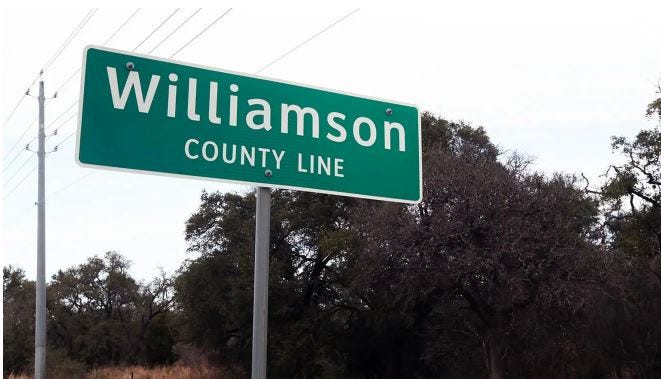
When Ruben Leal began his job investigating deaths in Williamson County a year ago, he began noticing how many suicides he was seeing. It affected him personally. "My own suicide attempt was interrupted many years ago," Leal said. He said he got help the same day he planned to kill himself.
Now Leal is putting together an outreach team to help prevent suicides in Williamson County, based on a model started in Louisiana in 1998. The volunteer team — a mental health professional and a suicide loss survivor — will respond soon after a suicide to offer immediate support and connect families to resources. Leal said it helps to have a survivor available to speak with people facing a similar loss. "They can say 'I've been down this path, let me help you,'" said Leal. "Peer support builds that trust and a survivor-to-survivor connection," he said. The team also will stay in touch long-term, he said, because suicide loss survivors face a higher risk of suicide.
Williamson County had 220 reported suicides of people under the age of 75 in 2024, according to provisional data from the Centers for Disease Control and Prevention. Provisional CDC data also showed there were 4,490 suicides reported in Texas in 2024. The suicide death rate in Williamson County in 2024 was 12.5 per 100,000 people, lower than the statewide rate of 14.2 per 100,000, according to the CDC. CDC data for 2024 is not final. Data for suicides in Williamson County among people 75 and older was not available.
Leal said suicides in Williamson County do not seem to fit a pattern, cutting across ages and ethnicities. Leal is a senior death investigator for Justice of the Peace Precinct 1, KT Musselman. His duties include determining the cause and manner of deaths and ordering autopsies in homicides, suicides, accidents, drug overdoses or deaths with undetermined causes because the county doesn't have a medical examiner.
He said he hopes to launch the outreach team in June. Volunteer suicide survivors on the team will receive extensive training, he said. Leal said volunteers need to wait at least two years after a loss before serving on the team. "We want to make sure your mental health is where it should be because I don't want to put more strain on you," he said.
Leal said a coordinator at Bluebonnet Trails, the county's mental health authority, came up with the idea to use the L.O.S.S. model — Local Outreach to Suicide Survivors — created in 1998 by Dr. Frank Campbell at the Baton Rouge Crisis and Trauma Center. Campbell found that many survivors waited 4½ to five years before seeking professional support, Leal said. The outreach team aims to reduce that time.
Kara Yocom, a suicide loss survivor, said that when her 14-year-old son killed himself 10 years ago in San Marcos, she didn't know how to react. "I was completely numb and in shock," she said. "If I had something like a L.O.S.S. team that came out and talked to me, it would have helped me." Yocom said she was so depressed after her son took his life that she tried to end her own life three times.
She now holds suicide awareness events and has trained to join a suicide prevention team in the Waco-Temple area. Her advice to parents: "Don't hold your grief in like I did," she said. "Don't be strong all the time. Let yourself grieve. Let yourself feel the emotion and find a support group." Yocom said one common misconception is that talking about suicide will put the idea in a child’s head, but children already know about suicide through television and social media, said Yokum. "The most important thing is to let your children know you are a safe person to talk to and that it is a judgement-free zone," she said. If parents cannot have that conversation, they can reach out to others for help, she said. "A lot of times children don't want to talk to parents, not because the parents are horrible but because they don't want to hurt their parents' feelings," Yokum said.
Leal said he had struggled with depression for years when he developed a plan to kill himself. He said he told himself he was worthless, even though his family loved him. "I was always making people laugh because I didn't want people to hurt like I did," he said. A family member came home and interrupted his plan, he said. His mother urged him to get help, and he has had extensive therapy.
Leal's advice for people trying to support suicide loss survivors: "Don't tell them 'I know how you are feeling.' Everybody is so different. We may have walked the same path but I don't know how you are feeling. Be direct and have them talk openly about it." People interested in volunteering can email Leal at ruben.leal@wilcotx.gov for more information.