

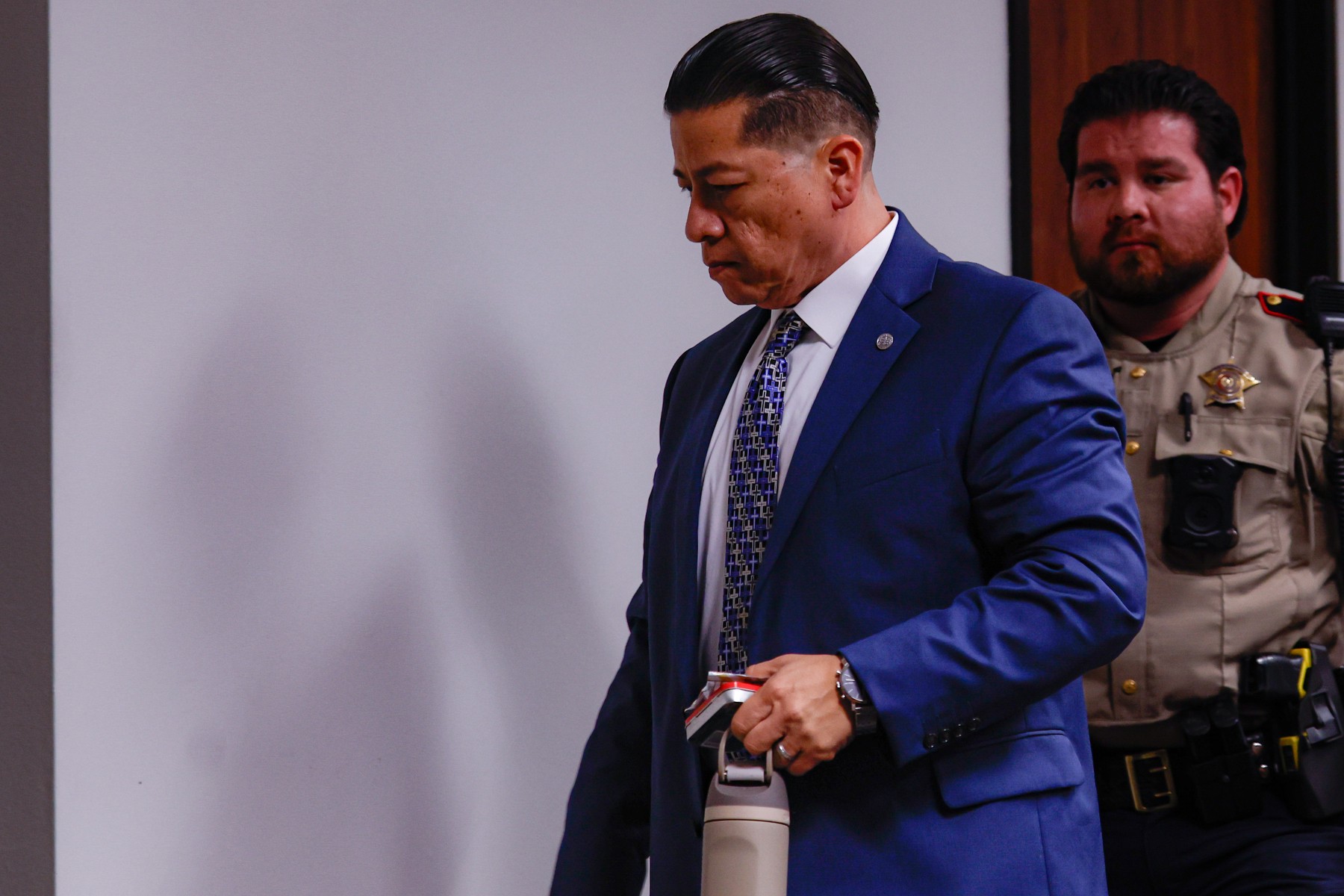
CORPUS CHRISTI – Late Wednesday, a jury found former Uvalde school police officer Adrian Gonzales not guilty of abandoning children in his response to a mass shooting at Robb Elementary School.
Gonzales stood trial for more than two weeks, accused by prosecutors of failing to act immediately to stop a gunman who burst into the Uvalde elementary school on the morning of May 24, 2022, killing 19 children and wounding 10 other students. He was charged with 29 counts of abandoning or endangering a child.
Gonzales, 52, wiped away tears as the verdict was delivered. He then hugged his lawyers.
A family member of one of the victims shook her head, and others wept.
Gonzales was the first law enforcement officer to arrive at the mass shooting. He was normally stationed at Uvalde High School, but he voluntarily responded to a call for help at Robb Elementary that was broadcast on the police radio. He arrived 25 seconds before several other officers, his attorneys said.
The jury reached the verdict after more than seven hours of deliberation, starting at 12:10 p.m.
Before the verdict was read in court, a mother of one of the victims bowed her head in prayer. Other family members appeared tense and anxious as they waited.
The jury and Gonzales returned to the courtroom at 7:38 p.m.
Prosecutors claimed Gonzales heard gunshots and was told the gunman’s general whereabouts, but failed to confront the gunman and never attempted to do so before the shooter went into two classrooms and killed the victims. Two teachers also were among those slain.
But defense attorneys told the jury that Gonzales went willingly into the line of fire and was among the first five police officers who entered the school before being driven back when the gunman opened fire on them.
Defense attorneys also said Gonzales did the best he could with the limited information he received while responding to a rapidly developing and chaotic situation. They questioned why more police officers weren’t charged with any wrongdoing.
“This case is about and has always been about holding officers to the duty that’s mandated for them in the law,” District Attorney Christina Mitchell said during closing arguments Wednesday morning. “I’m here to say that when you are a peace officer for a school district, you’re going to be held responsible, you’re going to be held to that duty.”
Gonzales was part of a police force that was responsible for the safety of Uvalde school district’s buildings and students, said Mitchell, whose jurisdiction includes Uvalde and Real counties.
“That means these buildings, they are their homes,” the district attorney said of the school district’s police force as she pointed to a map of Robb Elementary. “Those hallways, they are their roads. Those students in those classrooms, those are their people to protect.”
Gonzales “had cover,” Mitchell told the jury. “What did the children have? They had chairs and desks. He had a pistol ... The defendant had a vest on. What did the children have in Rooms 111 and 112? They had curtains to hide behind.
“I know this case is difficult. And it has been difficult. But we cannot continue to let children die in vain. We cannot. We cannot let 19 children die in vain and another 10 suffer.”
Defense attorneys said in their closing arguments that prosecutors were holding Gonzales responsible because the gunman was dead and couldn't be hauled into court for his actions.
“The government, the power of the state, has decided that he has to pay for the pain of that day, the mistakes of that day,” defense attorney Jason Goss told the jury.
But Gonzales performed his duties and tried his best to respond appropriately to the emergency at Robb Elementary, Goss said. Even so, Gonzales never had the gunman in his line of sight.
Gonzales was outside the school for one minute and 48 seconds talking with a witness and relaying information on his police radio before entering the building with four other officers, Goss said.
Holding Gonzales responsible for what happened that day would be an injustice, Goss argued.
“It’s one of the most horrible things that’s ever happened in this state,” Goss said. “But the memory of those children is not honored by an injustice in their name.”
The charges filed against Gonzales were a state jail felony, the lowest-level felony under the Texas penal code. If the jury had found him guilty, the 10-year police veteran would have faced up to two years behind bars.
Senior District Judge Sid Harle of San Antonio presided over Gonzales' trial.
Other law enforcement officials ultimately killed the gunman 77 minutes after the massacre began.
Those officers stormed a classroom to reach the gunman, who burst from a book closet and opened fire on them with his assault-style rifle before he was mortally wounded.
The trial was moved to Corpus Christi after Gonzales’ attorneys argued he could not get an impartial jury in Uvalde, which is about 200 miles away.
A jury was chosen after a 12-hour selection effort on Jan. 5.
Defense attorney Nicholas “Nico” LaHood, a former Bexar County district attorney, told jurors that prosecutors were asking them to ignore that Gonzales drove into the danger zone and never had the gunman in his line of sight, even though other police officers who weren’t charged with any crimes briefly saw the shooter at the school that morning.
LaHood also claimed prosecutors wanted the jury to ignore that some exterior and interior doors were unlocked at the school building where the victims died, which gave the gunman easier access.
“I’m sorry for what Mr. (Arnulfo) Reyes went through,” LaHood said, referring to one teacher who survived being shot and whose 11 students present were killed. “But (his classroom) door was unlocked. It should have been locked.”
LaHood described Gonzales as “the man lowest on the totem pole” of those who could be charged with wrongdoing.
Nearly 400 law enforcement officers from two dozen agencies, including the Border Patrol and the Texas Department of Public Safety, responded to the emergency at Robb Elementary that day.
The defense suggested that convicting Gonzales could prompt other law enforcement officers to stay back, avoiding running into danger when responding to mass shootings for fear that they might be prosecuted.
Prosecutors said that teachers did what Gonzales did not.
“We brought you teachers who experienced that gunfire. They still put their kids first and followed their training,” special prosecutor Bill Turner told the jury. “Their priorities were where they needed to be — children first.
“That was a dark day. For 29 families, it was extremely dark, and they still await justice.
“Adrian Gonzales had a duty to put kids first — and he called for cover.”
The family members of 11 children who were killed and of one wounded survivor filled five rows of seats in the courtroom to hear Wednesday’s closing arguments. Some of them grew emotional when Mitchell described how one mother told her young daughter to stay at Robb Elementary for a pizza party when the child asked to go home early that day. That child was among the victims killed.
Gonzales was somber yet attentive while listening to the closing arguments.
He is one of two law enforcement officers charged in connection with the police response.
The other is former Uvalde school district police chief Pedro “Pete” Arredondo, 53, who is charged with 10 counts of abandoning or endangering a child — one for each of 10 children who suffered physical or psychological injuries in the massacre. He was the presumed incident commander in charge of the police response.
Arredondo will stand trial at a later date.