

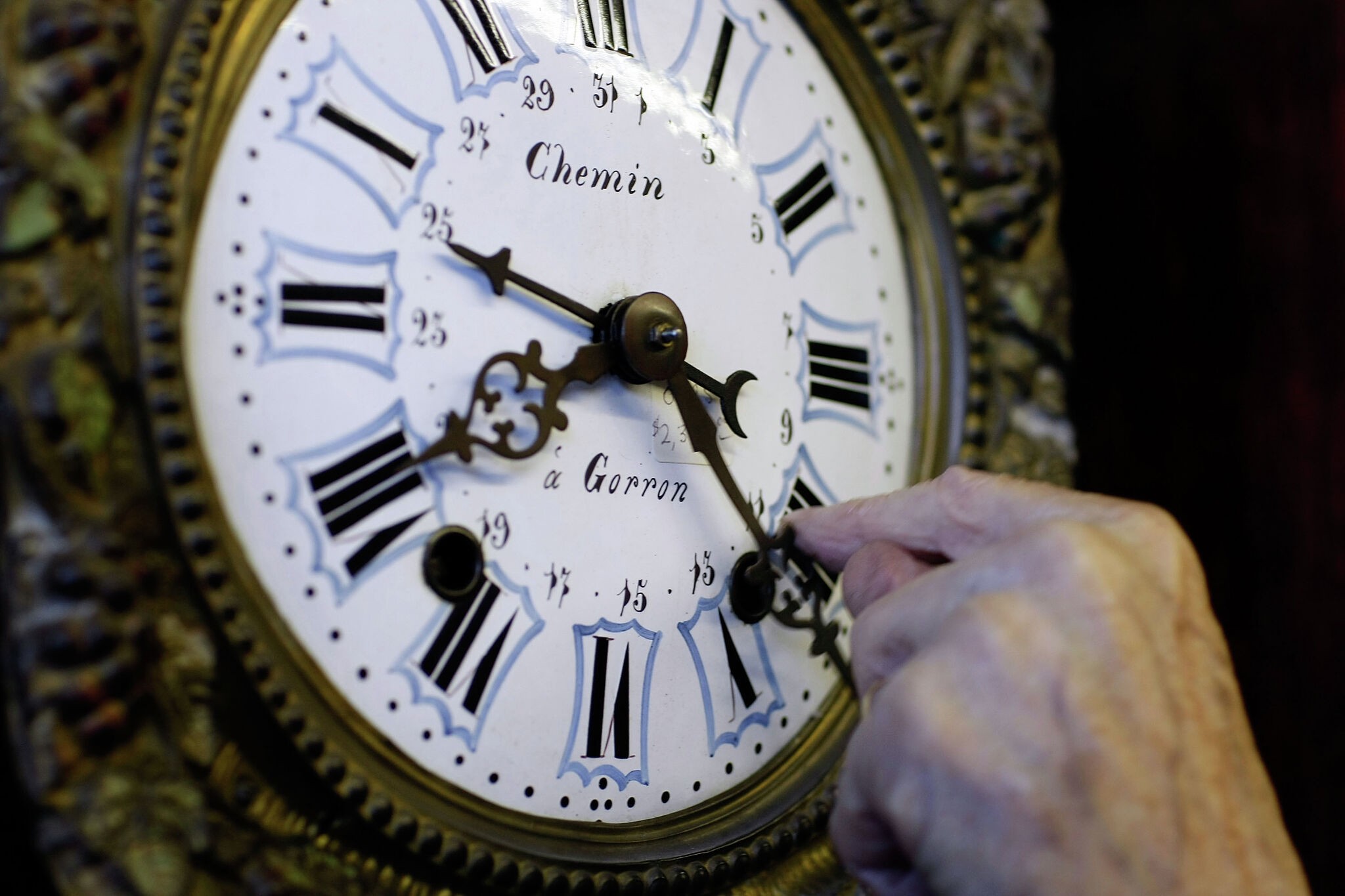
Texans will need to turn clocks on their non-smart devices forward one hour on March 8, 2026.
After a powerful winter storm, and with another possibly on the way, many Texans are fed up with winter and looking forward to spring. And along with the meteorological start of spring, another indicator of warmer weather is the beginning of daylight saving time.
Most of the U.S., including Texas, will still change clocks for daylight saving time in 2026, despite years of debate and recent efforts to end the practice. While lawmakers in Texas and Washington have repeatedly pushed to eliminate the biannual time change, those efforts have stalled — meaning daylight saving time will continue as usual this year.
Daylight saving time is set to begin on Sunday, March 8, 2026. In the early hours, time will jump forward by one hour from 2 a.m. to 3 a.m. This marks the shift to local Daylight Saving Time (DST).
Many devices, such as phones and computers, will automatically change to DST, but non-smart devices, such as microwaves and some car radios, as well as any clock with hands, will likely need to be changed manually.
When does daylight savings time end?
The end of daylight saving time on Nov. 1 means there will be more light in the morning and it will get dark earlier in the evening. Sunrise and sunset will be about one hour earlier on Sunday, Nov. 1, than they were on Saturday, Oct. 31.
For most Americans, except those in Arizona, Hawaii and a handful of other places, the end of daylight saving time means an extra hour of sleep on Nov. 1. It also helps the country accommodate for more daylight in the mornings in preparation for winter.
Is daylight saving time going away? What Trump, Texas lawmakers say
The debate over daylight saving time has increasingly played out in Congress and state legislatures, including in Texas.
In 2022, the U.S. Senate unanimously approved the Sunshine Protection Act-,Sunshine%20Protection%20Act%20of%202025,standard%20time%20for%20those%20areas.), which would make daylight saving time permanent; however, the U.S. House of Representatives did not pass it and President Joe Biden did not sign it.
In December 2024, then-President-elect Donald Trump said he aims to put an end to daylight saving time and make standard time year-round. He renewed this commitment in April 2025.
“The House and Senate should push hard for more Daylight at the end of a day,” Trump wrote on Truth Social. “Very popular and, most importantly, no more changing of the clocks, a big inconvenience and, for our government, A VERY COSTLY EVENT!!!”
Opponents of the proposed legislation, like Sen. Tom Cotton (R-Ark.), believe it would have overall negative consequences.
“If permanent daylight savings time becomes the law of the land, it will again make winter a dark and dismal time for millions of Americans,” Cotton argued on Oct. 28, 2025. He added it would mean “depriving Americans of morning sunshine that’s essential for our safety and well-being.”
The Sunshine Protection Act was debated in Congress again in 2025 and once again stalled in the House. Until legislation is passed in both the House and Senate and signed by the president, the majority of the U.S. will continue to have time changes.
There has also been debate for years among Texans and state legislators about whether the Lone Star State should adopt daylight saving time permanently. House Bill 1393, also known as “Texas Time,” could bring an end to that discussion.
The “Texas Time” bill aims to eliminate biannual clock changes and keep Texas on daylight saving time year-round. Gov. Greg Abbott signed the bill on June 20; however, it can’t take effect unless Congress changes federal law to allow states to adopt daylight saving time permanently.
Supporters argue that maintaining a consistent time year-round would reduce confusion, improve safety and enhance productivity.
Cotton and others who oppose permanent daylight saving time cite health and safety concerns, often arguing that maintaining standard time year-round would be preferable.
How did daylight saving time start? 108 years of US law
Daylight saving time (DST) claims a variety of other names: daylight savings time, daylight time, summer time (not to be confused with summertime). It refers to the practice of setting clocks forward by one hour during the warmer months of the year and then setting them back one hour in the fall.
One way to remember the pattern: “spring forward, fall back.”
The idea dates back to World War I, although some credit Benjamin Franklin for daylight saving time due to a satirical letter he wrote in 1784 stating: “Every morning, as soon as the sun rises, let all the bells in every church be set ringing: and if that is not sufficient, let cannon be fired in every street to wake the sluggards effectually.”
To maximize resources for the war, Germany and Austria implemented the first daylight saving time in 1916. The U.S. did the same in 1918. An outdated idea, some argue.
The general idea of daylight saving time is to maximize the use of natural daylight, according to the Almanac. This always occurs around the summer months. As the earth moves around the sun and is tilted on its axis, certain parts of the world experience longer days during certain months. For those in the northern hemisphere, like the U.S., these longer days run from March to November, with June to August seeing the longest days.
For those in the southern hemisphere, such as Australia, the seasons are reversed: June through August mark winter months and are, therefore, the shortest of the year.
When does winter end? First day of spring 2026
Astronomically, winter ends with the first day of spring on March 20, 2026. Also known as the spring equinox, this date can vary by year between March 19 and March 21.
However, a meteorologist may tell you the first day of spring is actually March 1 — a date that stays consistent from year to year. While astronomical seasons are measured by Earth’s position in relation to the sun, meteorological seasons are based on the annual temperature cycle. Both versions still have four seasons lasting roughly three months each.
Here are the astronomical and meteorological dates for the 2026 seasons:
| Season | 2026 astronomical dates | 2026 meteorological dates |
|---|---|---|
| Spring | March 20 | March 1 |
| Summer | June 21 | June 1 |
| Fall | September 22 | September 1 |
| Winter | December 21 | December 1 |
When is the longest day of the year in 2026? The shortest?
The longest day of 2026, also known as the summer solstice, is Sunday, June 21. Central Texas will get around 14 hours of daylight.
On the flip side, 2026's winter solstice — the shortest day of the year — is Monday, Dec. 21. Austin will see just over 10 hours of daylight.
The Earth is tilted approximately 23.5 degrees on its axis, and each solstice is dictated by the amount of solar declination, or “ the latitude of Earth where the sun is directly overhead at noon,” according to National Geographic.