

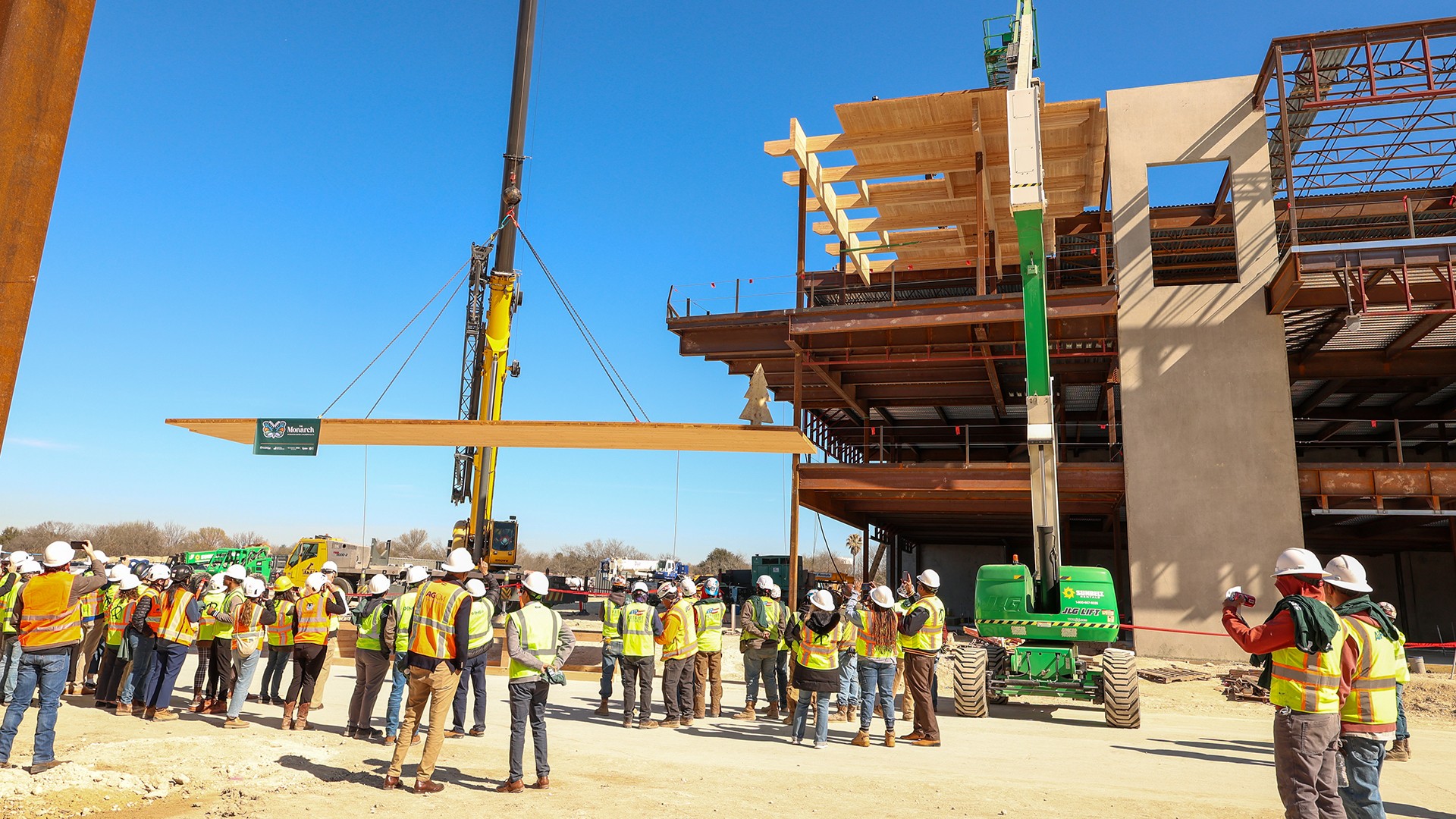
Construction workers and city officials celebrate a major milestone in the Downtown East project on Feb. 23, 2025 with the topping out of The Monarch multigenerational recreation center. The final structural wood panel was raised into place and signed by attendees to mark the occasion. The Downtown East project will also include a new City Hall, a community plaza, commercial space and public parking.
Nine Texas cities rank among the hardest-working in America, according to a new WalletHub study — and Irving, Dallas and Austin all landed in the top 10.
WalletHub analyzed 116 of the largest U.S. cities across 11 metrics measuring work ethic, including employment rate, average weekly work hours and the share of workers holding multiple jobs.
While Austin made the top 10 list for the hardest-working cities, two North Texas cities ranked higher: Irving (No. 5) and Dallas (No. 7). However, the Texas capital ranked highest in the nation for direct work factors.
Every Texas city included in the analysis ranked higher for direct work factors than for indirect work factors. All but San Antonio made the top half of the national list.
| Overall rank | City | Total score | Direct work factors rank | Indirect work factors rank |
|---|---|---|---|---|
| 5 | Irving | 74.37 | 3 | 72 |
| 7 | Dallas | 73.63 | 5 | 64 |
| 10 | Austin | 72.74 | 1 | 97 |
| 13 | Fort Worth | 71.10 | 11 | 52 |
| 14 | Corpus Christi | 70.86 | 13 | 94 |
| 15 | Arlington | 70.81 | 12 | 59 |
| 17 | Plano | 70.49 | 14 | 66 |
| 22 | Laredo | 69.11 | 23 | 93 |
| 24 | Garland | 68.95 | 29 | 42 |
| 37 | Houston | 67.10 | 31 | 77 |
| 43 | El Paso | 66.19 | 43 | 80 |
| 46 | Lubbock | 66.09 | 35 | 108 |
| 61 | San Antonio | 64.03 | 41 | 98 |
10 hardest-working US cities
- Cheyenne, Wy.
- Anchorage, Alaska
- Washington, DC
- Sioux Falls, S.D.
- Irving
- Nashville, Tenn.
- Dallas
- San Francisco
- Denver
- Austin
How much does the average American work?
To achieve the American Dream, the average U.S. employee works more hours than workers in many other industrialized nations, according to the Organization for Economic Cooperation and Development (OECD). A typical American works 1,796 hours each year — 179 than those in Japan, 284 more than those in the United Kingdom, and 465 more than those in Germany. In some instances, the growing popularity of remote work has further increased work hours in recent years. American culture values this strong work ethic and its role in supporting the world’s largest economy.
"Hard work is the backbone of America’s economy and a big reason why the country has become so successful, as Americans outwork people in many other developed economies," WalletHub analyst Chip Lupo said in a statement. "In addition, between 40% and 64% of Americans leave at least some of their allotted vacation time on the table, depending on the city. While working long hours, minimizing time off, and having side jobs all lead to increased productivity, they can also have negative effects on people’s physical and mental health. It’s important for people to figure out how to work hard without overworking."
To determine which U.S. cities best exemplify the nation’s strong work ethic, WalletHub analyzed each of the 116 largest cities across 11 key measures — from the employment rate to average weekly work hours to the share of workers with multiple jobs.
The study also ranked direct and indirect work factors. Direct work factors included average workweek hours, employment rate, share of household where no adults work, share of workers leaving vacation time unused, share of engaged workers and idle youth rate. Indirect work factors included average commute time, share of workers with multiple jobs, annual volunteer hours per resident, share of residents who participate in local groups or organizations and average leisure time spent per day.
States with the best direct, indirect work factors
| Rank | Direct work factors | Indirect work factors |
|---|---|---|
| 1 | Austin | Baltimore |
| 2 | Cheyenne, Wy. | Milwaukee |
| 3 | Irving | Boston |
| 4 | Anchorage, Alaska | Portland, Ore. |
| 5 | Dallas | Honolulu |
| 6 | Washington, DC | Seattle |
| 7 | Nashville, Tenn. | Washington, DC |
| 8 | Siouz Falls, S.D. | Minneapolis |
| 9 | San Francisco | Salt Lake City |
| 10 | Denver | St. Paul, Minn. |
City of Austin Street and Bridge Operations workers Ray Cummings, left, and Bobby Roberson prepare to head out from a facility on Harold Court to pretreat roads with a brine solution on Friday, Jan. 23, 2026, ahead of an approaching winter storm.
10 least hard-working US cities*
- Burlington, Vt.
- Detroit
- Buffalo, N.Y.
- Newark, N.J.
- Toledo, Ohio
- Bridgeport, Conn.
- Columbia, S.C.
- Providence, R.I.
- Cleveland
- Fresno, Calif.
*1 = worst
States with the worst direct, indirect work factors
| Rank (1 = worst) | Direct work factors | Indirect work factors |
|---|---|---|
| 1 | Burlington, Vt. | Jackson, Miss. |
| 2 | Detroit | Winston-Salem, N.C. |
| 3 | Buffalo, N.Y. | Greensboro, N.C. |
| 4 | Bridgeport, Conn. | Durham, N.C. |
| 5 | Newark, N.J. | Columbia, S.C. |
| 6 | Toledo, Ohio | Birmingham, Ala. |
| 7 | Cleveland | Reno, Nev. |
| 8 | Providence, R.I. | Miami |
| 9 | Columbia, S.C. | Lubbock |
| 10 | Stockton, Calif. | Hialeah, Fla. |
MAP: Employment rates by state, 2009-2024
Stories you won't want to miss, handpicked by Statesman editors.