

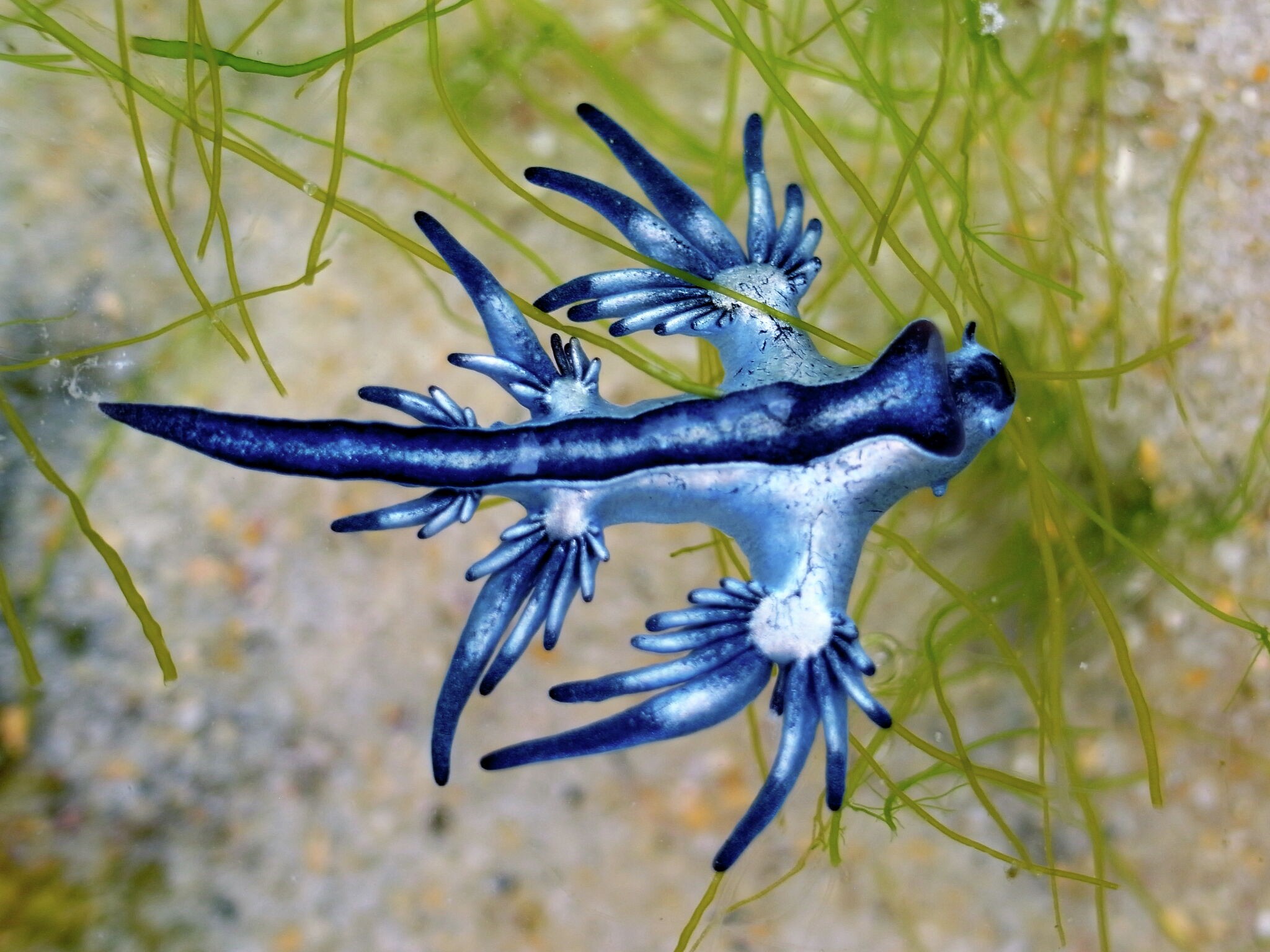
Beachgoers headed to the Texas coast for spring break may want to keep a close eye on the sand. Researchers with the Harte Research Institute say blue dragons, tiny blue sea slugs with a painful sting, are washing up again along Texas beaches as spring winds push offshore marine life onto shore.
In a warning shared online, the institute said researchers found about 20 blue dragons along a short stretch of beach along North Padre Island and Mustang Island. The creatures, known scientifically as Glaucus atlanticus, are small enough to miss at a glance, usually measuring about 1 to 3 centimeters long, with dark and light blue coloring and wing-like appendages that give them their “blue dragon” nickname.
“If you see one, take a photo — but look and don’t touch,” the institute — which is part of Texas A&M University-Corpus Christi — said in a social media post.
Blue dragons feed on Portuguese man-o-war and can store the stinging cells from their prey in their own appendages, then use them for defense, even after the animal has washed ashore. The institute and federal ocean officials say those appendages, called cerata, hold the stinging cells in a concentrated form, making the slug’s sting especially potent.
Why are blue dragons in Texas?
The Bureau of Ocean Energy Management says blue dragons are ocean drifters that spend their lives floating at the surface, carried by wind and currents and kept buoyant by a gas-filled sac in the stomach.
The species is commonly found in tropical and temperate waters of the Atlantic, Pacific and Indian oceans, but federal officials say its range has expanded in recent years to places including the east and south coasts of Australia, waters off South Africa and the Texas Gulf Coast. According to BOEM, that expansion is likely tied to warming ocean temperatures and changing ocean currents.
The "Blue Wave"
The institute warned the slug usually show up alongside a larger mix of floating marine life that includes Portuguese man-o-war, blue buttons, by-the-wind sailors and purple sea snails, a grouping oceanographers sometimes call the “Blue Wave.”
Loungers and swimmers alike should admire these animals from a distance and leave them alone. While some of the animals have a mild or no sting, BOEM and the National Oceanic and Atmospheric Administration warn that Portuguese man-o-war can also give a painful sting even after washing onto the beach.