

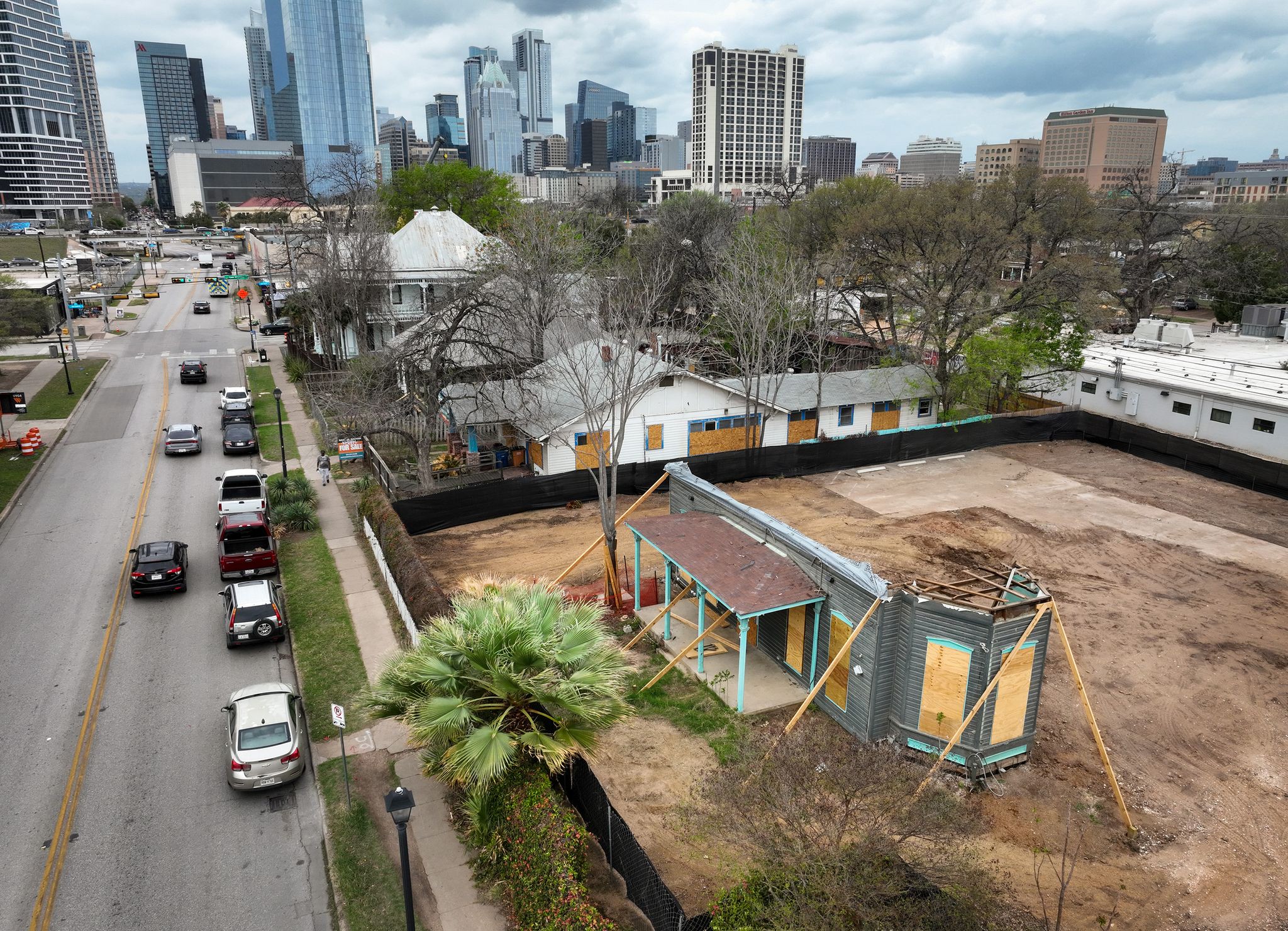
A 140-year-old house that once housed Cenote café on East Cesar Chavez Street was mostly demolished, prompting the city of Austin to issue a stop-work order.
Only the front facade remains of a 19th-century Victorian home at 1010 E. Cesar Chavez St. in Austin on Tuesday, March 10, 2026. The roughly 140-year-old building, which previously housed Cenote coffee, was recently demolished, drawing concern from some community members who had hoped it would be preserved.
On a stretch of East Cesar Chavez Street, where century-old houses sit beside new construction and vacant storefronts, a familiar building is now mostly gone.
The small wood-framed structure at 1010 E. Cesar Chavez St. — for years home to the café Cenote — has been reduced largely to a façade and dirt after demolition work that neighborhood leaders say went beyond what the city had approved.
The city has since issued a stop-work order at the property. Under the order, the project’s owner must submit a revised site plan and updated building permits. Failure to comply could result in the city revoking those permits entirely.
The owner said he wanted to save the character of the old building, but that it was structurally unsound and riddled with exposed asbestos.
The building that stood there dated to the late 1800s. Over the decades it had served different purposes, most recently as Cenote, a neighborhood café that operated from the house for more than a decade before relocating to East Seventh Street last year.
A demo that nobody seemed to want: 'This is what new Austin looks like'
Mary Jenkins, who opened the café with her late partner in 2012, said the demolition bears little resemblance to what had been presented during the city approval process.
“They were supposed to keep the roof. They were supposed to keep the sides of the house,” Jenkins said. “What they represented to the city and what actually happened are two very different things.”
Jenkins and her partner spent two years restoring the structure after acquiring it in 2010.
“It was very difficult,” Jenkins said. “But we tried to treat the building with respect.”
Now, Jenkins says, much of what made the structure distinctive has disappeared.
“The character of the building is completely gone except for the front façade,” she said. “We had such a beautiful patio and so many plants and trees. Seeing that destroyed is really heartbreaking.”
In a social media post responding to the demolition, Jenkins wrote: “This is what new Austin looks like.”
Owner cites structural problems
The current owner, Adam Hadair, managing partner at Haidar Estates, has announced that he plans to rent the space to Los Angeles-based Urth Caffé,
“We really did want to save the building, but there was no way to salvage it,” Hadair told the Statesman.
Hadair said that the plan was to keep the walls and the character of the building and restore as much as possible.
“Engineer after engineer told us that the structural beams were rotting and that asbestos was being released from cracked walls,” he said. “We plan to bring the same format back, not a high rise. We want it to last hundreds of years. As it was, it had only 10 years left.”
City says demolition exceeded permit
City officials say the work that occurred on the property went beyond what had been authorized.
According to a city spokesperson, the project had been approved only for a renovation with limited demolition tied to the remodel.
Residents in the East Cesar Chavez neighborhood have long debated how growth along the corridor should unfold.
When inspectors visited the property after a complaint on March 6, they found that “entire structures on the property had been demolished, with the exception of one wall,” according to the city.
A full demolition had not been authorized.
Eric Pace, chairman of the East Cesar Chavez Neighborhood Association, said early indications suggest the plans presented during historic review may not match what ultimately happened on the site.
“What we can tell so far is that the owner presented something to the Historic Landmark Commission that was essentially an addition and renovation where the entire structure would remain,” Pace said. “Then the plans submitted later for the building permit appear to have been completely different.”
City officials said inspections and pre-construction meetings are meant to ensure projects follow approved plans, though they cannot always prevent violations. The city does not track how often demolition exceeds what permits allow.
Preservation concerns resurface
For some residents, the demolition has revived longstanding fears about how development could reshape the East Cesar Chavez neighborhood.
“There’s an ever-present concern and anxiety that what happened with Rainey Street is going to happen in our neighborhood,” Pace said.
Rainey Street was once a district of small houses. After zoning changes allowed high-rise development, most of those homes were demolished.
“It was culturally and historically significant, and then those houses were knocked down in favor of towers,” Pace said. “There’s this sense that the only way to make progress is with a sledgehammer.”
Lindsey Derrington, executive director of Preservation Austin, said the demolition was particularly frustrating because the building had previously been recognized for preservation work.
The group honored the project with a Preservation Merit Award in 2011 for rehabilitating the house.
“This 140-year-old building is incredibly special to many in our community,” Derrington said. “The site embodies significant Black and Mexican American heritage.”
The East Cesar Chavez neighborhood has seen waves of change before. Originally settled by Swedish, Scottish and German immigrants, after World War II it became a historically Hispanic community. Many of the buildings that remain date back more than a century.
Neighborhood leaders say they have been pushing the city for planning tools that encourage incremental development — projects that adapt historic buildings rather than replace them.
For now, Pace said, the immediate question is what happens next at the former Cenote site.
“We can’t bring the building back,” he said. “But there may be ways to hold the owner accountable. And hopefully there’s also an opportunity to change policy so this doesn’t happen again.”
Until revised plans are approved, construction at the property remains on hold.
City historic preservation officials say they are aware of community concerns.
“This Historic Preservation Office and Historic Landmark Commission worked closely with the applicant on this project, and we are aware of the concerns brought forward by the community,” said Kim McKnight, division manager of the city’s historic preservation office.
The review of the project was triggered by the building’s age and because it had been identified as eligible for City of Austin historic landmark designation in the 2016 East Austin Historic Resource Survey.
McKnight added: "I’ll note that we are launching a major 10-year update to the East Austin survey in the coming year.”
Whether that update will arrive in time to protect what remains of the neighborhood’s older buildings is an open question — one residents along East Cesar Chavez say they’re watching closely.