

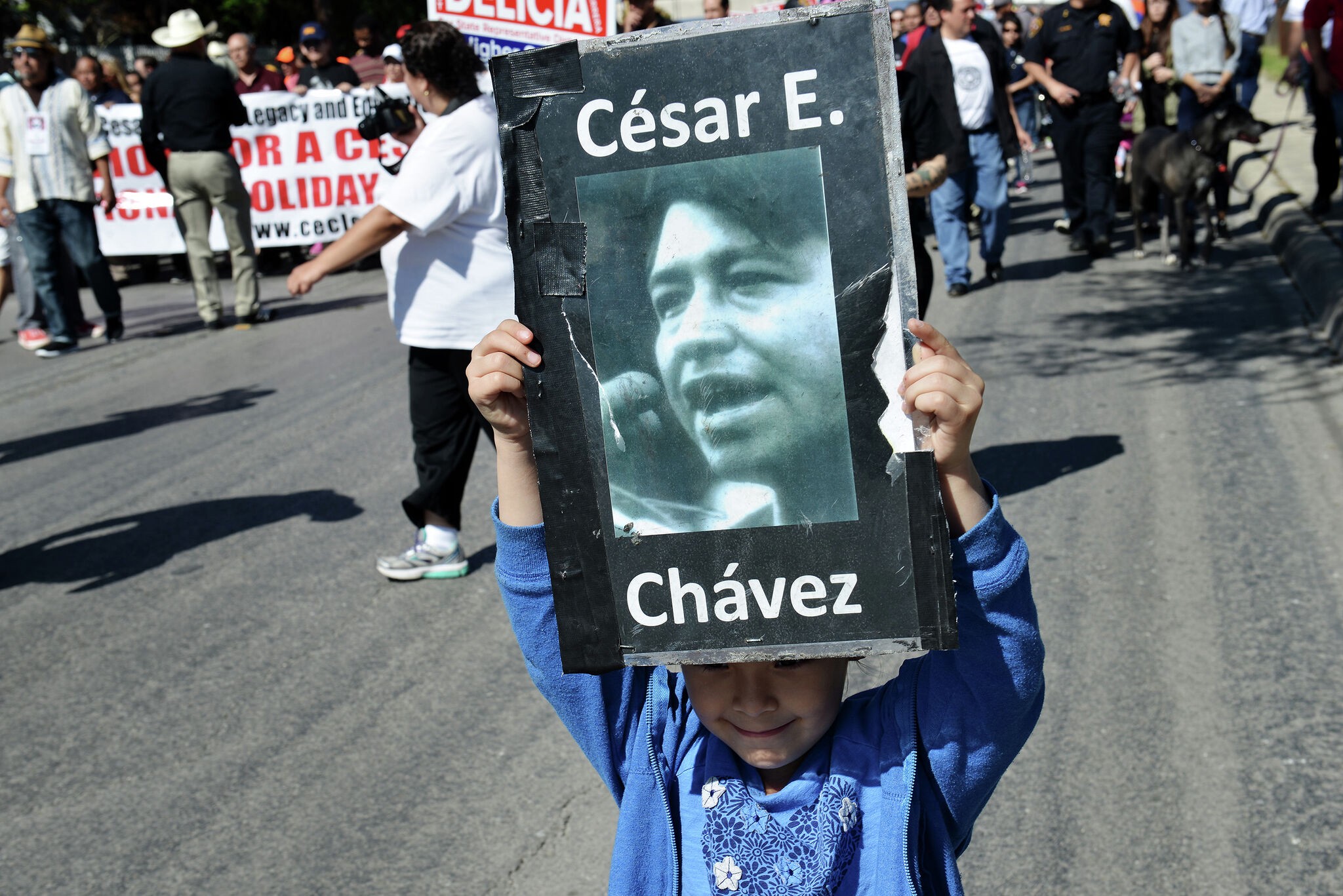
The family of the late César Chávez, a farmworker organizer who became a national civil rights icon, is at the center of a mounting crisis involving allegations that he engaged in sexual relationships with women and at least one minor, according to interviews with former insiders and a historian.
The fallout has already led to the cancellation of public marches across the country and raised new questions about his public record.
In a statement released Tuesday, the United Farm Workers said it had learned of “deeply troubling allegations” that Chávez behaved in ways “incompatible with our organization’s values,” including claims involving “abuse of young women or minors.”
The union said it has no firsthand knowledge of the allegations but called them “serious enough” to take “urgent steps” to learn more and to create a confidential, independent channel for potential victims to come forward.
“Allegations that very young women or girls may have been victimized are crushing,” the statement said.
The United Farm Workers also announced it will not participate in any César Chávez Day activities this year and instead urged supporters to focus on immigration justice and service efforts.
Multiple sources told the San Antonio Express-News that a report by a national news publication is expected in the coming weeks and may be driving the cancellations of marches and the response.
Chávez, who co-founded the United Farm Workers with Dolores Huerta in 1962, helped transform the American labor movement through strikes, marches, and nationwide boycotts that brought attention to farmworkers' conditions and led to the first union contracts in the industry.
He died in April 1993 at age 66 and would have turned 100 next year, a milestone organizers had begun preparing to commemorate. But interviews with former insiders and historians describe a different narrative that has largely remained outside public view.
His legacy is embedded in public life across the country, from holidays to schools and landmarks. Several states observe César Chávez Day on March 31, his birthday, and President Barack Obama proclaimed it a federal commemorative holiday in 2014, the same year Chávez was posthumously awarded the Presidential Medal of Freedom.
Streets, schools, and parks across the country bear his name; a U.S. Navy cargo ship, the USNS César Chavez, was named in his honor; and he was featured on a U.S. postage stamp issued in 2014.
The César Chávez Foundation has evolved into a large nonprofit focused on housing and community development. Through its Housing and Economic Development Fund, the organization builds and manages affordable housing for working families and seniors across California, Arizona, New Mexico, and Texas. It reported investing more than $200 million in underserved communities in a single year and constructing hundreds of housing units.
The San Antonio march, scheduled for March 28, has been held annually since 1997 and has grown into one of the largest César Chávez events in the country. The event traces its roots to the late Jaime P. Martinez, a San Antonio labor activist who helped establish the annual march, led efforts to rename Durango Street as César Chávez Boulevard after Chávez died in 1993, and later helped establish the local foundation that organizes the march.
The statement follows a series of cancellations this month, including San Antonio’s César E. Chávez March for Justice, a decades-old event that draws thousands each year, and a Corpus Christi march that was called off last week after labor leader Dolores Huerta withdrew.
Ernest J. Martinez, chairman of the César E. Chávez Legacy & Educational Foundation in San Antonio, confirmed the cancellation but declined to elaborate, indicating the decision came from the national organization.
“With regards to the cancellation of the march that falls in my wheelhouse, I’ll definitely navigate that and communicate to the community for that,” Martinez said. “Anything outside the scope of San Antonio … I don’t speak for the family nor the foundation.”
A memo sent to City Council members said the local César E. Chávez Legacy & Educational Foundation canceled the event at the direction of the Chávez family. Deputy City Manager María Villagómez wrote that the organization told city officials the cancellation involved a “sensitive matter” but did not provide details.
According to its most recent tax filing, the San Antonio-based César E. Chávez Legacy & Educational Foundation reports about $200,000 in annual revenue and less than $100,000 in assets.
The cancellations have fueled concern among organizers and elected officials, who say they have been given little information.
In Tucson, Arizona, organizers announced Monday they would move forward with a renamed event, dropping the march and rebranding it a “Comunidad y Labor Unity Fair.” In a social media post, the coalition said it made the “difficult decision to cancel the March” while continuing with a rally focused on community issues.
Sources familiar with the discussions told the Express-News that additional events tied to Chávez’s upcoming centennial have been affected, though details have not been shared.
Mark Day, a former Franciscan priest who worked with the United Farm Workers for about five years in the 1970s, said he believes allegations involving Chávez could soon become public.
Day said at least two women raised allegations.
“What I know is that definitely those young women spoke out,” he said. “And it never went anywhere.”
Matt Garcia, a historian at Dartmouth College and author of “From the Jaws of Victory: The Triumph and Tragedy of César Chávez and the Farm Worker Movement,” has documented internal conflicts within the United Farm Workers, including accounts of leadership disputes and allegations of misconduct.
In interviews with the Express-News, Garcia said he became aware of allegations against Chávez after former activists discussed them following the publication of his book.
“I’ve seen the allegations from at least one victim,” Garcia said. “There are more victims, I’m told.”
Garcia said the allegations surfaced among longtime participants in the movement who spoke out on a closed listserv.
On Sunday, Garcia declined to comment further.
“I have been asked to remain quiet, and I will abide by those wishes,” he wrote. “At this point, the most important issue for me is allowing the victims to have the space to express themselves as they wish.”
Another longtime participant in the movement, Enos Flores, said in an interview that he believes some victims have spoken to reporters. He said the cancellation of the march in San Antonio suggests leaders may be responding to something significant.
“When I saw that article, the first thing that flashed in my head was the jig is up,” Flores said.
Not all Chávez events have been canceled.
In San Francisco, organizers of a long-running César Chávez celebration said they plan to move forward, underscoring a split among organizers as events in Texas were canceled.
Now in its 33rd year, the San Francisco celebration draws thousands of participants, including labor unions, students, and community groups, and includes both a march and a festival in the Mission District.
Eva Paterson, who has led the San Francisco César Chávez and Dolores Huerta Holiday Parade and Festival for more than three decades, said in an interview last week — before the Chávez family issued its statement — that the event would continue.
“We’re moving forward,” Paterson said. “This is more than one man. The workers need support now.”