

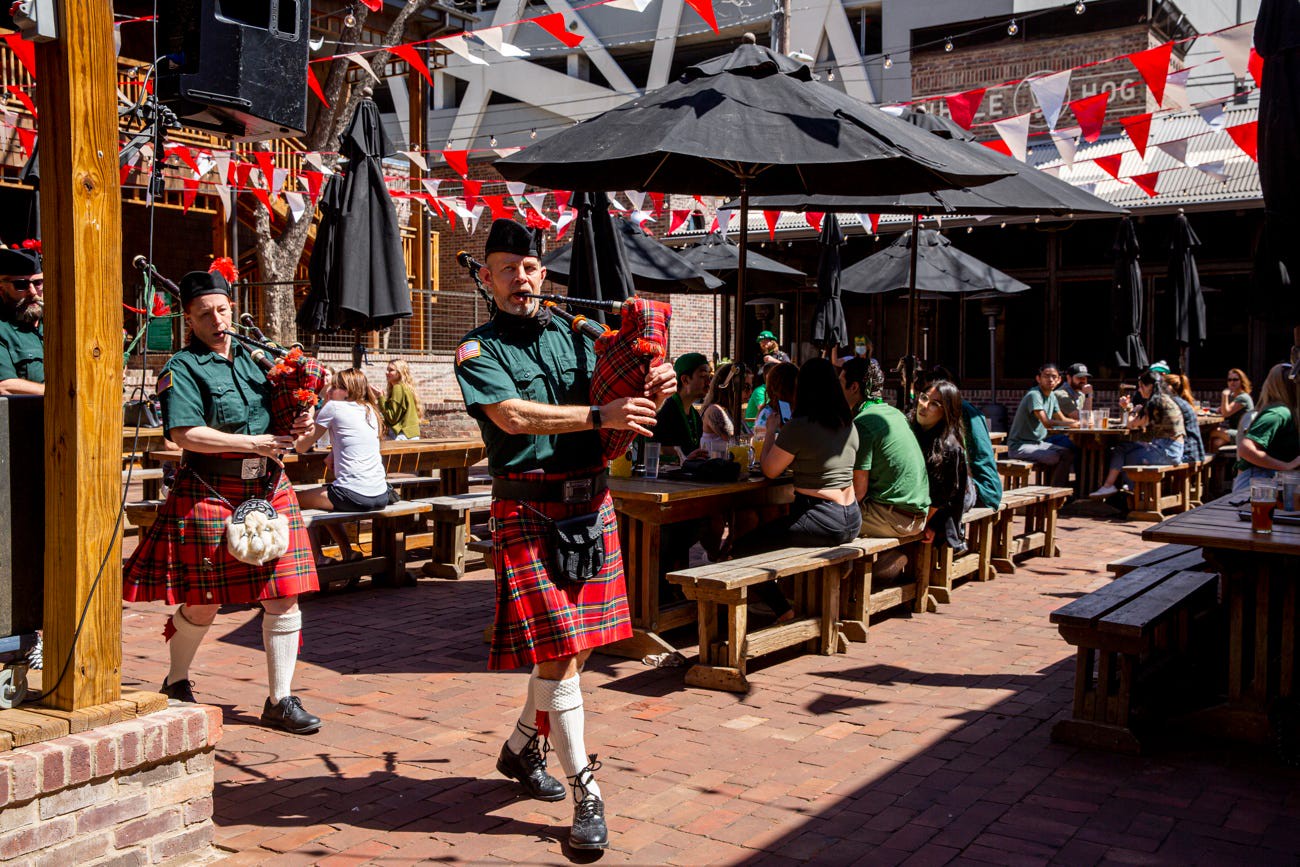
Philip Bates of Capitol City Highlanders performs while walking out of Banger's Sausage House and Beer Garden on Rainey Street during St. Patrick's Day in Austin on Wednesday, March 17, 2021.
Bronte Wittpenn / American-Statesman, Austin American-Statesman
Are you ready for a cold pint of Guinness and a plate of bangers and mash while wearing a giant green hat?
While St. Patrick’s Day is not recognized as a federal holiday in the U.S., it gives both Irish and non-Irish Americans a reason to celebrate — but it is a national holiday in Ireland. Today, the holiday kicks off the country’s tourist season, though 40 years ago the day was marked by religious observances that even closed down bars.
American celebrations of St. Patrick’s Day have turned the occasion into the festive bar crawls often seen today. Still, the rich history behind the day of laughter and libations remains behind the surge of shamrocks and drunken shanties.
When is St. Patrick’s Day 2026?
St. Patrick’s Day, the feast day of the patron saint of Ireland, is celebrated each year on March 17. In 2026, it falls on a Tuesday.
Who was Saint Patrick? The history of St. Patrick’s Day
Circa 440 AD, Saint Patrick — who was born in 387 AD possibly in Kilpatrick, Scotland and died on March 17, 461 in Downpatrick, Ireland — converted much of Ireland from paganism and Druidism to Christianity.
Archive Photos/Getty Images
Despite what many people think, Saint Patrick was not Irish. He was born in Britain near the end of the fourth century and was captured by Irish raiders when he was 16. He spent six years in captivity in Ireland, according to the History Channel, where he eventually became a devout Christian.
According to Patrick’s writings, he believed God spoke to him in a dream and told him to leave Ireland, and he escaped. Later, he wrote that an angel appeared to him in another dream telling him to return to Ireland as a missionary. He eventually became a priest after about 15 years of study.
While many people believe St. Patrick brought Christianity to Ireland, the History Channel reports that his mission focused on ministering to existing Irish Christians as well as converting non-Christians.
Ireland and its neighbors across the pond have commemorated Saint Patrick since the ninth or 10th century, according to the History Channel.
St. Patrick was never canonized by the Catholic Church but has enjoyed longstanding historical popularity. Saint Patrick died on March 17, 461, which later became the day we celebrate him and the Irish.
America’s first St. Patrick’s Day celebration was in 1600 in the Spanish colony of present-day St. Augustine, Florida. Spanish colonial records mentioned a celebration for Saint Patrick in 1600 and the first known St. Patrick’s Day parade was held on March 17, 1601.
The tale of Saint Patrick likely traveled from Ireland to the Americas in the 16th century by way of Richard Arthur, a priest in St. Augustine and an Irish soldier, The Washington Post reports. Records of St. Patrick celebrations died with Arthur, but additional records show Irish soldiers in the English military marched in celebration of Saint Patrick in Boston in 1737 and New York City in 1762.
A general view of the 264th St. Patrick's Day Parade on Fifth Avenue in Manhattan, New York, on March 17, 2025, with the parade organizing committee. This is the oldest and largest St. Patrick's Day Parade in the world, according to organizers, the St. Patrick's Day Foundation. The first parade takes place in 1762.
Deccio Serrano/NurPhoto via Getty Images
Decades of growing Irish patriotism resulted in Irish Aid societies and annual parades of bagpipes and drums. They united to form one official New York City St. Patrick’s Day Parade in 1848, according to the History Channel.
While rowdy celebrations occurred in the U.S., Irish laws mandated pubs be closed on St. Patrick’s Day until the 1970s. In 1995, the Irish government began campaigning for bigger March 17 celebrations to drive tourism.
Patrick’s legacy continues in the U.S., particularly in areas with large groups of Irish immigrants. St. Patrick’s Cathedral in New York City is one of the most recognizable churches in the country and was “created to affirm the ascendance of religious freedom and tolerance,” according to the Cathedral’s site.