

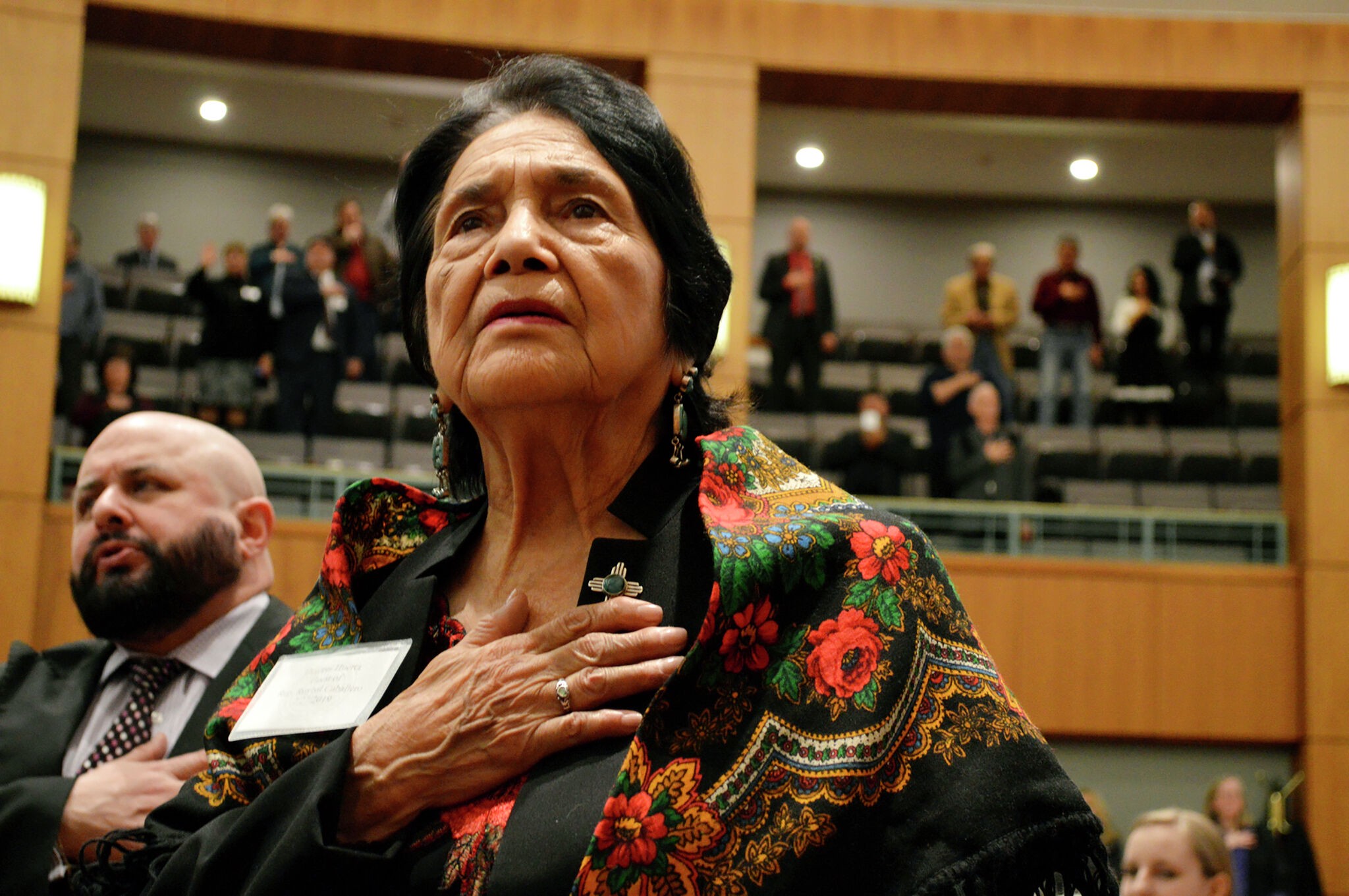
Dolores Huerta, César Chávez’s longtime organizing partner and co-founder of the United Farm Workers, said Chávez raped and pressured her into sex in the 1960s, breaking decades of silence as part of a New York Times investigation detailing allegations that Chávez groomed girls and sexually abused women.
Huerta, 95, said in a statement Wednesday that she experienced two sexual encounters with Chávez in the 1960s, describing one as coercive and the other as forced.
“I am nearly 96 years old, and for the last 60 years have kept a secret because I believed that exposing the truth would hurt the farmworker movement I have spent my entire life fighting for.
“The first time I was manipulated and pressured,” she said. “The second time I was forced, against my will. I have kept this secret long enough. My silence ends here.”
She said both encounters resulted in pregnancies that she kept secret. She said the children were raised by other families. Huerta said she remained silent for decades because she believed speaking out would harm the farmworker movement.
“I convinced myself these were incidents that I had to endure alone and in secret,” she said.
The New York Times investigation, published Wednesday, is based on interviews with more than 60 people and a review of union records, emails and archival materials. It found that multiple women accused Chávez of sexual abuse, including two who said they were minors at the time.
The San Antonio Express-News reported Tuesday that organizations tied to Chávez’s legacy had acknowledged allegations involving women and minors and canceled events across the country.
Ana Murguia told the newspaper that Chávez, then in his 40s, began abusing her when she was 13 after summoning her to his office at the United Farm Workers’ La Paz headquarters in California. She said the encounters continued for years.
Debra Rojas said Chávez first touched her inappropriately at age 12 and later had sex with her when she was 15, which would constitute rape under California law, the report states. The women, both 66, were the daughters of longtime organizers who had marched in rallies with Chávez.
The Times reported that elements of both women’s accounts were corroborated through interviews, documents and contemporaneous records. Other women described unwanted advances or coercive behavior.
The reporting expands on allegations that had circulated privately for years but had not been fully documented publicly. The fallout had already begun this month, starting in San Antonio.
On Tuesday, two organizations connected to Chávez’s legacy — the César Chávez Foundation and the United Farm Workers — released statements acknowledging allegations involving women and minors.
The César Chávez Foundation said it had become aware of “disturbing allegations” that Chávez engaged in inappropriate sexual behavior with women and minors during his time leading the union.
“We are deeply shocked and saddened by what we are hearing,” the foundation said.
In a separate statement, the United Farm Workers said it had learned of “deeply troubling allegations” involving its co-founder, including claims of abuse of women and minors.
The union said it has no firsthand knowledge of the allegations but called them “serious enough” to take “urgent steps” to learn more and to create a confidential, independent channel for potential victims to come forward.
“Allegations that very young women or girls may have been victimized are crushing,” the union said.
Both organizations said they are working with leaders and outside experts to establish processes for individuals to safely share their experiences and seek support.
The United Farm Workers also announced it will not participate in any César Chávez Day activities this year and instead urged supporters to focus on immigration justice and service efforts.
The Times reported the union had already canceled its annual Chávez celebrations after learning of the investigation.
Chávez’s family said Tuesday that it was “not in a position to judge” the allegations but added that it supports those who come forward with claims of sexual misconduct.
Before the Times published its findings, multiple sources told the San Antonio Express-News that a report by a national news organization was expected and could be driving cancellations of public events.
San Antonio’s César E. Chávez March for Justice, one of the largest events honoring Chávez, was among the first to be canceled, with other events across the country following. The march, scheduled for March 28, has been held since 1997.
Ernest J. Martinez, chairman of the César E. Chávez Legacy & Educational Foundation in San Antonio, confirmed the cancellation but declined to elaborate.
“With regards to the cancellation of the march that falls in my wheelhouse, I’ll definitely navigate that and communicate to the community for that,” Martinez said. “Anything outside the scope of San Antonio … I don’t speak for the family nor the foundation.”
A memo sent to San Antonio City Council members said the local foundation canceled the event at the direction of the Chávez family, describing the reason only as a “sensitive matter.”
Other events have also been affected. A Corpus Christi march was called off last week after Huerta withdrew. In Tucson, organizers canceled their march and rebranded the event as a unity fair. In San Francisco, organizers of a long-running celebration said they would move forward.
Chávez, who co-founded the UFW with Huerta in 1962, helped transform the American labor movement through strikes, marches and nationwide boycotts that brought attention to farmworkers’ conditions and led to the first union contracts in the industry.
He died in April 1993 at age 66 and would have turned 100 next year, a milestone organizers had begun preparing to commemorate.
His legacy is embedded in public life across the country. Several states observe César Chávez Day on March 31, his birthday, and his name appears on schools, streets, parks, a Navy cargo ship and a U.S. postage stamp.
But interviews with former insiders and historians suggest that allegations about Chávez’s conduct had circulated privately for years.
Mark Day, a former Franciscan priest who worked with the United Farm Workers in the 1970s, said at least two women had raised allegations.
“What I know is that definitely those young women spoke out,” Day said. “And it never went anywhere.”
Matt Garcia, a Dartmouth College historian who has written about the movement, told the Express-News he became aware of allegations after former activists discussed them following publication of his book.
“I’ve seen the allegations from at least one victim,” Garcia said. “There are more victims, I’m told.”
Another longtime participant, Enos Flores, told the Express-News the recent cancellations suggest leaders may be responding to something significant.
“When I saw that article, the first thing that flashed in my head was the jig is up,” Flores said.
Huerta said the movement Chávez helped build extends beyond any one individual.
“The farmworker movement has always been bigger and far more important than any one individual,” she said.