

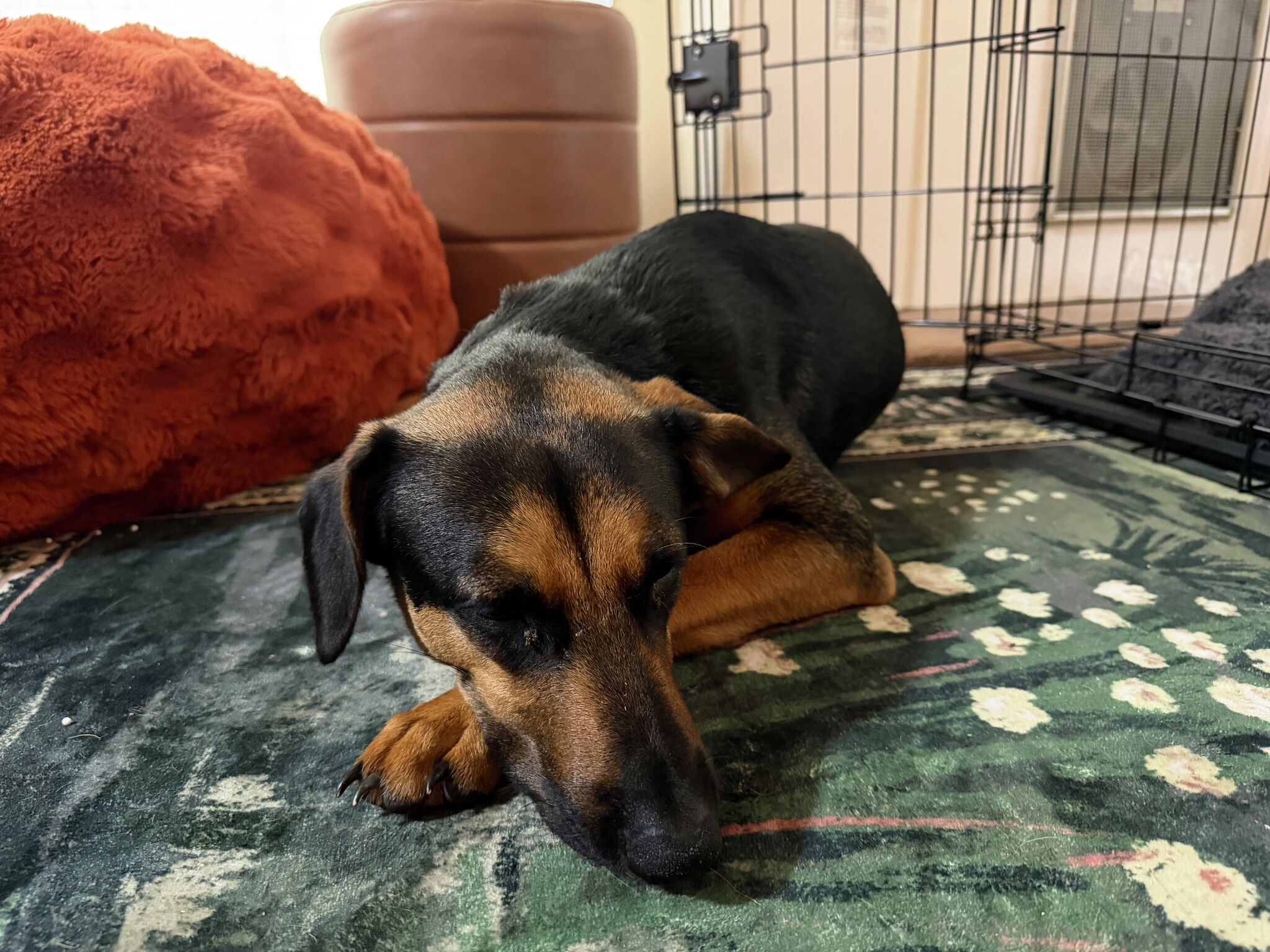
Ronny, the German shepherd mix, resting on the floor of his new home. Statesman reporter Dante Motley adopted Ronny after covering a program at a state jail where inmates trained dogs for three months. Ronny was one of the graduating dogs.
On Tuesday afternoon, in a room that smelled like folding chairs and pet stores, 11 dogs walked across the front of a room in the Travis County State Jail, a correctional facility in East Austin, to applause and the occasional answering bark. They had spent three months living with incarcerated military veterans — sleeping in the jail, eating on their schedules, learning to sit and stay and heel on command. The men who trained them stood in their white outfits, holding their leashes for the last time. And somewhere in the back of the room, I was taking notes and quietly melting at my subject’s cuteness, which reporters are probably not supposed to do.
Then I adopted one of the dogs, which, when the dogs are the story, reporters are also probably not supposed to do.
His name was Ronny — a German shepherd mix, bashful and beautiful. He was trained by Christopher Creed and Michael Perez, and when he came off the stage he pulled curiously at his leash, a little overwhelmed and alert, head swiveling like he wanted to go see the world but was maybe a little too afraid to do so. I understood that impulse. Immediately after the ceremony, this Statesman reporter asked Austin Animal Services if I could adopt him.
The program is called Enduring Service. It was developed through a partnership between AAS and the Texas Department of Criminal Justice Rehabilitation and Reentry Division, modeled after a similar initiative in Williamson County. Jason Garza, the Assistant Director of Austin Animal Services, sees it as vocational. Inmates learn animal training, a marketable skill that could help them get a job or start a business. Twelve pairs of inmates were each assigned a shelter dog to train, feed, bathe and live with for three months. Eleven dogs made it through. One was returned to the shelter early, and that pair graduated without their dog present. Four were adopted at or before the ceremony. The rest went to foster homes.
For the men inside, the program was something harder to quantify. Raymond Gerena, a former Navy legalman, said he was glad to have bonded with other veterans while giving dogs a second chance. Jarrod Plunk, a former Army infantryman, trained a dog named Connor. He said he developed a friendship with his training partner he wouldn't have had otherwise.
“This was very therapeutic,” Plunk told me. “When you are stuck in your ways it’s like being stuck in the mud. Unless you work hard to change your ways and do something new, you are never going to move.”
Connor was adopted before the ceremony. Plunk watched him go.
Keantrick Sterns and Kevin Adams, both Army vets, trained a chunky mutt named London. During the ceremony London spent most of his time lying down, indifferent to the formality. Sterns told me he had never been a dog person. He also told me he had struggled with vulnerability his whole life, with the particular difficulty of being soft, and that London had pulled that out of him in the way dogs do, without asking permission. Adams said the program helped with his anxiety and his PTSD. Both men said they plan to adopt dogs when they're released later this year.
London was adopted by Ladajia Williams, a correctional officer at the jail who said she had always wanted a dog and had never been more excited to go to work than in these past three months. She said she was moved by the will of these men to change another creature's life.
“Wish me luck,” she said as she turned to leave. The room laughed, and she walked out with London ambling beside her.
Perez, one of Ronny's trainers, told me that working with the dog had quieted something. His self-doubt and his depression eased. His blood pressure had come down. He said he discovered he had a talent for being relied on, that it gave him joy.
Warden James Hales said the inmates had put everything they had into the program and done an amazing job. I’d tend to agree.
I am aware of how this looks: I covered a program and left with one of its dogs. That may complicate my ability to write about Enduring Service with perfect detachment. But perfect detachment felt like the wrong standard by the time I got Ronny home and sat on the floor for hours while he investigated my apartment with that same cautious, hesitant curiosity he had shown at the jail. I thought about Christopher and Michael, who gave him that gentle quality, or drew it out of him, which may be the same thing. If the program’s purpose was to leave something good behind — in the dogs and in the men who trained them — then Ronny carried some of that home with him. He did not leave them behind completely, as I doubt any of the dogs will. I will be keeping in touch.