

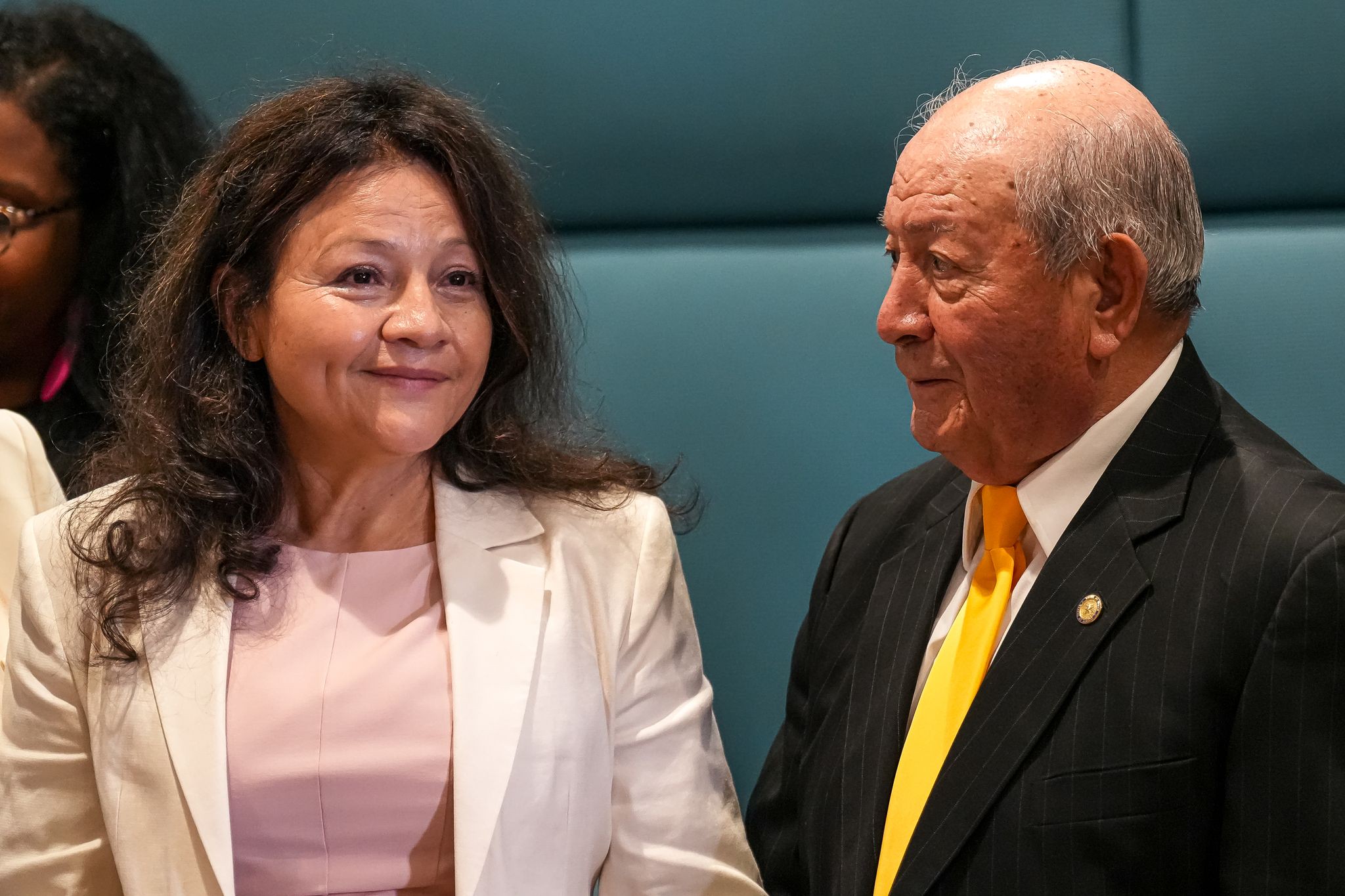
Carmen Mejia, left, stands with former court bailiff Art Guerrero, right, at the Austin Community College Highland Campus on Thursday, April 30, 2026. Guerrero, a now-retired bailiff that worked on Mejia’s trial in 2005, began to fight for her exoneration in 2021 and it was, in part, Guerrero’s insistence that led the Innocence Project to take on Mejia’s case.
Art Guerrero stood in a crowded hallway at Austin Community College on Thursday afternoon, waiting.
Students milled around him, chatting among themselves and scrolling on their phones. Guerrero didn’t seem to notice.
Carmen Mejia, center, is walked into the Austin Community College Highland Campus by Brenda Cachay, a paralegal with Innocence Project, left, and Vanessa Potkin, Mejia's attorney with Innocence Project, right, to meet former court bailiff Art Guerrero on Thursday, April 30, 2026. Guerrero, a now-retired bailiff that worked on Mejia’s trial in 2005, began to fight for her exoneration in 2021 and it was, in part, Guerrero’s insistence that led the Innocence Project to take on Mejia’s case.
The retired Travis County bailiff had spent decades waiting for this moment — the day he would meet Carmen Mejia, the woman he believed was wrongfully convicted of murder and sentenced to life in prison.
Now, under the hum of fluorescent lights, the moment had arrived.
Mejia, 54, turned the corner and appeared at the end of the hallway, flanked by her daughters and the attorneys who helped secure her freedom. Guerrero’s eyes welled with tears as she approached, and the two soon folded into a tight embrace.
He stepped back, grasped her hands and looked her in the eye, speaking to her in Spanish. Tears streamed down her face.
While Mejia was serving the first 22 years of her life sentence, Guerrero, too, had carried the weight of her conviction. He believed she was innocent but had no idea how to raise his concerns. He didn’t know her at all.
“I didn’t even know what she looked like,” Guerrero said. “I only saw her face twice in the courtroom.”
Despite some initial hesitation, it was Guerrero who finally brought questions about the quality of her legal representation to a trusted judge in 2021, and then to Travis County District Attorney José Garza.
It was Guerrero who contacted attorneys at the Innocence Project, a New York-based group that works to exonerate people who were wrongfully convicted, and asked for their help seeking justice for Mejia.
And it was during her official exoneration hearing in March, as Guerrero took the stand to share his account publicly, that Mejia learned who he was for the first time.
“I felt like my heart could breathe again, like my heart was beating again,” Mejia said through a translator. “All those years having someone advocating for me, even though I didn’t know, God knew that he was looking out for me.”
'Two persons were freed that day'
In 2005, Guerrero served as the bailiff during Mejia’s murder trial.
The mother of four stood accused of intentionally killing a 10-month-old child she had been babysitting in July 2003. The infant died after being burned by scalding bathwater.
Although Mejia maintained it was a tragic accident, a jury found her guilty of murder. She was sentenced to life in prison, narrowly avoiding the death penalty.
Guerrero hadn’t even been scheduled to work the trial — a colleague had asked him to step in to cover a vacation at the last minute, and he’d obliged.
“I wasn’t even supposed to be there,” Guerrero said. “And that’s why I always say, God works in mysterious ways.”
Former court bailiff Art Guerrero waits to meet Carmen Mejia at the Austin Community College Highland Campus on Thursday, April 30, 2026. Guerrero, a now-retired bailiff that worked on Mejia’s trial in 2005, began to fight for her exoneration in 2021 and it was, in part, Guerrero’s insistence that led the Innocence Project to take on Mejia’s case.
From the beginning of the proceedings, he said something felt off.
After working dozens of trials, Guerrero said courthouse staff could easily distinguish between seasoned attorneys and those who were in over their heads. When he saw Mejia’s court-appointed defense attorney — and the prosecutors they were up against — he feared her fate was already sealed.
“Pretty much everybody that worked at that courthouse and was inside the courtroom knew that from the very beginning,” he said. “I’m thinking, why would they allow that to happen?”
The prosecution brought three expert witnesses to the stand. Mejia’s defense team brought none.
“We were all witnessing a crime being done to this lady,” Guerrero added. “Every one of them that was there — none of them were going to speak up.”
And at the time, he didn’t either.
Guerrero said he feared expressing his concerns while he was still employed by the court, but the case haunted him through his retirement. He prayed every day for her to receive justice.
“A lot of people don’t understand how it can eat at you,” he said. “It gets to you, that you can’t do anything and that lady is sitting there for the rest of her life.”
After his tenure with the court ended, Guerrero finally began reaching out for help. When the Innocence Project agreed to review Mejia’s case, he said he felt the attorneys were “angels” sent by God. He felt hope for the first time.
That effort prompted a reexamination of the case, and the Innocence Project and the Travis County District Attorney’s Office together spent years navigating the state appeals process.
On March 9, the day of Mejia’s official exoneration hearing, Guerrero said he felt a weight lifted from his shoulders.
“She was free from prison,” Guerrero said. “And I was free from my duty. Two persons were freed that day.”
The limits of freedom
For Mejia, that freedom has brought both relief and uncertainty.
After more than 20 years behind bars, she is working to rebuild her life and reconnect with her four daughters, all of whom were under 8 years old when she was sentenced. They had no contact throughout her time in prison.
“Now I have new life,” Mejia said. “It’s been very beautiful for me. I never thought I was going to be able to see my kids again. When you have faith in God, he’s the God of making the impossible, possible.”
Mejia understands some English, but she speaks mostly in Spanish. Her children, who were adopted after their mother’s conviction, speak English.
Mejia, an immigrant from Honduras who had protected legal status at the time of her 2003 arrest, saw it expire while incarcerated. She remained in custody after her exoneration because of an immigration detainer, but federal officials later lifted it. Her attorneys are now working to secure legal residency for her in the United States.
With assistance from the Innocence Project, Mejia is living in temporary housing as attorneys work to help her secure permanent accommodations. She has no line of credit and no recent rental history, both barriers to her rental applications, according to Vanessa Potkin, director of special litigation at the Innocence Project.
Still, Mejia said, she’s focusing on spending time with her daughters and moving forward with the rest of her life.
“I want to be happy. I want to have the opportunity to keep reaching out and being close with my kids, and that one day we establish a relationship again where they call me 'mother' and 'mom.'”