

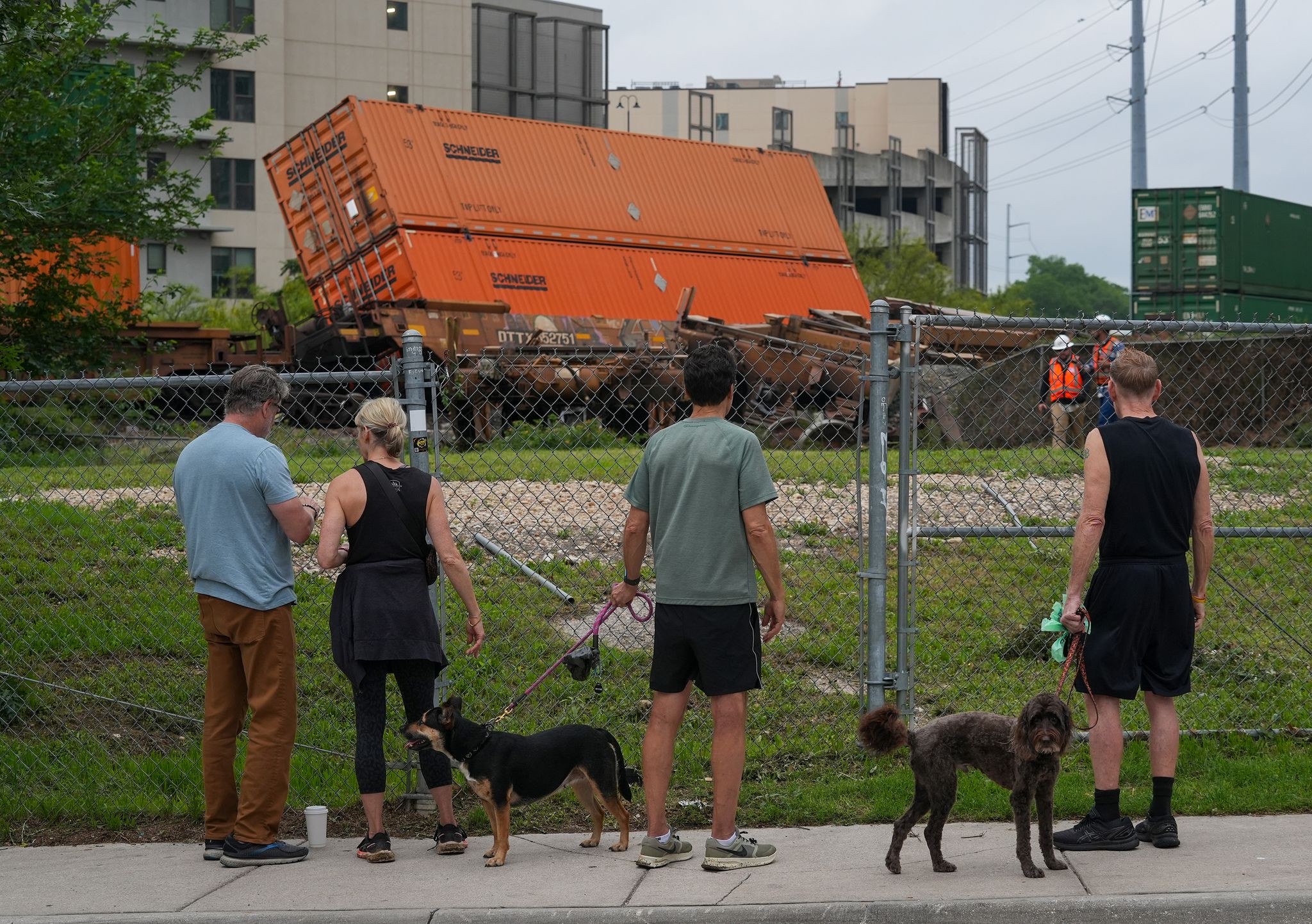
A freight train derailment in downtown Austin last month is prompting Travis County Judge Andy Brown to renew calls to move a major rail line out of the city’s urban core — a long-debated idea that has yet to gain traction.
Seven Union Pacific cars derailed early on April 23 as a 230-car train rounded a sharp curve near West Third and Bowie streets in the Seaholm District. No one was injured, but the incident snarled traffic for hours and delayed school bus routes in West Austin as crews worked to clear the scene.
The train was transporting “mixed commodities” rather than hazardous chemicals, but Brown — a longtime passenger rail advocate who oversees emergency management in his role as county judge — said the cars could just as easily have been carrying something far more dangerous, like chlorine.
“Chlorine can cause a cloud of chlorine gas, and that would be a horrible thing,” Brown said. “Just the fact that you’re potentially carrying hazardous chemicals right through this huge metro area with condos literally feet away from where this curve was is not great.”
A long-running proposal renewed
Brown has pushed for expanded passenger rail in Central Texas for years, including a proposed line between Austin and San Antonio. In October, the Travis County Commissioners Court — which Brown presides over — commissioned a feasibility study of a new passenger rail line between the two cities. The study examines the cost and technical feasibility of building the line within existing highway rights-of-way. The results have not yet been released.
Brown said the recent derailment underscores the risks of maintaining a freight corridor through the city’s urban core and adds urgency to efforts to shift that infrastructure. Relocating Union Pacific’s freight route outside downtown and converting the corridor for passenger rail could reduce the risk of a more serious incident while improving transportation options, he said.
“Let’s make this a largely passenger corridor and find a new way to have new freight rail service east of downtown, where Union Pacific and others could have a much straighter route without these curves and without going through heavily populated areas,” he said.
A similar proposal to move freight rail out of Austin and repurpose the corridor for passenger service stalled in 2016. The Lone Star Rail District had envisioned a train between Georgetown and San Antonio and planned to relocate Union Pacific’s freight route outside of Austin, converting the existing line for passenger use. The nearly 20-year effort collapsed when Union Pacific pulled out of negotiations, citing uncertainty about the plan’s viability.
How often derailments happen in Austin
Derailments in Austin are not uncommon, though serious outcomes are rare.
Ninety-two trains derailed in Travis County between 1975 and 2025, including 47 within Austin city limits, according to Federal Railroad Administration data. No one died as a result of those derailments, though incidents in 1976 and 1984 caused injuries.
The county has averaged one to two derailments per year over the past two decades.
Along the Union Pacific corridor through Austin, three derailments have occurred in the past 20 years.
Derailments have been more frequent along the Austin Western Railroad, which runs through East Austin and northwest toward Leander. Capital Metro’s Red Line operates on those tracks during the day, with freight service at night.
Since 2005, four CapMetro trains and seven Austin Western freight trains have derailed in Austin. In the most recent incident in 2024, a 90-car train carrying gravel derailed overnight near the East Sixth Street crossing, overturning seven cars and disrupting traffic and transit but causing no injuries. Earlier incidents in 2007, 2013 and 2018 also caused disruptions, and the 2007 derailment led to a lower speed limit at the East Sixth Street junction after diesel leaked from a railcar.
Risk in a dense corridor
Although the derailment last month was relatively routine, emergency responders say such incidents can escalate quickly.
“These situations can quickly become high-risk for both the community and first responders,” the Austin Firefighters Association said in a statement. “Train derailments can carry serious risks — ranging from toxic chemical exposure and explosions to blocked roadways that delay critical emergency access.”
Brown said those risks are amplified in dense areas. Tank cars commonly carry chemicals like chlorine and fertilizer, according to Union Pacific, and while first responders have plans to deal with leaks, the railroad’s location complicates those responses.
The derailment site is about 100 feet from the nearest residence and adjacent to businesses including Trader Joe’s and Merit Coffee.
First responders are trained to handle such situations, according to the Austin Fire Department. Crews can verify the contents of train cars using placards and an app and run training scenarios based on chemicals commonly transported through the area.
“Our training scenarios are based on known chemicals that are transported through our area and chemicals that are likely to be, based on experience and training,” Assistant Fire Chief Jeffrey Kennedy said in a statement. “AFD and our public safety partners have and will continue to run scenarios under federal security rules to prepare to respond to derailments of hazardous materials.”
But past incidents illustrate the potential consequences. Two women who died in Bexar County in 2004 “had no hope of being saved,” Hearst Newspapers reported at the time. They lived 160 feet from a derailment that released a plume of chlorine fumes and were exposed to a dose 900 times the lethal level.
The cause of derailments and industry’s response
Track defects are among the most common causes of derailments, according to the Association of American Railroads. The cause of last month’s derailment has not yet been determined.
Citing preliminary findings from the county study, Brown said the tracks running through Seaholm are in poor condition and that the curve where the derailment occurred adds to the risk.
Union Pacific spokesperson Robynn Tysver said the track complies with federal regulations and is visually inspected twice per week. She emphasized that rail remains one of the safest ways to transport freight, including hazardous materials.
“Union Pacific shares the same goals as our customers and the communities we serve — to deliver every tank car safely,” Tysver said. “Railroads are the safest way to transport hazmat material, with more than 99.99 percent of shipments reaching their destination safely, without a release.”
Nationally, derailments and train accident rates have declined in recent decades.
“The bottom line is that freight rail safety continues to improve year after year,” said Ted Greener of the Association of American Railroads. “While every incident is taken seriously, the broader record shows an industry that is investing heavily, adopting new technologies, and constantly working to make an already safe mode of transportation even safer.”
Challenges lie ahead
Although previous efforts have failed to advance, officials are considering relocation of the freight line among several options for the newly proposed Austin-San Antonio passenger train, Brown said.
Relocating freight rail out of downtown Austin would require coordination among Union Pacific, local governments and other stakeholders and would likely involve significant costs and infrastructure changes. Brown said federal funding would almost certainly be required under any scenario, and Union Pacific hasn’t publicly taken a position on relocation.
Still, Brown added, shifting freight traffic away from dense areas would reduce risk.
“Transporting cars full of people and not full of hazardous chemicals” would be much safer, he said.