

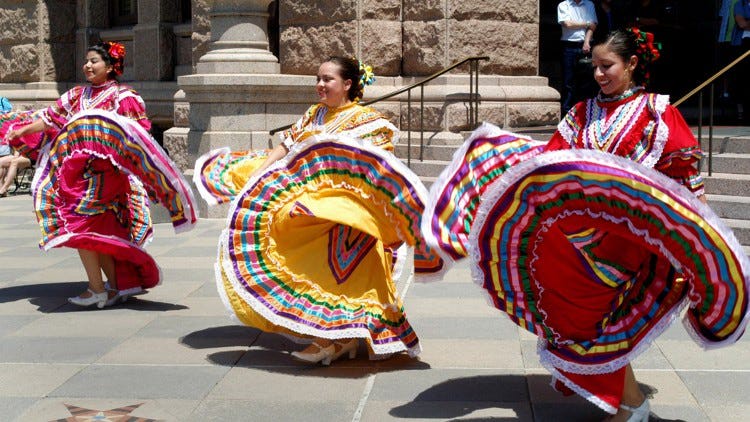
In this 2006 file photo, members of the University of Texas Ballet Folklorico, left to right, Veronica Chidester, Melanie Gomez and Guadalupe Rodriguez perform for spectators on the Capitol steps in celebration of Cinco de Mayo.
There’s something special about celebrating Cinco de Mayo and Taco Tuesday on the same day. But contrary to many assumptions, the holiday — which means “fifth of May” in Spanish — is neither Mexico’s Independence Day nor the Mexican counterpart to the Fourth of July in the United States.
The holiday actually commemorates the Mexican army’s victory over French forces at the Battle of Puebla on May 5, 1862. Despite its historical significance, however, it’s not one of the seven national holidays of Mexico that is a required no-work day.
Here’s a quick breakdown of the holiday’s history and why it’s celebrated today.
Who celebrates Cinco de Mayo?
There are some Cinco de Mayo celebrations throughout Mexico, particularly in the city of Puebla. However, the event is small compared to Día de la Independencia, which has been celebrated annually on Sept. 16 since the country claimed its independence from Spain in 1810.
Meanwhile, in the United States, Cinco de Mayo has become an annual celebration of Mexican-American culture that began with the rise of the Chicano movement in the 1960s and 1970s, according to The History Channel.
Why is Cinco de Mayo celebrated in Texas?
Cinco de Mayo is celebrated in Texas as a way to honor the rich cultural heritage of people of Mexican descent, particularly Tejanos, who have deep historical roots in the state, according to the Texas State Historical Association. After the Texas Revolution, Tejanos began holding fiestas patrias in the 1820s to reinforce their ties to Mexico and celebrate their unique bicultural identity.
In cities like San Angelo and Houston, these celebrations have a long tradition. In San Angelo, celebrations began with a grand parade in 1910 and continued with large festivals, including sporting events and school concerts. By the late 1920s, the Mexican-American community began organizing events through the Comité Patriótico Mexicano, and in 1946, Estanislado Sedeno became a key figure in San Angelo’s Cinco de Mayo festivities, holding the event for 27 years at Sedeno Plaza.
In Houston, the celebrations started in the 1920s as the Hispanic population grew large enough to warrant a Mexican consulate. Early festivities included historic plays at Teatro Azteca and expanded over the years to include parades and dances. By the 1960s, groups like the Hispanic Club Familias Unidas began sponsoring events such as the Baile Ranchero, celebrating Mexican culture through music and dance. Today, Cinco de Mayo in Houston continues to be a major event, with various civic organizations playing a key role in maintaining and growing the celebrations.
“Cinco de Mayo, in particular, has recently been embraced more generally in the same way as other ethnic celebrations such St. Patrick’s Day, Mardi Gras, and Oktoberfest have found acceptance in American cultural life,” according to the Texas State Historical Association.
A woman dressed as a Zacapoaxtla Indian holds a machete as she dances before the start of a reenactment of the battle of Puebla — between Zacapoaxtla Indians and the French army — during Cinco de Mayo celebrations in Mexico City in 2015. Cinco de Mayo commemorates the victory of an ill-equipped Mexican army over French troops in Puebla on May 5, 1862.
Should you celebrate Cinco de Mayo?
When celebrating Cinco de Mayo, it’s important to be culturally respectful. Focus on participating in events that authentically celebrate Mexican culture. Be mindful of avoiding stereotypes or appropriation, and refrain from using slogans like “Cinco de Drinko,” which can trivialize the significance of the day.
When is Mexican Independence Day?
Mexico’s actual Independence Day — Diez y Seis de Septiembre — is celebrated on Sept. 16. It commemorates Father Miguel Hidalgo y Costilla’s Grito de Dolores (“Cry of Dolores”), delivered in the early morning hours of Sept. 16, 1810, in the village of Dolores near Guanajuato. In his call to arms, Hidalgo urged the people to rise up and end Spanish rule in Mexico.