

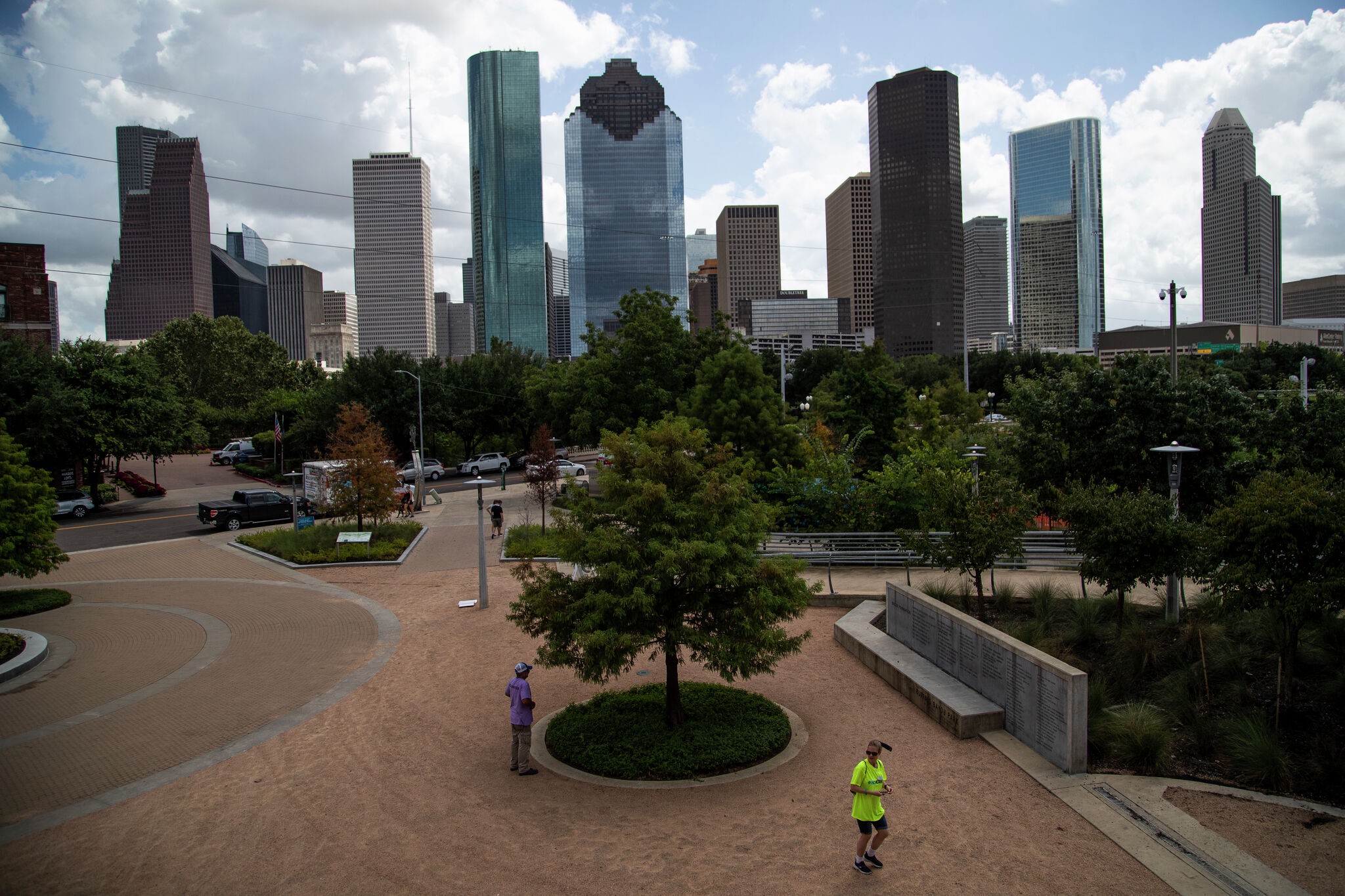
View of the Houston skyline from the Water Works at Buffalo Bayou. (Photo by Marie D. De Jesus/Houston Chronicle via Getty Images)
Houston Chronicle/Hearst Newspap/Houston Chronicle via Getty Imag
Our first article on the current golden age of Texas urban history, published May 3, was devoted to “San Antonio and Its Missions: Three Centuries of History, Memory and Heritage” by Joel Daniel Kitchens (Texas A&M University Press, 2026).
Kitchens shared five little-known stories about the Alamo City.
Geoffrey Connor served as Texas secretary of state from 2003 to 2005.
Statesman File
For the second installment in our series, “Texas Urban Tales,” we turn to the history of the state’s biggest city: Houston.
The rise of Houston
We focus on “The Rise of Houston as a Global City” (Texas A&M University Press, 2026).
It was written by Geoffrey Scott Connor, an attorney and National Security Fellow at the University of Texas’ Clements Center. He memorably served as Texas secretary of state from 2003 to 2005, and later earned a Ph.D. in history at UT in 2016.
Connor celebrates Houston’s extraordinary growth, wealth and social leadership since it was founded in 1836. The city quickly usurped its nearby rival, Harrisburg, then, after the 1900 hurricane, Galveston, the most developed city in Texas during the 19th century.
The author rightly concentrates on Houston’s railroads, deep-water ship channel and booming port, its role as the world’s energy capital after the Spindletop discovery in 1901, and its visionary leaders who backed the Texas Medical Center — the largest in the world — Johnson Space Center, and educational institutions such as Rice University and the University of Houston.
He's particularly good on the early years of the oil-and-gas age. Despite having read several accounts of that era, including Bryan Burrough’s classic, “The Big Rich,” I learned all sorts of hidden connections among the Houston players from Connor. A case in point: What was the basis of the Hogg fortune, much of which fuels the UT-anchored Hogg Foundation? Turns out, former Gov. Jim Hogg participated in the founding of Texaco.
Connor, who also excels at the gripping tales of the medical and space centers, does not pretend to tell the whole story. That would take quite a few more volumes. Yet he answers the tightly defined question behind his title: How, after all, did Houston rise as a global city?
The following are five things that Connor felt were essential to that story, yet little noticed by the casual observer, or even by, in my case, a hometown boy who followed Houston’s evolution scrupulously.
‘Houston dared to dig a ditch’
The Neches a freight ship in Houston Ship Channel.
Don Uhrbrock/Getty Images
The Houston Port and Ship Channel is one of the most famous and distinctive features of the state’s largest city. Houston’s water access was the essential reason for its founding location, and the continued expansion and improvement of that access proved to be the most important element in its rise to global prominence.
Founding brothers John Kirby Allen and Augustus Chapman Allen established Houston in 1836 on the banks of Buffalo Bayou, a slow-moving stream that flows ultimately to Galveston Bay. Augustus Allen and his wife, Charlotte Allen, invited Sam Houston to a dinner in Nacogdoches during which Charlotte asked if they could name their new town for him. Naturally, the recent hero of the Alamo did not refuse his hostess.
The Allen brothers' vision was to collect all the agricultural produce of the region, load it onto barges and ship it down the bayou to Galveston, where it could be sold or reloaded to oceangoing ships to the Caribbean, the U.S. or Europe. The Allens successfully marketed Houston, and the volume of trade dramatically grew both ways, with manufactured goods coming into Houston from Galveston and beyond. Cotton was the main commodity shipped from Houston, and the global demand drove Houston to continually work to make the bayou wider, deeper and straighter to accommodate bigger ships.
In 1897, U.S. Rep. Tom Ball of Houston was a freshman member in Washington, D.C., and asked to be assigned to the Rivers and Harbors Committee. Over the next few years, Ball ably advocated for Houston and was eventually able to obtain federal funding linked to state funding for a true deep-water port at Houston.
The mechanism of federal-state cost sharing so common in the modern era was born with the Port of Houston project. By the official opening of the expanded port in 1914, Houston was already one of the major ports of the world, with a Turning Basin, built across from the site of the San Jacinto Battlefield, that easily handled large commercial oceanic ships.
Improvements to the Intracoastal Canal waterways, hugging the U.S. shoreline from Texas around Florida all the way to Virginia, allowed massive shipping to and from the Port of Houston in relatively protected waters. After the Panama Canal opened in 1914, Houston could ship more quickly to the many lucrative ports of Asia, as well as bring Asian shipments in for distribution throughout North America via Houston’s extensive rail connections, transfer stations and storage facilities.
By focusing originally on international trade, Houston acquired massive water and land infrastructure along with sophisticated banking, legal, engineering and insurance industries. It was Houston’s standing in international business that enabled it to pull in all levels of the Texas oil boom and to maximize the ship channel with gas refineries, plastics factories, rubber manufacturing, chemical plants and other expanding uses of the energy industry coupled with highly developed land and water transportation.
It is accurate to say that Houston’s global fame in energy, medicine, technology and space was built on the bedrock of its inception as an international trade center. As Will Rogers once said, “Houston dared to dig a ditch, and bring the sea to its door.”
A medical center for the world
"The Rise of Houston as a Global City" by Geoffrey Scott Connor (Texas A&M University Press, 2026)
Texas A&M University Press
The Texas Medical Center in Houston is the largest and most famous medical center in the world. It is essentially its own city, with 50 million square feet of buildings over more than 1,300 acres. It employs more than 100,000 people and receives over 10 million patient visits each year.
Given these statistics, many people are surprised to learn that the idea of such a medical center was only conceived in 1941.
Monroe Dunaway Anderson formed a cotton merchandising company, Anderson, Clayton and Co., in 1904 with his brother Frank and brother-in-law Will Clayton. With the facilities of the Port of Houston, they were able to build Anderson, Clayton into the world’s largest cotton firm, operating in Europe, South America, the Middle East and Asia.
By the 1930s, M.D. Anderson’s health was declining and he turned to his lawyers at Fulbright Crooker — later Fulbright and Jaworski, now Norton Rose Fulbright — to help him with estate planning. Before he died in 1939, Anderson had established a charitable foundation for community purposes, directing almost all of his fortune to it. However, he was not specific about what charities should be favored.
In 1941, the Texas Legislature appropriated funds to be used to build and operate a cancer hospital under the auspices of the University of Texas. The M.D. Anderson trustees met with UT officials and proposed that, if the cancer hospital could be located in Houston, then they would provide the land and enough funds to match the legislative appropriation. The deal was made, and things began falling into place.
Captain James A. Baker — grandfather of U.S. Secretary of State James Baker III — had just died and left his mansion to the Rice Institute. Rice transferred the property to M.D. Anderson to use as a temporary hospital facility. Meanwhile, tensions were growing between the regents of Baylor University on how to manage the Baylor College of Medicine in Dallas. Some regents proposed moving the Baylor medical school to Houston.
The M.D. Anderson Foundation jumped at the chance, offering land, a building fund and research dollars. In this way, the center became a combined medical research, teaching and treatment center in its first two years.
At that point, Houston had a concentration of families made immensely wealthy by trade and the energy industry. One such couple, Hugh Roy and Lillian Cullen, dedicated millions of oil royalties to fund the construction of Baptist Hospital, Methodist Hospital and St. Luke’s Episcopal Hospital. Other families began to follow their lead, and very quickly vast fortunes were flowing into the center to fund more treatment hospitals, teaching hospitals and research facilities. Houston society competed to outdo each other in philanthropic gifts and to give their time on the center’s board.
The concentration of skill and facilities attracted the leading medical experts of the world, and Houston became famous for many medical “firsts” like open heart surgery (Michael DeBakey), artificial heart valves (Denton Cooley), and life flight ambulance service (Red Duke). Any person in the world with the capacity to do so turned to the center for medical treatment, including Presidents John F. Kennedy, Lyndon B. Johnson, Richard Nixon and George H.W. Bush; the Shah of Iran, the Duke of Windsor, Boris Yeltsin, and many more from recent years.
Additionally, hundreds of private sector companies were created around the center in such fields as artificial limbs, gene splicing, pharmaceuticals, testing kits and medical equipment. The health industry is virtually immune to economic downturns and has become a constant in Houston’s diverse economy.
Space Age power brokers
Photographer Rhiannon Adam makes photos in the Teague Auditorium at Johnson Space Center in Houston during coverage of the Artemis II mission as astronauts conduct a lunar flyby on Monday, April 6, 2026.
Brett Coomer/Houston Chronicle
The Johnson Space Center in Houston is the headquarters of the U.S. human spaceflight program. Opened in 1962, the center controlled the launch of Apollo 11 in 1969 that placed astronauts on the moon. Texans love to recount that the first word spoken from the moon was “Houston.”
The exploration of space and the determination to reach the moon was driven by the dynamics of the Cold War, and especially the panic caused by the Soviet satellite Sputnik in 1957. Then-U.S. Sen. Lyndon B. Johnson passed the Space Act of 1958, establishing NASA, and quickly became a leading voice on space policy. After being elected vice president in 1961 on the Kennedy-Johnson ticket, Johnson became chairman of the Space Council with direction from Kennedy to get America to the Moon before the Soviets.
The search for a manned spaceflight center immediately sought a location on warm waters in the relatively protected Gulf of Mexico region with a deep-water port. Houston was qualified, but so were 21 other cities NASA decided to investigate. Vice President Johnson was obviously in a position to be influential in site selection, but the decision in favor of Houston was more complex.
NASA considered proximity to higher education in technology and engineering to be important, and Rice University was very suitable. Additionally, business leader George R. Brown was on Rice’s board of regents and was a close friend and college roommate of U.S. Rep. Albert Thomas of Houston, the chairman of the House Appropriations Committee. When President Kennedy sought Thomas’ help on some legislation, he wooed the chairman by telling him that the space center might be located in his district. Meanwhile, Brown was able to persuade Humble Oil to donate 1,000 acres of well-located real estate to Rice University if it could be used for the space program. Rice subsequently donated the land to NASA.
In the end, Houston was able to take its many attributes and use its considerable political clout to make the most compelling case to NASA.
Space City, Houston rolled out the red carpet to the astronauts and all the employees of NASA who suddenly moved in. Local companies offered free furniture, free draperies, free telephone installation, cars and Stetson hats. Houston held a big July 4 bash in 1962 with a parade, barbecue and a huge slate of officials.
Houston’s society and culture were permeated by its new Space City status. They built the space-themed Astrodome in 1965 as the world’s first air-conditioned, fully enclosed sports stadium, and then invented Astroturf to go in it. People competed to meet and entertain astronauts and anyone working at the space center.
The 1960s fashions reflected a more sleek, minimalist look, and Houstonians readily took to the modern trend. In 1965, designer Andres Courreges presented his Space Age collection at a fashion show in Paris attended by Houstonian Lynn Sakowitz Wyatt.
Through her introduction, Courreges agreed with her brother Robert Sakowitz to debut his collection at Sakowitz department store in Houston rather than at a New York store as originally planned. Sakowitz agreed to pay him on each item sold rather than a set price for the design to be copied. In this way, the now common merchandising structure of designer clothes was established in Houston.
From Southern gentlemen to cowboys
The dining room of Ima Hogg’s former home at Bayou Bend Collection and Gardens is photographed in Houston, Wednesday, April 8, 2026.
Raquel Natalicchio/Houston Chronicle
Many people see Houston as the Energy Capital of the World, while others are focused on its role as Port to the World or as Space City USA. Large cities are generally multifaceted, but the diverse scope of Houston is such that even locals are often unaware of sectors of Houstonian culture that are world-renowned in other circles.
The historical identity of the city and its people is part of a statewide cultural shift that played out in the early 20th century. Houston had identified as a Southern city from its founding and was heavily populated by immigrants from other Southern states. The institution of slavery was recognized in early Texas and was protected by the Republic of Texas constitution of 1836. Texas was admitted to the U.S. in 1845 as a slave state, and subsequently seceded in 1861 as part of the Confederacy.
After the Civil War, enslaved people were freed, but the culture of the South remained widespread, including in Houston. The city billed itself as the Magnolia City until the 1920s. Its local festivals were focused on cotton, Mardi Gras and other Southern themes. But the nostalgia of the antebellum era eventually grew stale, and Texas and Houston cultural leaders began a shift to a Western identity instead.
The shift was partly a political response to a resurgence of the Ku Klux Klan after World War I that was distasteful to many. An intellectual rebranding was led by Gov. James Allred, who clamped down on the KKK and appointed like-minded people to steer the Texas Centennial in 1936. Houston, led by Jesse Jones, constructed the Art Deco-style San Jacinto Monument on the site of the battle for Texas independence. Houstonians focused their celebrations on independence from Mexico, not dwelling on the Civil War.
Historians such as UT professor Walter P. Webb published famous books like “The Great Plains” and “Texas Rangers,” both of which made a strong case for the state’s Western heritage. J. Frank Dobie also embraced the Western culture of Texas, and artists began to depict historic Texans more as cowboys, not Southern gentlemen.
Houston was generally in line with the cultural shift, although it moved at a different pace, reflecting its similarities to other Southern port cities like New Orleans and Savannah.
The children of Gov. Jim Hogg developed the opulent River Oaks neighborhood in the 1920s, including a home for themselves named Bayou Bend. Designed by John Staub, it was a large, pale pink Southern plantation-style home set in a lush Southern garden of magnolias, azaleas and water features. Staub continued building other grand Southern homes in River Oaks, many of which are beautifully preserved today.
In the end, Houston seems to have largely followed the statewide shift to a Western identity, especially with the Houston Livestock Show and Rodeo, the largest such Western event in the world. But it has largely replaced its official Southern identity with a more truly international image in keeping with its transformation as a global city. Southern plantation homes still abound, but many are filled with boot-wearing oilmen.
Or they are occupied by immigrants from Asia and the Middle East associated with the Texas Medical Center, Johnson Space Center and the city’s technological transformation. Even the city’s ballots and election guides are available in seven languages, including Vietnamese, Mandarin and Hindi.
Houston, host to 91 foreign consulates, has not just moved from a Southern to a more Western identity, but has developed pride over how truly international the city has become and the reach of its global influence. Looking back at the city’s evolution from international trade port to global energy center to world technology and cultural center, the city’s modern image as an international city seems the most accurate and becoming.
Some outsized Houston characters
Geoffrey Connor is particularly good at following the lines of power among Houston's elite and what they accomplished with dedicated philanthropy.
Geoff Connor
Like any large city, Houston has had generations of outstanding leaders in business, politics, society and the arts. But the aggressive and daring culture of Houston has produced some especially famous, flamboyant, even swashbuckling personalities.
William Marsh Rice moved to Houston in 1837, when it was still a community of tents and provisional buildings. He bought land and established businesses in shipping, railroads and insurance, growing his wealth rapidly alongside Houston. He established the Rice Institute in 1891 for both boys and girls and wrote a will, prepared by James A. Baker, Sr., leaving the bulk of his estate to ensure the school’s future. Rice then moved to New York.
In June 1900, Baker received a telegram advising that Rice, age 84, had passed away. At the same time, a check for $25,000 signed by Rice was presented for payment to a Houston bank. The bank was suspicious of several factors and declined to honor the check. Baker decided to travel to New York to investigate.
Baker learned that a local lawyer, Albert Patrick, had prepared a new will for Rice that left most of his fortune to Patrick and almost nothing to the Rice Institute. Baker alerted law enforcement. who determined that Rice had been poisoned over time with mercury and, in his weakened state, was smothered by his valet, Charles Jones. The investigation also established that the valet was working with Patrick, who had forged the will.
In the end, the Rice Institute flourished, later becoming a full university and a player in Houston’s energy industry and its space program. Baker’s firm, Baker Botts, is a major global law firm that has been closely involved with Houston’s business and political rise in the U.S. and the world.
Another notable Houstonian is Jesse Jones, who moved to Houston in 1898 to manage a family lumber business. He began buying land, investing in oil and shipping and eventually bought the Houston Chronicle. He traveled internationally and was determined to build the type of buildings he saw abroad. He constructed the luxury Rice Hotel on the site of the old Texas Capitol building. He built the Lamar Hotel, the Texaco Building, the Metropolitan Theatre and the Loew’s Theatre.
Jones was close to President Woodrow Wilson and President Herbert Hoover. President Franklin D, Roosevelt appointed him secretary of commerce, although the two later had a serious falling out. Before he died, Jones established the Houston Endowment, leaving the bulk of his fortune to it. The Houston Endowment now has assets of about $2.5 billion and disburses about $100 million each year.
Ima Hogg is a famous name in Houston and in Texas generally. The only daughter of Gov. Jim Hogg, she lived as a girl in the Governor’s Mansion in Austin. She studied music in Vienna and Berlin and returned to found the Houston Symphony in 1913. She and her three brothers developed River Oaks and built a home there for themselves, Bayou Bend, in 1928.
Ima assembled a vast collection of American antiques and art, but also was an early collector of European modern art. Her brothers all preceded her in death without children. When Ima died in 1975, she left Bayou Bend to the Houston Museum of Fine Arts and left her wealth to the Hogg Foundation. She had already restored and gifted the Winedale Historical Center near Round Top, the Varner-Hogg Plantation at West Columbia and the Hogg Museum in Quitman.