

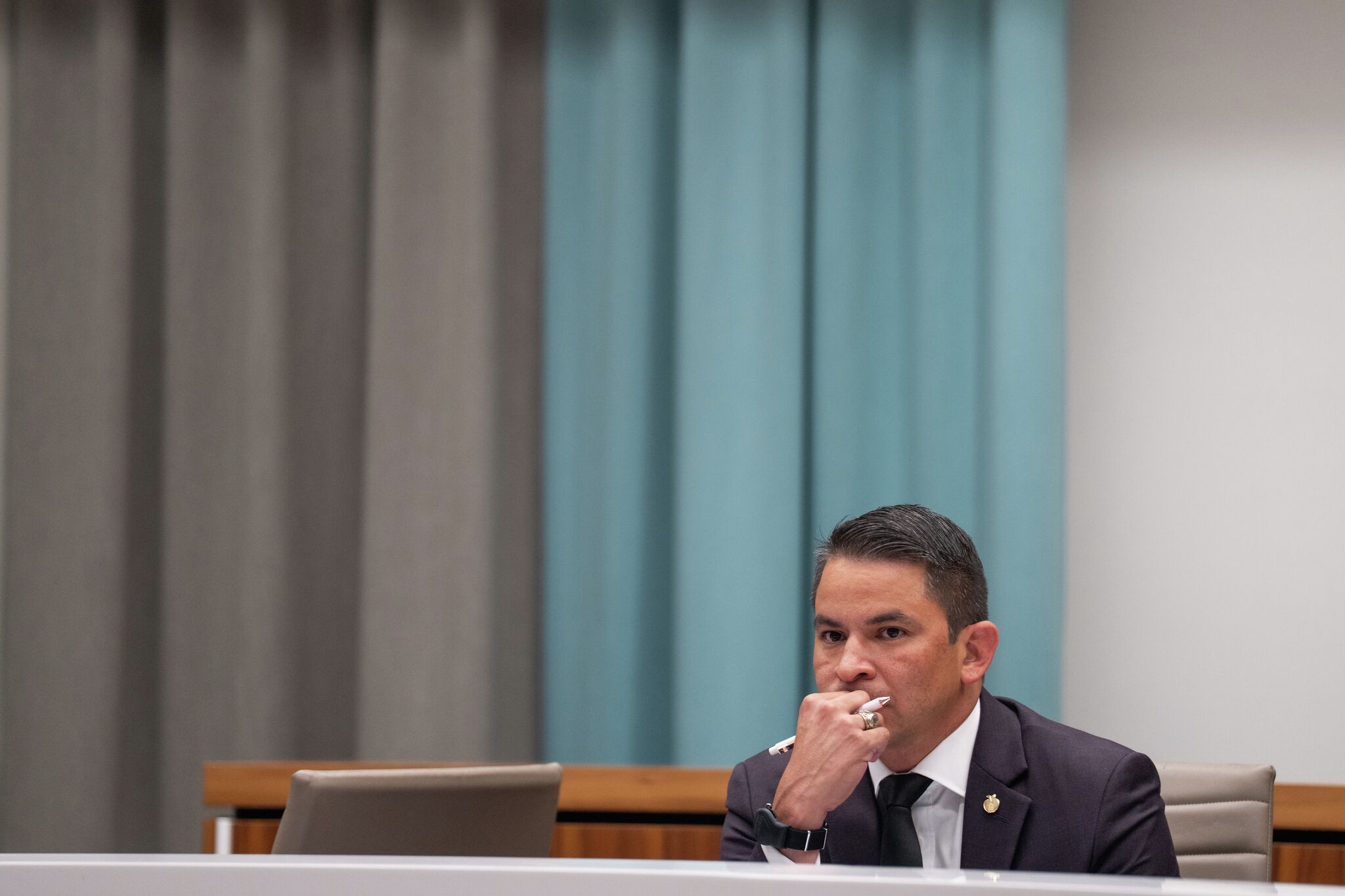
Austin ISD faces a $181 million budget shortfall next school year. District leaders avoided hard decisions around closures and staffing for years.
When Rachel Preston became a teacher more than a decade ago, she fell in love with helping Austin students learn French.
“Sometimes, I get to see the kids go from zero to conversant, almost fluent in the language,” said Preston, who teaches at the Liberal Arts and Science Academy, or LASA. “They’re growing the whole time they’re in your class. You just get to see them succeed.”
The school district is far from alone in its financial woes. School systems across Texas have laid off staff and scaled back student programming to grapple with multimillion-dollar deficits as the costs grew. However, no other Texas school system faces a deficit of such scale.
AISD’s shortfall dwarfs those of any other urban-area district in Texas and represents nearly 20% of Austin ISD’s operating budget. Trustees will debate the budget at a meeting Thursday and must approve it by the end of June.
The $181 million deficit cannot be explained by state funding issues alone. A Statesman analysis found that district leaders spent years delaying difficult decisions as enrollment plummeted — preserving staffing levels, operating dozens of under-enrolled campuses and maintaining programs that became increasingly expensive to sustain.
Over the years, Travis County’s growing property values helped soften the impact of declining enrollment in the short term. But Austin ISD remained vulnerable to financial pressures when inflation, state mandates and student enrollment declines intensified budget issues.
Although academic failings at a single campus can trigger a state takeover, Education Commissioner Mike Morath has said he also considers a district’s fiscal health when deciding whether to remove elected trustees from power.
If financial, academic or safety problems are acute, Morath believes there is “a moral obligation to the students and a fiduciary obligation to the taxpayers for the state to temporarily intervene and correct those problems,” he told the Statesman in March.
The TEA declined to comment.
Superintendent Matias Segura agreed that for years, Austin ISD leadership delayed difficult cuts, in part because the district’s finances were cushioned by the area’s ballooning property values.
“All those pressures (of declining enrollment, property values and stagnant state funding) have compressed and have required this administration with this board to do all of (the cuts) at one single time,” Segura said Monday. “That’s why this feels so disruptive, because many decisions should have been considered many years ago.”
Now, the district is making “hard decisions,” and that is the kind of change the agency wants to see, he said.
Public school funding experts the Statesman spoke with about Austin ISD’s shortfall put a fine point on the difficult decisions the district will face as it moves forward.
“That’s $2,500 a kid,” Marguerite Roza, director of the Edunomics Lab at Georgetown University, said of needed cuts. “That’s going to be really hard.”
The grim financial picture has thrown staff like Preston into uncertainty. For days, she contemplated how to tell students she may be at the school on a more limited basis — or not at all if she has to find a new job.
In the 11 years that Preston has taught in Austin ISD, she’s never felt that the district — and her position in it — was so unstable.
Enrollment falls as staffing remains relatively stable
Since 2011, Austin ISD’s total enrollment dropped by 17,000 students as families fled high city prices, left because of immigration fears or enrolled outside the district.
Last year alone, 16,500 students who live within Austin ISD boundaries attended other public school campuses, largely charters.
But as student numbers plummeted by 20% in the past 15 years, Austin ISD didn’t reduce staff at the same rate, a Statesman analysis found. Over the same period, total staffing dropped by 3.2%.
In previous years, the district regularly made exceptions for campuses with small or declining enrollment to keep positions, Segura said in a May interview.
“The history of Austin ISD has been: we make exceptions everywhere,” Segura said.
When enrollment drops quickly, districts have to restructure staffing, said Lori Taylor, a professor of public service and administration at Texas A&M University who studies school funding.
“You don’t have to serve as many kids, so the funding coming down is not a problem if you adjust your staffing and services accordingly,” she said.
District leaders repeatedly budgeted as though enrollment would remain stable, despite enrollment declines, Segura said in May.
From 2016 to 2025, AISD’s costs per student for counseling increased by 76% and by nearly 50% for security spending, in part because of a 2023 state law requiring districts to place a police officer on each campus. Staffing of aides, who assist teachers in the classroom, grew by 40% and special education teachers grew by 32% since 2016.
The special education hiring surge came as the district scrambled starting in 2022 to clear a chronic backlog of special education evaluation requests. Federal law mandates schools test students who request a special education evaluation within a strict timeline, but for years, Austin ISD failed to test thousands of students by that deadline. Students missed out for months on critical support to help them learn.
The backlog triggered a 2021 lawsuit against the district. A 2023 state order to clear the waitlist prompted the district to boost spending and staffing for the costly services, Segura said in May.
Even though Austin ISD’s enrollment declined, the number of students receiving special education services grew from 8,300 to 13,300 from 2016 to 2025.
Since 2016, the district has made cuts to regular teaching staff and central office positions, but not at a proportionate rate as enrollment declined. From 2011 to 2025, the number of students per Austin ISD teacher dropped from 15 to 13.9.
Enrollment loss isn’t always concentrated in one area geographically, making staffing cuts difficult to do at scale, Taylor said.
“When the enrollment declines are dispersed, the cost-minimizing thing for the district to do is to redraw the boundaries and close the school, but that is very politically difficult,” she said.
Small schools
Austin ISD’s enrollment decline started in 2012, but the district has continued to add campuses with funds from the 2004, 2008 and 2017 bonds, most recently with the opening of Marshall Middle School in 2024.
All the while, more students left the district and small schools proliferated across Austin ISD. By 2025, 24 of Austin ISD’s 115 campuses enrolled fewer than 300 students, the Statesman found.
A third-party auditor hired by AISD to identify cost-saving measures zeroed in on the small school issue in a report released in March 2025. The consultant told Austin ISD that operating small schools was costing the district $43.6 million annually.
The audit found that an elementary campus with fewer than 500 students and a middle school enrolling under 750 students didn’t produce better outcomes for students than larger schools, despite costing almost $2,000 more per child.
Forty-nine AISD elementaries enrolled under 500 students and 10 middle schools had fewer than 750 in 2023-24, auditors wrote. All similar Texas urban school systems educated more students on average at their campuses, except for Fort Worth ISD.
Small schools cost more per student to operate. While many families love small, neighborhood schools, each campus requires its own principal, counselor, custodian and cafeteria worker. But with fewer enrolled, school systems receive less revenue to cover the costs.
That’s why right-sizing a district to match enrollment is essential work, Taylor said. In the same way that growing districts prepare to build more schools ahead of enrollment growth, shrinking districts must plan for losses, she said.
“They need to be as proactive at shutting schools as the fast-growth districts need to be proactive at building new ones,” Taylor said.
Austin ISD proposed redrawing attendance boundaries across the district last year, the first time in decades that leaders had undertaken the project in earnest. But officials announced in November that they would delay that decision for at least a school year, also shelving a plan to close another three campuses, all of which enrolled under the recommended 500 students.
One — Bryker Woods Elementary — had just 284 students in 2024-25.
Austin ISD expects this year’s closures will save $21.5 million, but the vast majority of the savings are already accounted for by new expenses to run state-mandated academic improvement plans.
What is AISD spending its money on?
Based in Travis County, where property values have grown in recent decades, Austin ISD often benefited from rising property tax revenue. Officials began to expect extra cash to flow into district coffers when property values rose more than projected, Segura said.
Because of a special taxing tool, Austin ISD could also collect — and keep — more money per student than other peer districts with lower property values.
But the district also spent more. In 2025, Austin ISD spent almost $13,000 in general fund costs per student, while the average Texas school district spent $11,300 per student, according to TEA.
When more money came in from higher property values, Austin ISD could afford to increase the number of counselors at a school, create new curriculum and spend money on other programs that Segura said represent the district’s values of choice, student supports and smaller classes.
“We have to bring the cost per student down to get the budget to be balanced,” Segura said Monday. “Austin ISD has spent over the many, many years more per student than what was offset by the state.”
Austin ISD’s high per-student spending comes despite the fact that the district serves a smaller share of students who are at-risk, low-income or learning English — groups of students who tend to require costly additional supports for learning.
Critics have questioned what Austin ISD is getting out of its higher per-student spending as the district had more F-rated campuses in 2024-25 than any other Texas public school system.
Small campuses and student-to-staff ratios contribute to AISD’s higher per-student cost. The district also provides a slew of upgraded academic options like Montessori education, a firefighting academy, International Baccalaureate courses and specialized resources for newly arrived immigrant students.
These programs are what kept Maplewood Elementary prekindergarten teacher Traci Dunlap in Austin ISD.
“I stayed in this district for 20 years because I feel like AISD has offered me and my students opportunities that they may not get in other districts,” Dunlap said. “They offer more than what the state requires.”
But in a district that once marketed that families could “Have it All,” Austin ISD may no longer be able to shoulder those costs, Segura has said.
Proposed cuts include extracurricular programs like water polo, librarian positions at small schools and music and art classes at campuses that serve a smaller population of “high-needs” students.
State funding 'mismatch'
Austin ISD is one of many school districts across the state contemplating major budget cuts to deal with a bleak financial picture. Districts nearby, including Pflugerville and Leander ISDs, have turned to school closures. In El Paso, school leaders declared financial exigency, initiating staff layoffs.
Public education advocates — and Austin ISD staffers like Dunlap — have pointed fingers at state leaders.
“It’s all been manufactured by the state,” Dunlap said.
But even as Austin ISD sends back about half of what it collects, the district still keeps enough to fulfill state-mandated education spending requirements.
Others blame stagnant state funding. While Texas has invested billions in public education over the past decade, the funding has not kept up with the rate of inflation or costly state mandates on schools, said Chandra Villanueva, director of budget and policy for Every Texan, a left-leaning public policy nonprofit.
“It really is just a mismatch of what (the state is) willing to provide our schools and what things actually cost in real life,” Villanueva said.
For instance, districts spend more on special education than what they get from the state. Austin ISD’s special education spending grew from $112.1 million to $164 million since 2021, with the state only covering half of the expenses.
“We’ve been shortchanging our schools for a really long time,” Villanueva said.
Next steps
In the face of such demanding financial pressure, Austin ISD has to change how it budgets, Segura said in May.
The district will have to dig into its fund balance — essentially a savings account — dropping the cash available to 10% of AISD’s total budget. The Government Finance Officers Association recommends having no less than two months — or roughly 17% — of general operating revenue in reserve.
The situation has been difficult, and Austin ISD officials have been trying to make decisions that the district’s fiscal health requires, Segura said.
“I’m 1,000% committed to getting this budget balanced, getting to become a healthy, vibrant school system,” Segura said Monday.
Because of the cuts Austin ISD is making this year, the district isn’t yet considering financial exigency, a legal procedure that allows districts to terminate employee contracts, he added.
Trustees could vote on a budget as soon as this week with proposals to slash $125 million in recurring costs and a one-time $60 million infusion from the sale of district-owned property.
For trustees, the deficit has real consequences for students, classrooms and educators. The district is already at ‘bare bones,’ trustee Arati Singh said last week.
Singh worried that continued cuts to student services would impact learning but said the district is “going to have to weather that storm” of painful budget cuts.
“What we can’t weather is going bankrupt.”