

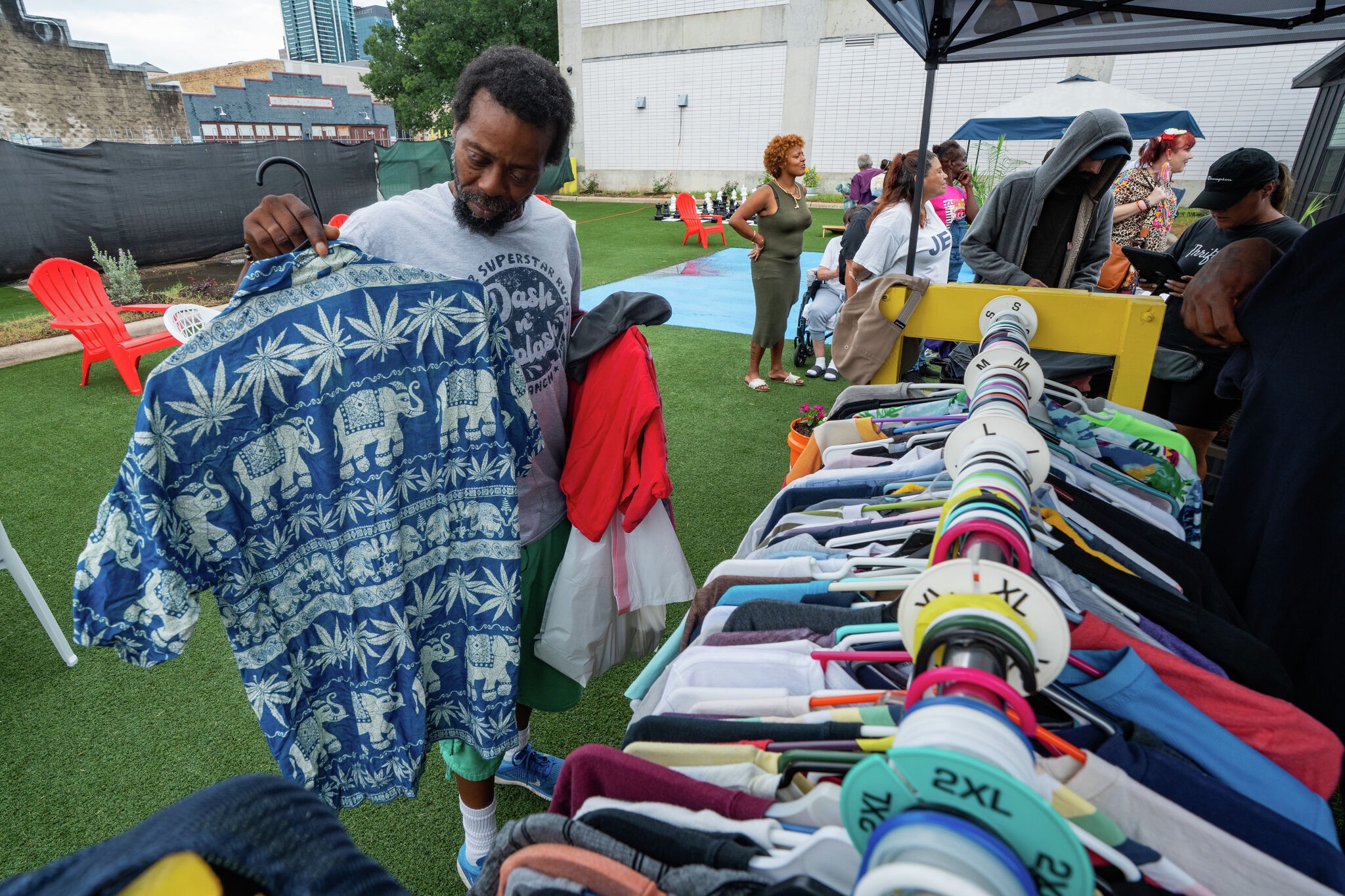
People experiencing homelessness in Austin now have a new place downtown to shower, eat, escape the heat and connect with housing and healthcare services after city officials and nonprofit leaders opened a community resource hub Monday between two of the city's largest shelters.
The SOW Community Resource Hub, located in an alleyway between two of the city's downtown homeless shelters, will operate Monday through Friday from 9 a.m. to 6 p.m. as a centralized location where people can access case management, employment support, meals, bathrooms and showers, as well as other services. Leaders behind the project say they hope to eventually expand operations into evenings and weekends if additional funding becomes available.
"This hub exists because we believe every person deserves to be seen, heard, respected and supported," said Rachid Sow, executive director of the Austin-based SOW Family Foundation, which funded and helped redevelop the site. "We saw a place where people could find food, support, guidance, housing resources, workforce opportunities, wellness services and, most importantly, hope."
The project is a partnership between organizations including the city, the SOW Family Foundation and Endeavors, which operates the Austin Resource Center for the Homeless and the Eighth Street Women's Shelter under contract with the city near where the resource hub will operate. According to Sow, his foundation privately funded the redevelopment of the site and will continue privately funding its operation.
Austin Homeless Strategy Officer David Gray said the resource hub fills a critical gap in the city's homelessness response system by offering a low-barrier entry point for people who may not yet be ready to enter shelter or housing programs.
The hub's reopening comes as Austin continues to grapple with unsheltered homelessness and the dangers heat can pose to people living outdoors. According to a 2025 report from the Ending Community Homelessness Coalition, 20 people experiencing homelessness died of heat-related causes between 2018 and 2023.
Gray said facilities like the hub can provide a place to cool off during dangerous weather while helping connect people to longer-term solutions.
"For a lot of people, this site is the perfect entryway into our homeless response system," Gray told the American-Statesman. "They just need a safe space where they can sit down and get comfortable and exist for a little bit. Then you start building that relationship and rebuilding that trust."
The center revives a site previously known as the Oasis, which was operated by Urban Alchemy as part of the city's shelter services network. The city declined to renew Urban Alchemy's contracts for the Austin Resource Center for the Homeless and the Eighth Street Women's Shelter in 2025 and later entered into an emergency contract with Endeavors to operate the facilities.
Barbara Galindo, 63, who has been staying at the Eighth Street Women's Shelter for about four months, said she is looking forward to having a place nearby where she and other residents can spend time during the day. Unlike other women at the shelter, Galindo said a back injury makes it difficult for her to take the bus to other parts of the city.
"We need a place like this where we can gather and hang out," Galindo said.
The hub also will host service providers offering healthcare, addiction treatment and other support programs.
Eltoniesha Williams, a community impact specialist with Community Medical Services, said she regularly visited the site when it operated as the Oasis, helping connect people to medication-assisted treatment for opioid addiction and providing overdose prevention education.
"Vulnerability breeds vulnerability," Williams said. "Showing up consistently allows you to break down barriers and connect with people."
Austin City Council Member Zo Qadri, whose district includes downtown Austin, called the hub an investment in people and community.
"The challenges facing our city cannot be solved by one organization alone," Qadri said during the ribbon-cutting ceremony. "They require partnerships between nonprofits, community leaders, residents and local government."
For now, the center's operating hours are limited by available funding. Sow said the foundation has submitted budget requests and is exploring ways to expand operations.
"Our goal is to bring all resources into one space," Sow said. "So they don't have to be out there anymore."