

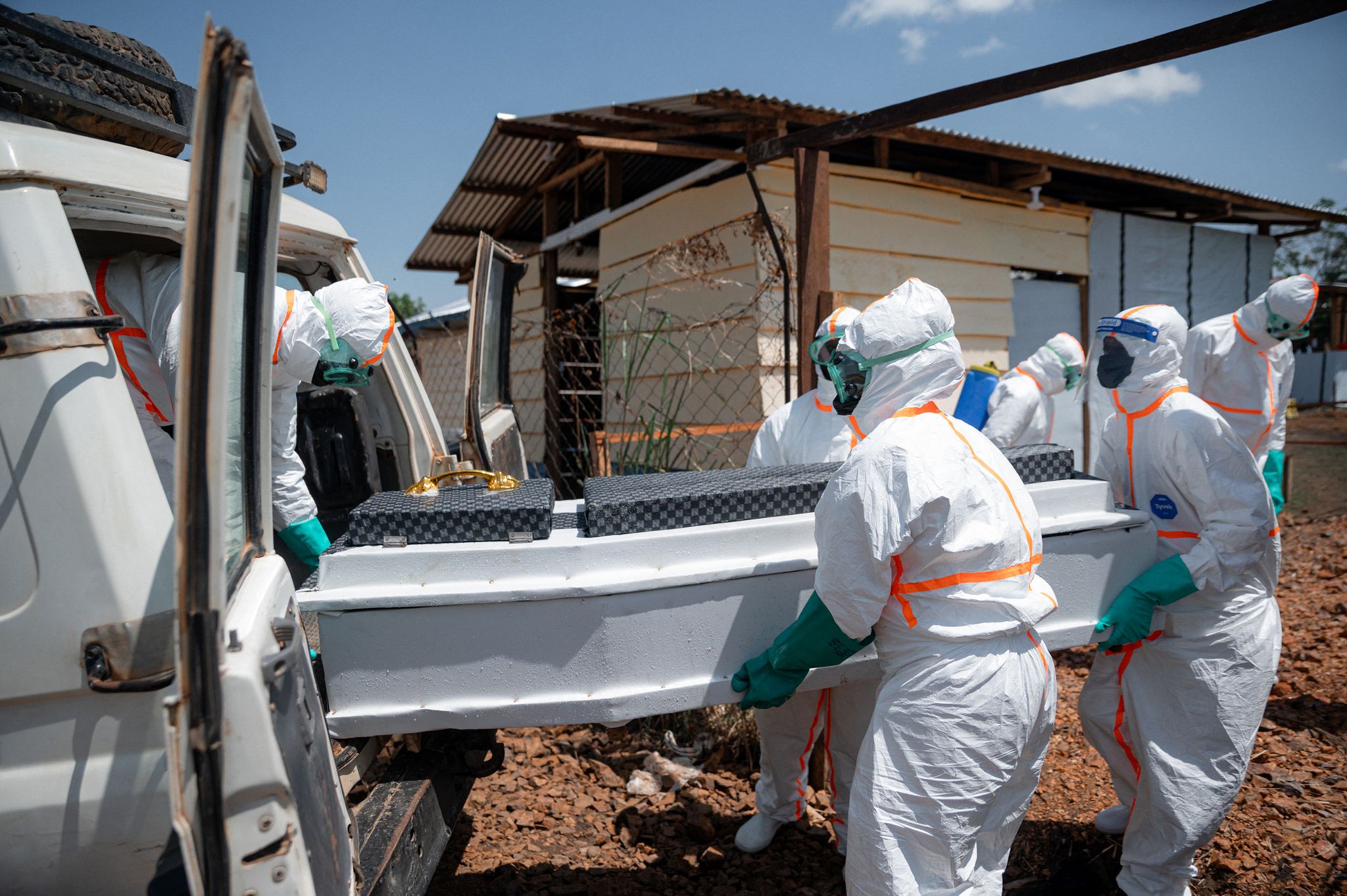
Volunteers of the Democratic Republic of Congo Red Cross, wearing personal protective equipment, load the casket containing the body of an Ebola virus victim at the morgue of the Rwampara health center, into a vehicle for transfer to a cemetery as part of safe and dignified burial operation aimed at preventing the spread of the virus. Jospin Mwisha/AFP/TNS
Twelve years ago, a man from Liberia came to Dallas to visit his family. He developed symptoms of Ebola and infected two of the nurses caring for him before he died. Both nurses survived.
That remains Texas' last brush with Ebola. Now, as the outbreak in the Democratic Republic of Congo has spread to neighboring Uganda, resulting in more than 800 confirmed cases and nearly 200 deaths, could the U.S. be at risk for another case? How prepared is Austin?
What are Austin health groups doing to prepare?
Austin Public Health and local hospitals and emergency services agencies have been having "table talks," said Dr. Desmar Walkes, Austin-Travis County's public health authority. These calls have included sharing updates from the CDC and addressing how different groups are preparing in case Austin gets a case.
"The current risk for this is low," Walkes said.
St. David's HealthCare said its hospitals have been conducting simulation training to ensure the hospitals are prepared.
Baylor Scott & White Health said its teams prepare throughout the year for many scenarios by hosting drills, practicing with emergency communication systems and other steps.
Ascension Texas did not respond to questions.
The U.S. has limited which airports people can fly into from the infected areas, and those airports conduct health screenings for Ebola. Currently, those airports are Washington Dulles in Washington, D.C.; Hartsfield-Jackson AtlantaInternational; George Bush Intercontinental in Houston; and John F. Kennedy International in New York.
Marie Roseline Darnycka Belizaire, a World Health Organization epidemiologist,said that airport screening is a good first step. She also recommended hospitals and doctors offices train on how to recognize Ebola and how to treat it safely while not spreading it.
"The U.S. has capacity to identify hospitals where we can have highly infectious diseases," she said. A refresher on how to recognize the disease, which can be similar to malaria at first, and a reminder on how to put on and take off personal protection equipment also should be done, she said.
The biggest prevention step the U.S. can take right now is to provide more funding to help contain the outbreak to where it is, Belizaire said.
What are the symptoms of Ebola viruses?
Symptoms can take two to 21 days to appear after contact, though typically happen around day eight to 10.
Initial symptoms:
- Fever
- Aches
- Pains
- Fatigue
Later symptoms:
- Diarrhea
- Vomiting
- Unexplained bleeding
What's happening in Africa?
"This is a very rapidly evolving outbreak," Belizaire, who is on the ground in the Democratic Republic of Congo, saidlast week. In previous outbreaks, a typical day would have 25 new cases. In this outbreak, WHO is seeing 90 to 120 suspected cases a day, she said. People immediately get two tests for the disease, an initial test and then a follow-up test two to three days later. Only about 64.5% of the contact tracing needed to isolate people and do testing has been done, she said.
The cases are spread in three areas of the DRC, she said, and one area of Uganda, but the area of the DRC with 94% of the cases is also an area where ongoing conflict has occurred and where official and unofficial displaced persons camps are, she said. Those factors make the disease hard to contain and hard for health providers to work safely or transport necessary supplies for containment.
This area is also where refugees often are crossing on foot to other countries, making an outbreak difficult to contain.
As of last weekend, the World Health Organization is reporting 782 confirmed cases and 178 deaths in the DRC, and 19 cases and two deaths in Uganda.
How is this Ebola different than previous Ebolas?
This Ebola is the Bundibugyo strain, which is not the common Ebola strain of past outbreaks. This strain does not have a vaccine, yet, though worldwide efforts are underway to create one based on previous vaccine technologies.
"There is a rapid escalation (of cases)," said Richard Hatchett, CEO of the Coalition for Epidemic Preparedness Innovations. In the 2018 outbreak, it took 22 months to contain the outbreak and that was with a vaccine, Hatchett said. The 2018 outbreak was the Zaire strain, which has a vaccine.
The mistakes of other Ebola outbreaks, including 2014, was the world's inability to contain it. In that outbreak, Hatchett said, "the world collectively did not scale its response until things had spun completely out of control," he said. "The most important thing for America to do is scale its response on the ground. It hasn't yet spun completely out of control."
The Bundibugyo strain does not appear to be as deadly as the more common Zaire strain, which was up to 90%. Past Bundibugyo outbreaks have had a death rate of about 30%, according to the Centers for Disease Control and Prevention.
Is Ebola Austin's greatest health threat right now?
While Ebola is troublesome because of the death rates, Walkes said she was more concerned locally about dehydration, heat exhaustion, mosquito-borne illnesses such as West Nile virus, and the influx of people coming to Texas for the World Cup who might have heat-related illnesses or food-borne illnesses.
June 16, 2026