

politics
US Senate primaries in Texas may decide more than March winners
Cornyn faces Paxton and Hunt as Crockett and Talarico duel in Texas’ March 3 U.S. Senate primaries, a generational test for both parties.
Published December 28, 2025 at 11:00am by John C. Moritz
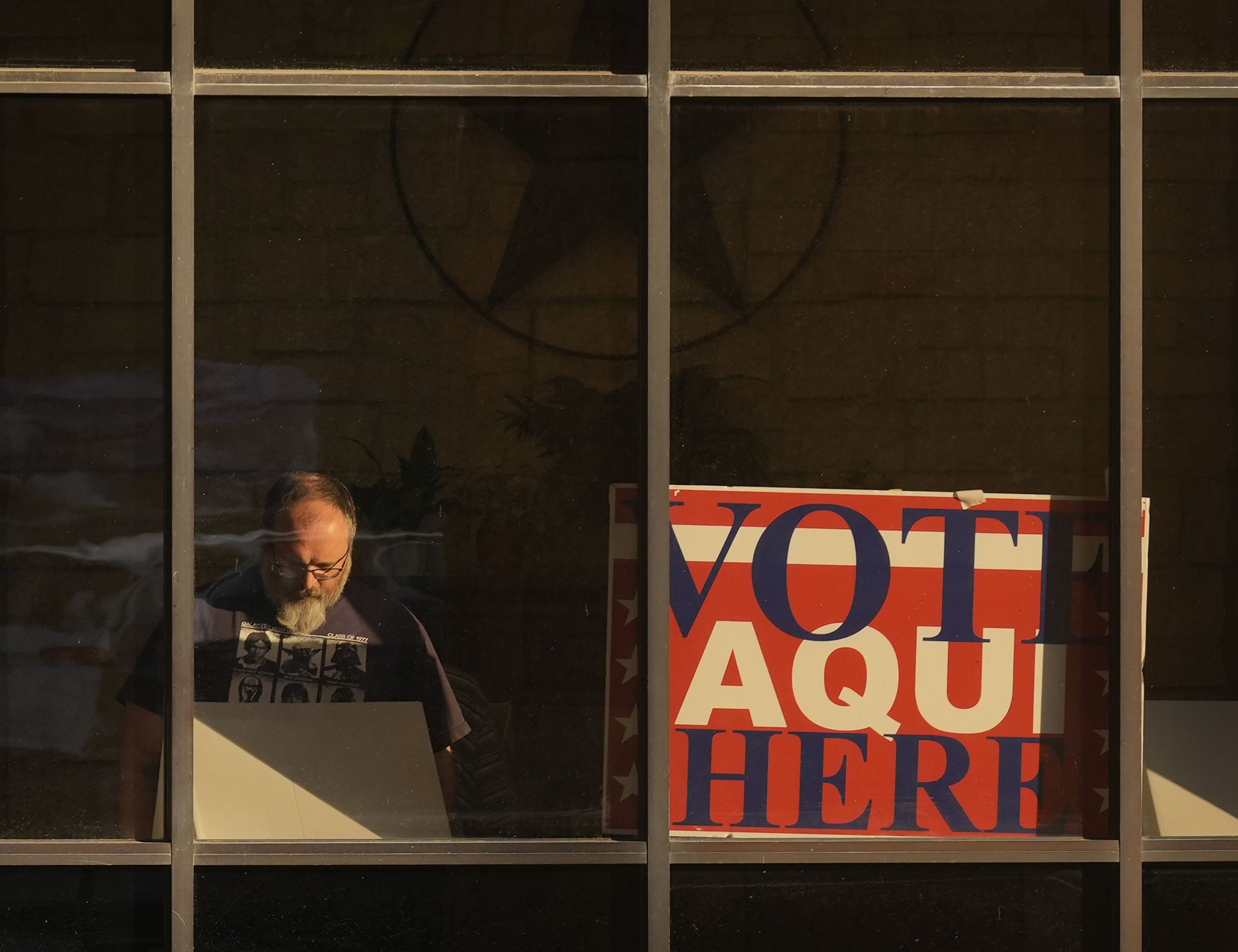
A voter casts a ballot at a polling location at Randalls on Brodie Lane in Austin on Oct. 27, 2025.
When the calendar rolls to 2026, the political drama that has been on high a simmer in Texas for several months will spring into a rolling boil.
And by the time the votes are tallied in the primaries — and perhaps the runoffs — one or both parties could see a generational transformation that sets the stage for one of the state's most tumultuous Novembers. Given the foreshadowing from the handful of states and cities that held off-year elections late in 2025, it's tempting to launch into bold predictions about what might be in store for Texas during the coming midterms, but let's keep that pot of stew on the back burner for now.
The top prize for both Democrats and Republicans in the March 3 primaries is the race for U.S. Senate. And on each side are studies of contrasting styles and divergent personalities.
We'll start with Republicans, where four-term incumbent John Cornyn is desperately fighting to keep alive his party's longest winning streak in Texas statewide elections. At 73, Cornyn is the last of the Bush Republicans in Texas. He won his first election to the Texas Supreme Court in 1990, the year of then-President George H.W. Bush's only midterm election in the White House.
But Cornyn's rise to prominence was lifted eight years later in large part by the long coattails of George W. Bush. That year, Cornyn was the GOP nominee for Texas attorney general while Bush was running for reelection as governor. “Running” is an understatement. Cruising — even soaring — would be more accurate.
Bush raked in 68.26% of the vote. Cornyn, who made sure there was never a dime's worth of daylight between him and Bush on the issues, ran 14 points behind the governor. But that was still enough to carry him past his Democratic opponent. Four years later, with Bush in the White House and still wildly popular in Texas, Cornyn made clear his continuing allegiance and comfortably won election to his first term in the U.S. Senate.
Now, the Bush Republican brand of "compassionate conservativism" and bipartisan consensus-building has given way to the take-no-prisoners style of President Donald Trump. And both of Cornyn's primary opponents — Attorney General Ken Paxton and U.S. Rep. Wesley Hunt of Houston — have embraced the new order just as tightly as a then-rising Cornyn clasped on to Bush a generation before.
Cornyn sought to keep Trump at arm's length at the start of both the 2016 and 2024 presidential campaigns. Now, the senator touts his 99% pro-Trump voting record as a way to court Republican primary voters who have moved on from the Bush era. The question heading into the homestretch of the 2026 primary is whether they've also moved on from Cornyn.
While Texas Democrats will choose between two liberal-leaning millennials in their Senate primary, the race is a contrast of gender, race and style. U.S. Rep. Jasmine Crockett, 44, of Dallas, would be the first female Democratic U.S. senator from Texas. Two Black Democrats — Ron Kirk, Cornyn's 2002 opponent, and Colin Allred in 2024 — made it as far as the general election. But, if elected, Crockett would become Texas' first Black U.S. senator.
At 36, state Rep. James Talarico of Austin would be the youngest senator to represent Texas since John Tower, then 35, won a special election in 1961 to replace Lyndon Johnson, who gave up his seat to become vice president. Talarico, who is white, has targeted what he sees as complacent national Democrats who've grown comfortable with losing, even as he assails Republicans whom he says will stop at nothing to win.
But he seldom misses an opportunity to point out that he's reached across the partisan divide to enact legislation capping insulin copayments and allowing home-schooled students to take part in interscholastic activities. It's a subtle contrast to Crockett's hard-charging style, which has sometimes devolved into partisan name-calling aimed at Republicans such as Trump, Vice President J.D. Vance and conservative U.S. Rep. Marjorie Taylor Green of Georgia.
For voters in both parties, the Senate race could also become a contest between their hearts and their heads. Among the 2025 backstories that could carry into the new year is a familiar concern: motivating the bases that dominate the primaries may be at odds with winning in November.
Cornyn, even when Paxton was an unannounced Senate candidate, has not been shy about highlighting the attorney general's legal challenges, including an impeachment by the Texas House, a securities fraud indictment that led to a settlement requiring him to pay nearly $300,000 in restitution, and a divorce petition in which his wife of 34 years alleged infidelity.
The indictment, and even the whispers of marital discord, haven't proved much of a problem among Republican primary voters in past attorney general races or when Paxton faced underfunded Democratic opponents. But all that could change in a high-profile U.S. Senate race that has already attracted the national spotlight, or so the thinking goes.
Crockett jumped into the Senate race in early December with polling showing her as the new Democratic frontrunner. But that polling also showed that 49% of general election voters would reject her in favor of any Republican in November.
In an ordinary election, that number might not alarm Democrats. Since 1998, well over 50% of Texas voters have rejected just about every Democrat who's run statewide. But early signs suggest 2026 could be a rough midterm for Republicans as Trump's approval ratings remain underwater and voters are increasingly nervous about the economy.
So primary voters in both parties may be asking themselves not who they want to win in March, but who will help them win in November.