

politics
Austin protesters denounce U.S. strike, Maduro capture
Hundreds rallied at Austin City Hall to oppose a U.S. strike in Venezuela and the capture of Nicolás Maduro, highlighting divisions among Venezuelans.
Published January 4, 2026 at 9:08pm by Dante Motley
Anastasia Trevino protests US intervention in Venezuela at City Hall in Austin on Jan. 04, 2026. (Kaylee Greenlee/Contributor)
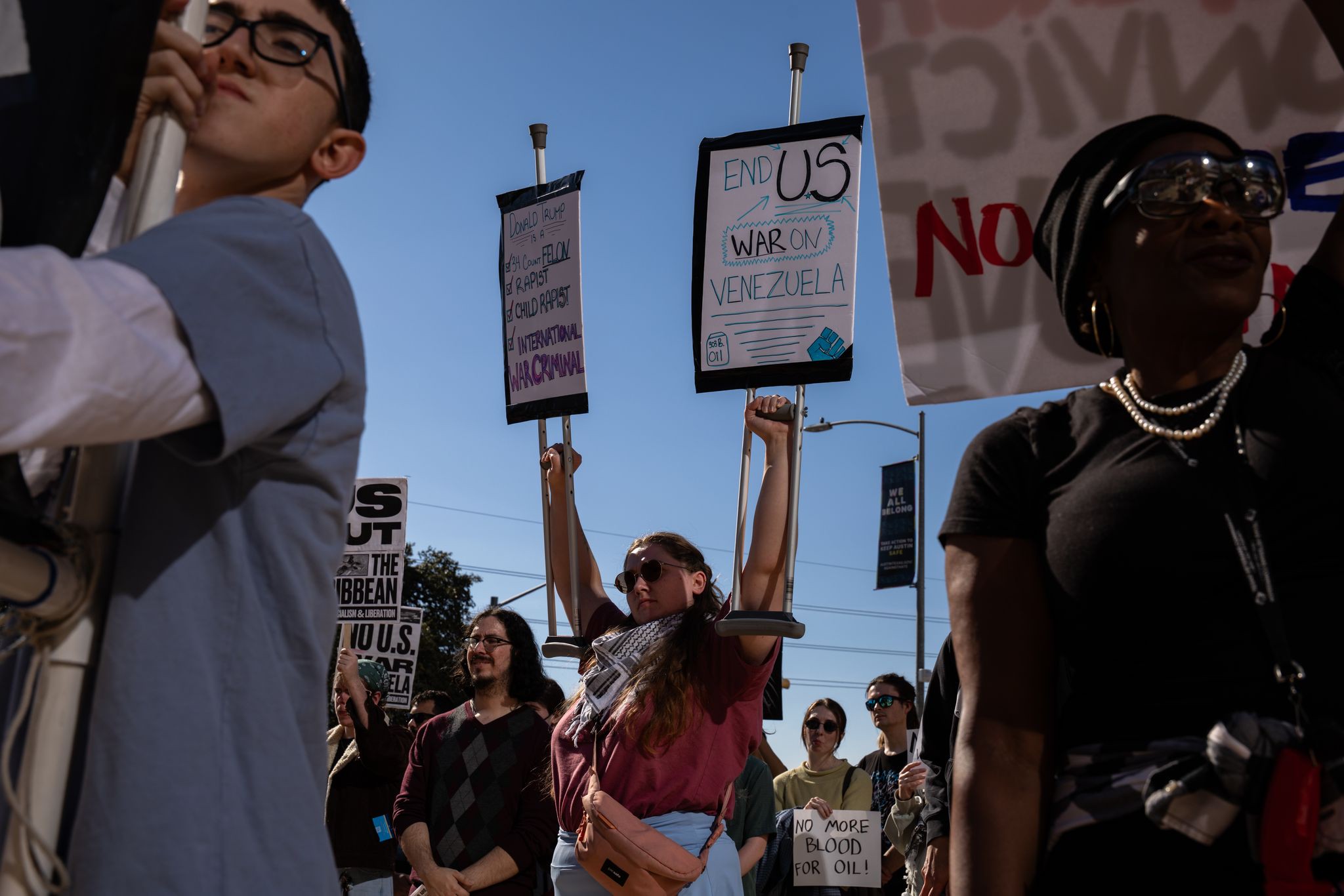
After the United States carried out what President Donald Trump called a "large scale strike against Venezuela" in order to capture Venezuelan President Nicolás Maduro, hundreds of people gathered in front of Austin City Hall on Sunday to protest the military action, which they called illegal.
Around 200 people gathered around noon in a quickly organized condemnation of the strike, which took place in the early hours of Saturday morning and resulted in the arrest of Maduro on narcoterrorism charges. Holding signs with phrases like "No war in Venesuela" and "Are my eggs cheaper yet?" the attendants and speakers expressed fears of escalation, disavowed the use of violence in pursuit of oil and asked government officials to focus on domestic issue rather than Venezuela.
"Donald Trump, you're a liar," the crowd chanted. "No more wars for empire."
Tara holds a sign during a protest of US intervention in Venezuela at City Hall in Austin on Jan. 04, 2026. (Kaylee Greenlee/Contributor)
In recent months, U.S.–Venezuela tensions have intensified amid stepped-up naval military operations in the Caribbean, where U.S. officials have accused Venezuelan networks of playing a growing role in cocaine trafficking by sea. The escalation is part of a wider U.S. drug-war messaging strategy, with increased naval patrols, seizures of so-called narco-boats and sharper rhetoric linking Venezuela’s government to transnational smuggling routes.
E. B. Parry protests US intervention in Venezuela at City Hall in Austin on Jan. 04, 2026. (Kaylee Greenlee/Contributor)
Scarlet Lopez, a press liaison for the Austin chapter of the Party for Socialism and Liberation, said organizers viewed the strike as a violation of international law and a “resource grab” dressed up as a drug case. She and multiple speakers pointed to economic issues in the U.S. that they believe should take priority over military intervention in Latin America.
Lopez argued the Trump administration’s stated rationale echoed past U.S. justifications for military interventions abroad. She said the U.S. lacks the standing to seize the president of another country, arguing that Americans have repeatedly been misled into past wars through what she described as a deliberate effort to manufacture public support.
“We’re here to show Austin, show Texas, to show the world and to show the people from Venezuela that we wholeheartedly oppose this — these illegal attacks,” Lopez said. “This illegal kidnapping of a president of a sovereign nation is only an oil grab, a power grab, a resource grab, and we will not fight this war for them.”
Jim (from left), Tara, Emily and Linda protest US intervention in Venezuela at City Hall in Austin on Jan. 04, 2026. (Kaylee Greenlee/Contributor)
One of the speakers at the rally was interrupted by a woman waving a Venezuela flag while yelling "We deserve freedom."
Elizabeth Gunz, a counter-protestor who identified herself as being with the Austin Venezuela Association, said she showed up because she felt the anti-war rally was being conflated with Venezuelan-led gatherings and did not reflect Venezuelans’ views.
“This protest today here at City Hall has nothing to do with Venezuela,” Gunz said, adding that she was “happy” about Maduro’s removal and believed Venezuelans had been “fighting for this” for decades.
Dozens gather in protest of US intervention in Venezuela at City Hall in Austin on Jan. 04, 2026. (Kaylee Greenlee/Contributor)
Sunday’s rally came amid sharply divided reactions among Venezuelans in Texas and across the country after Maduro’s capture. Maduro has led Venezuela since 2013, presiding over a government widely criticized for authoritarian rule, electoral irregularities, human rights abuses, deep economic collapse and mass emigration. His 2025 re-election was dismissed by many foreign governments as illegitimate amid ongoing political turmoil and competing claims to leadership.