

politics
Marcos Vélez Runs for Texas Lt. Governor with Blue-Collar Focus
Union organizer Marcos Vélez, a first-time Democratic candidate, enters the Texas lieutenant governor race arguing both parties have failed working-class voters, as he challenges Republicans and critiques his own party's leadership.
Published January 25, 2026 at 11:05am by John C. Moritz
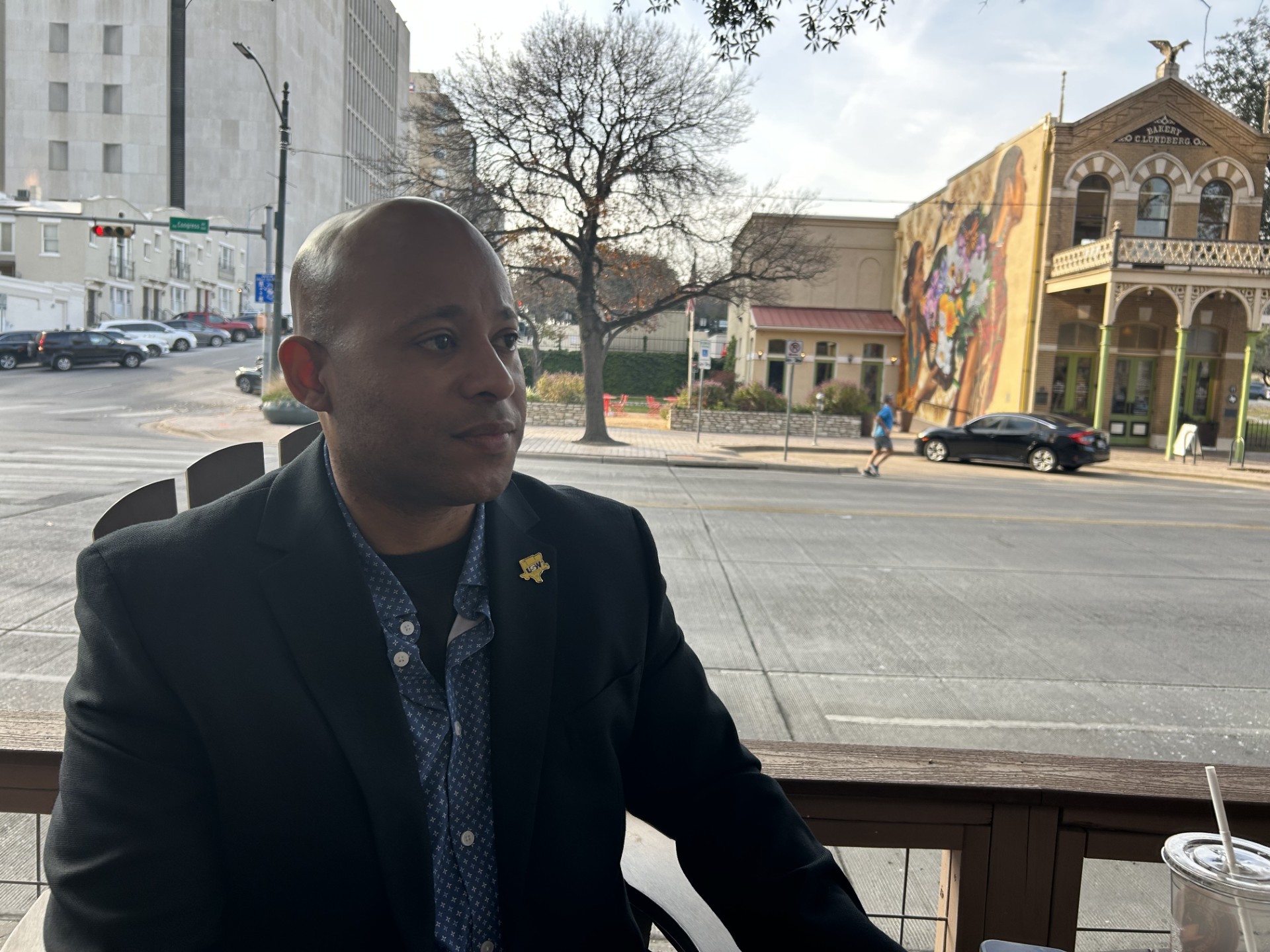
Union organizer Marcos Vélez is running for the 2026 Democratic nomination for lieutenant governor.
Someone watching the first 15 seconds of Marcos Vélez's 2-minute video announcing his plans to run for statewide office could be forgiven for assuming the first-time candidate is a Republican. The footage is heavy on industrial Texas — hard hats, work sites and sweat equity — and the narration centers on the bonds of a multigenerational blue-collar family.
Vélez also fits the bill for the sort of candidates Texas Republicans like to showcase. He is biracial — Puerto Rican and Black. His formal education ended with a high school diploma. He volunteers in his community, plays ball with his kids in the backyard, and he likes to hunt.
But the back end of his video, and the text on his campaign website, flip that assumption on its head. Vélez is a Texas Democrat running an uphill race for lieutenant governor, launching his first political campaign at age 40. And from the outset, he is aiming his message not only at Republicans, but at his own party.
Vélez’s campaign is built around two arguments. One is aimed at working-class voters like him, arguing that Republicans have failed to deliver on promises to tame inflation and jump-start the economy. The other takes direct aim at national Democratic leaders, whom Vélez argues have drifted away from blue-collar voters and ceded that ground to Donald Trump.
The one-time refinery worker, who showed up each day in a hard hat, said national Democrats have gone out of their way to alienate people who punch time clocks and take their showers after work.
"When I started working in the refinery, this was mid-2000s, most of your guys in their 50s and 60s were Democrats. They were blue-collar, Reagan-esque Democrats," Vélez said in an interview last week. "They voted for Obama, even though the bulk of them were white conservative men. And then you saw them drift to Trump in 2016. And now, they are entrenched with Donald Trump. You can't peel them away."
Vélez is running against state Rep. Vikki Goodwin, a four-term Texas House member from Austin, in the March 3 Democratic primary for the right to challenge three-term incumbent Republican Dan Patrick in November. Even though the Texas lieutenant governor presides over the Texas Senate, the race for this high office has been largely overshadowed by the Republican and Democratic primaries for the U.S. Senate, and by the governor's race, in which Democratic state Rep. Gina Hinojosa of Austin is the front-runner to challenge Republican incumbent Greg Abbott.
Vélez bid comes as Texas Democrats are openly grappling with how — or whether — they can win back blue-collar and rural voters who once formed the backbone of the party. In Texas, Democrats remained competitive down ballot in what are now ruby-red counties and constituencies through the Reagan era, and even into the early years of the 21st century.
A long-running rap on Texas Democrats is that they did little to stem the migration of white working-class and rural voters, especially men, to the Republicans. Harsher critics have contended that the party actively alienated those voters by focusing too tightly on identity politics and by fighting unwinnable cultural battles.
That reckoning has sharpened since the November 2024 elections, when Republicans, led by Trump, solidified their gains among working-class voters — including in parts of South Texas that had been Democratic strongholds for generations.
Perhaps the face of the effort to reverse that trend is popular Tejano singer Bobby Pulido, who has suspended his music career as he tries to win back a once-Democratic congressional district in the Rio Grande Valley.
"I'm really frustrated as a rural Democrat," Pulido said last week on a podcast with Democratic U.S. Senate hopeful James Talarico. "I talked to a lot of rural people, and I'm just trying to figure out what are we doing as a party that we're not getting our message across."
Pulido, who lives in the border city of Weslaco, and Talarico, an Austin suburbanite, said Democratic messaging on energy policy has driven a stake through the heart of South Texas where thousands of jobs are dependent on the oil and gas industry.
"When people say 'Green New Deal' or 'we want to ban fracking,' that tells (rural voters), 'I'm going to take away your job,'" Pulido said. "And it really freaks people out."
Talarico agreed. "These are some of the best jobs you can get and they are keeping whole families afloat," he said. "The idea that politicians in Washington think they can just eliminate this industry, eliminate these jobs, it's something we're going have to fight against. We're going to fight against our own party."
U.S. Rep. Jasmine Crockett, who is Talarico's rival for the Senate nomination, represents urban Dallas. But she is also touting her ties to rural Texas. After law school, Crockett told the Houston Chronicle editorial board last week, she took a job as a public defender in deep East Texas.
"Bowie County, Texarkana, is where I started practicing law, and so I actually lived in rural Texas," Crockett said. "I know what it is to wake up and smell the sulfur from (the) International Paper plant. I know what it is when there's a threat to shut down the Cooper tire (factory in Texarkana)."
Vélez, who works as an organizer and labor contract negotiator for the United Steelworkers union, said he is heartened that Democratic candidates are finally looking to reconnect with blue-collar and rural voters. The question remains whether those voters will find a connection with those candidates.
"I think the issue with the Democratic Party isn't its core beliefs — it's the leadership that we have," Vélez said. "If we don't do something radically different, the Democratic Party is going to continue to lose voters."