

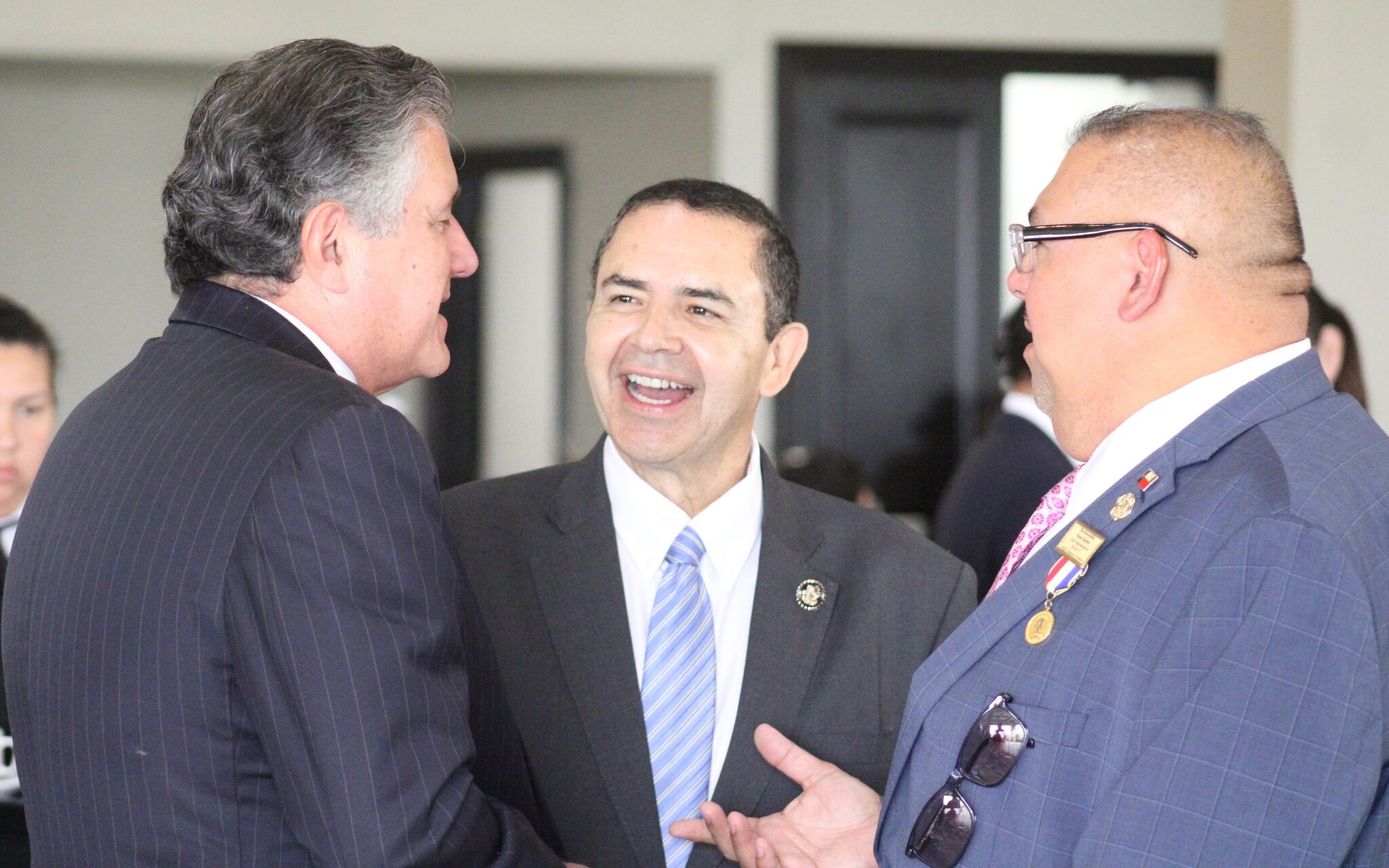
U.S. Rep. Henry Cuellar (center) mingles with Texas Rep. Richard Raymond and another person at the 74th Annual Mr. South Texas Luncheon, on Feb. 21, 2026, at Laredo Country Club.
David Gomez Jr./Laredo Morning Times
With the possible exception of U.S. Senate nominee James Talarico, the most relieved Democrats after Tuesday's primary might be U.S. Reps. Henry Cuellar and Vicente Gonzalez of South Texas.
Their relief has less to do with the fact that each easily secured renomination against lesser-known challengers. What matters more is the raw vote totals: in both districts, Democratic turnout matched or exceeded the total number of Republican votes cast in the GOP primaries.
That’s significant because both districts were redrawn last year by the Republican-controlled state Legislature at the urging of President Donald Trump, who wanted as many as five additional winnable Texas seats for the GOP in November’s midterm elections.
Consider Cuellar's 28th Congressional District, anchored by his home base in Laredo but stretching into rural Southwest Texas where Republicans showed surprising strength in the 2024 presidential election. That display of newfound muscle convinced Republican map drawers that they might finally be able to unseat Cuellar, even though he's been racking up votes in the region since the 1990s, when he was first elected to the Texas House.
Tuesday's results told a different story.
Cuellar drew just over 39,000 votes, about 58% total in a three-way race. In all, 67,401 votes were cast in the district's Democratic primary, according to the Texas Secretary of State's Office. On the Republican side, Webb County Judge Tano Tijerina captured nearly 75% of the vote against a single rival. But his raw total was just 12,487 votes out of 16,792 ballots cast.
Put simply, Democrats outvoted Republicans by more than a 4-to-1 margin in a district designed to give the GOP the edge.
A similar pattern emerged farther south the Rio Grande in Brownsville, the anchor city of the 34th Congressional District.
Gonzalez received 35,249 votes against his only challenger, good for 63% of the 56,198 ballots cast in the Democratic primary.
That’s notable because Gonzalez has had some close calls. In November 2024 he won reelection with just 51% of the vote, suggesting he might be vulnerable if Republicans tweaked the district’s boundaries during the 2025 redistricting.
U.S. Rep. Vicente Gonzalez (third from right wearing cap) of Texas mingles with Democrats at El Dorado Restaurant in Weslaco in South Texas. To his right is U.S. Rep. Adriano Espaillat of New York.
Gromer Jeffers Jr./TNS
The GOP certainly treated the race that way: eight Republicans entered the newly drawn District 34 primary.
Combined, those eight Republican candidates received 36,520 votes — slightly more than Gonzalez himself, but nearly 20,000 fewer than the total number of Democratic votes cast in the district.
None of this guarantees that Cuellar or Gonzalez will win in November. But it also doesn’t point to the kind of Republican landslide that some political strategists and GOP leaders predicted after South Texas shifted toward Trump in 2024.
South Texas has become one of the most closely watched battlegrounds in modern Texas politics.
Most of the state's large cities have been firmly Democratic since the turn of the century, while Republicans have long dominated rural Texas. But Trump's gains in heavily Hispanic counties along the Rio Grande in 2024 suggested the GOP might finally be building an insurmountable coalition across the state.
If that were the case — if Republicans could add South Texas to their existing strength in places like the Piney Woods, the Panhandle and the High Plains — Democrats could face decades more in the political wilderness.
Tuesday’s primary results don’t settle that debate.
Turnout in primaries is always far lower than in general elections — even in a cycle with unusually high participation. The electorate that shows up in November can look very different from the one that votes in March.
It’s entirely possible the Democratic turnout advantage seen Tuesday will disappear in the fall. It’s also possible that the GOP’s recent South Texas gains prove less durable than they first appeared.
Still, if Democrats are searching for signs of life in Texas politics, the primary numbers offer at least a hint of one.
And that’s the same glimmer of hope Talarico will be counting on this fall as he tries to end his party’s long statewide losing streak.