

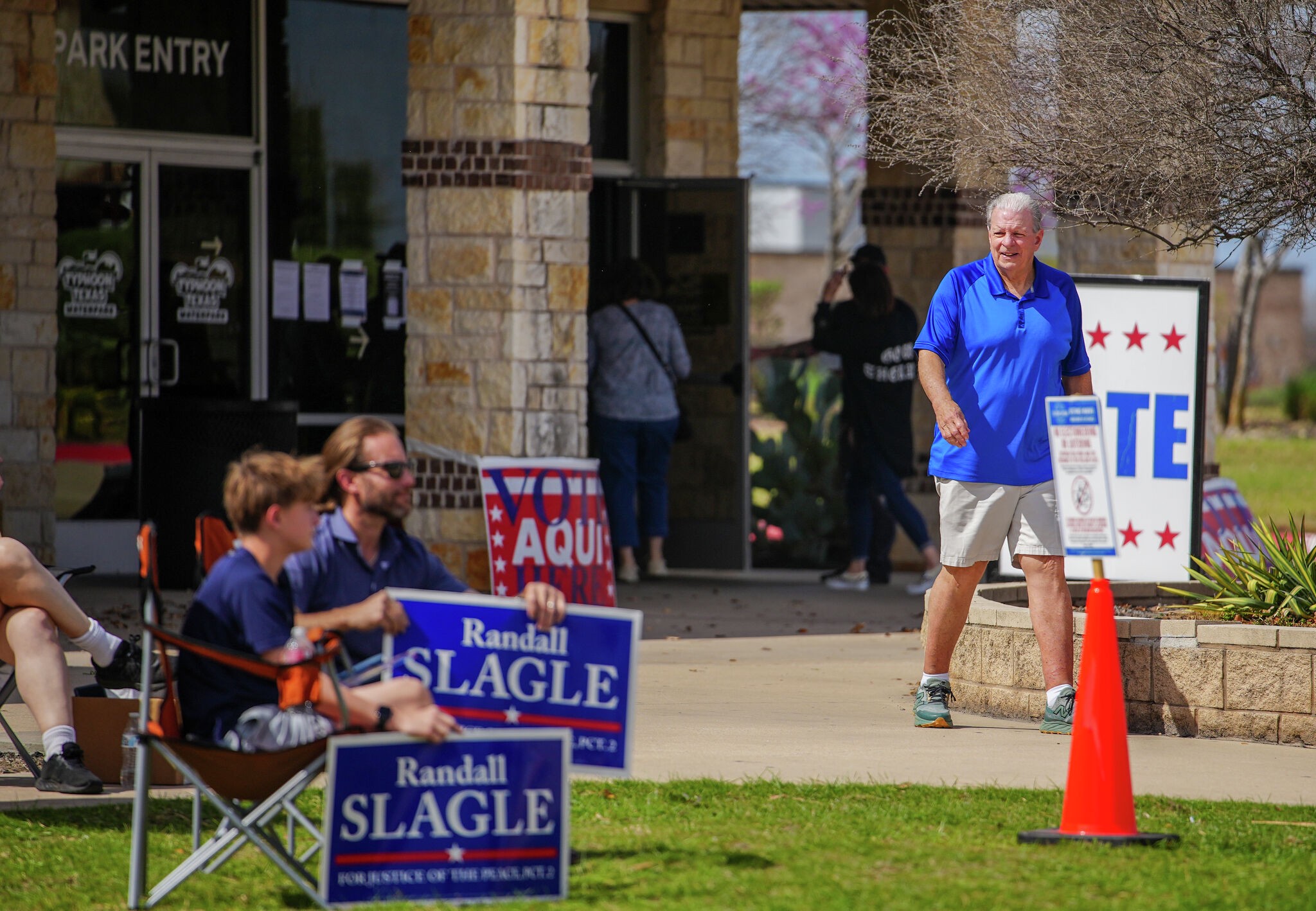
Scott Bredensteiner, a voter in central Texas, leaves an active polling station in Pflugerville, Texas after casting his vote on Tuesday, March 3, 2026, to take part in the democratic process.
Faith Bugenhagen
Old people rule!
That could be the slogan of both political parties in Texas, based on an Austin political researcher's deep dive into the data on which voters powered the record-breaking turnout in the March 3 primaries. But the slogan would be a lot more true, and potentially a lot more worrisome, for one of the two major parties.
The numbers crunched by Derek Ryan, founder of Ryan Data and Research, show that nearly 55% of the ballots cast early and on the same day in the recent Democratic primary came from voters 50 and older. By contrast, voters 30 and under accounted for just 14% of the turnout in a primary that nominated 36-year-old James Talarico, who would become the youngest U.S. senator if he wins in November.
But the age gap is even more yawning on the Republican side, according to Ryan's analysis, which uses data from the Texas Secretary of State's Office, the Texas Legislative Council and other sources. Voters 50 and older made up 78% of GOP primary turnout, and those over 70 accounted for one-third of the total.
That means just 22% of the Republican vote came from people 49 and younger. And if you just look at the under-30 subset, it comprised just 4% of the party's total vote. That would appear to be a shaky foundation for building a Texas Republican Party of the future.
Republican turnout was also anchored by voters who show up for the primary cycle after cycle. More than three of every four GOP voters had never wandered over to the Democratic side during the nominating process. A tiny sliver of the turnout — around 3% —had at least some history of going back and forth from primary to primary, but the large majority of that group has tended to side more often with Republicans than with Democrats.
Ryan's data shows that Democrats this cycle proved better at reaching voters outside of the party base. Only 55.5% of the 2.3 million participants on their side were hard-core, primary-after-primary Democratic voters. One in three had only voted in general elections in past cycles, and 4% had no history of voting in Texas before.
About 5.4% of the Democratic turnout was from the back-and-forth crowd. And among them, the group that had mostly sided with Republicans was just a hair smaller than the one that mostly sided with Democrats.
It's almost been taken as a given that, when it comes to voting, Democrats are the party dominated by women and that men run the show on the Republican side. It turns out, according to Ryan's calculations, that's only half true in the Texas primaries — the Democratic half.
Women outvoted men in the Democratic primary by a 60-40 margin. But among Republicans, the battle of the sexes ended in a near draw, with less than a percentage point separating men and women in turnout. For those keeping score for bragging rights, men led by a few thousand votes.
All of these sundry facts and stats take on an added significance because primary turnout was unusually high. Republicans, who drew more than 2.16 million to the polls, set a record for a midterm election. The Democratic turnout, meanwhile, was not only the highest for a midterm, it surpassed the party's totals for the 2020 and 2024 presidential primaries.
It's important to note that primaries and general elections are different animals. Primaries tend to be dominated by the true believers on either side, and that's why they draw only a fraction of the general election turnout. Case in point: About 2 million Republicans and 1 million Democrats voted in the 2024 primary, but the November turnout was close to 11.4 million.
But primaries can be barometers, and this year's numbers suggest Democrats are a bit more excited and appear to be expanding their base. That's no doubt due to the spirited U.S. Senate primary between Talarico, a state representative from Austin, and U.S. Rep. Jasmine Crockett of Dallas. Republicans also had a lively U.S. Senate race, which will be decided in the May 26 runoff between incumbent John Cornyn and Attorney General Ken Paxton. But their party controls the White House, and that tends to be a disadvantage in midterm elections.
To help offset that disadvantage, it would appear Republicans need a jolt of youthful energy. Their advantage among seniors seems to be rock solid, and seniors tend to vote in higher proportions than their younger counterparts.
Democrats this year, as they seem to do every year, are leaning into the youth vote with a robust social media presence and calls for generational change in politics. But if they hope to break the GOP lock on Texas, they can't afford to ignore the elders.