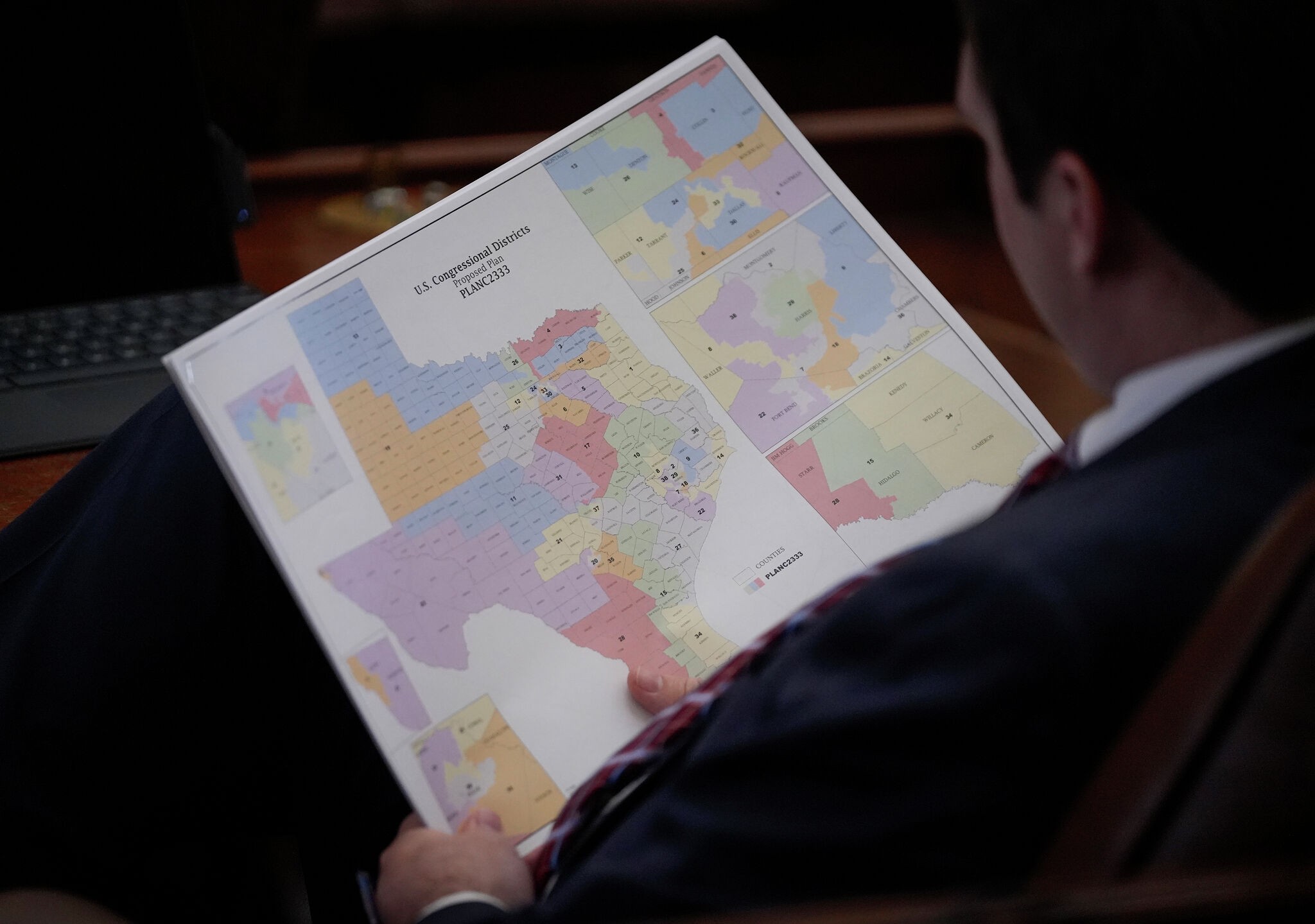
A representative looks at a congressional redistricting map during debate of a congressional redistricting plan in the House Chamber at the Capitol in Austin, Wednesday, Aug. 20, 2025.
Jay Janner/Austin American-Statesman
The Cold War doctrine of “mutually assured destruction” — or MAD — held that nuclear war would never happen because both sides knew it would mean total annihilation. The more weapons each side stockpiled, the less likely they were to be used. That logic, thankfully, has never been put to the test, though the Cuban Missile Crisis of October 1962 came dangerously close. Today, a far less deadly — but increasingly consequential — version of that dynamic may be playing out in American politics: the escalating fight that we've come to call "mid-decade congressional redistricting." It doesn't lend itself to a clever acronym — MDCR doesn't exactly roll off the tongue — so we'll just call it "redistricting" for short.
To catch everyone up, this new game of political one-upmanship started with Texas. But it didn't start in Texas. By most accounts, it was hatched in the White House last year as a strategy that might help President Donald Trump avoid a Democratic takeover of the U.S. House in the 2026 midterms. Trump had just scored a double-digit victory in Texas in the 2024 presidential election and had even carried the reliably Democratic and heavily Hispanic counties along the Rio Grande. All that, in his words, "entitled" him to five more Republican congressional seats in the Lone Star State. But to get them, it meant scrapping the congressional districts enacted by the GOP-led Legislature in 2021 that had provided the party a 25-13 advantage. When the redistricting effort got rolling, Democrats cried foul and stalled action in the state House for a couple of weeks with a quorum break. But in the end, they were powerless to stop Trump, Gov. Greg Abbott and the Republicans writ large. Or so the thinking went.
Sure, the new map contains five more winnable GOP districts. But the national publicity it generated prompted California to redraw its congressional map to give Democrats five more winnable seats. Utah jumped on the bandwagon and came up with one more Democratic district. Then Republican legislatures in states like Louisiana, Missouri and Ohio developed plans to boost their parties' chances in November. And last week, Virginia chimed in. Like California, the state's Democratic leaders asked voters to add four seats their party's column, and voters obliged, albeit narrowly. Florida, run by Republicans, may become the next redistricting battleground. And who knows which state might be next — or whether the whole process might be repeated in the 2028 cycle as Democrats and Republicans escalate their quests for partisan advantage?
The destruction in this iteration of the Cold War analogy is not just the congressional careers of a handful of politicians. The overhaul of maps in all of these states also continues, and perhaps accelerates, the gerrymandering process, whereby election outcomes are all but predetermined because districts are drawn largely along party lines.
But there is a chance that the original proponents of mid-decade redistricting may have outsmarted themselves. Take the Texas example and the five newly Republican-friendly districts. Creating new Republican districts does not create new Republican voters. It simply shifts some Republican voters from existing GOP districts into areas that had been reliably Democratic. And to keep populations roughly equal, as required by law, some Democrats must be drawn into what had been GOP strongholds. Some of the new districts were based on Trump's 2024 showing in Texas — the strongest of his three presidential campaigns. In the first two elections, his margins of victory were much smaller. And since 2024, the president's approval ratings have declined sharply, both nationally and in Texas. According to a February poll by the Texas Politics Project, conducted before the war with Iran and before $4-a-gallon gas, only 45% of Texans said the president was doing a good job. The president's slide in the polls likely helps explain the special election in late January for a state Senate district near Fort Worth that Democrat Taylor Rehmet won by 14 percentage points. Trump had carried the district by 17 points — meaning a fair number of Trump voters from November 2024 became Rehmet voters just 14 months later. Many of the congressional districts under the new map look just as Republican-friendly as the state Senate district, and some even less so.
The more upbeat takeaway than the foreboding "mutually assured destruction" analogy that opened this piece is not that Democrats might flip districts Republicans thought they had locked up. Instead, the winners in many of these races, regardless of party, will have to earn Texans' votes. They are not "entitled" to them.
April 26, 2026
politics
Redistricting Arms Race Escalates Nationwide
Mid-decade congressional redistricting in Texas and nationwide reflects a tit-for-tat strategy that could reshape power dynamics in Washington, with states like California, Utah, and Virginia following Texas's lead in redrawing maps for partisan gain.
Published April 26, 2026 at 10:00am by John C. Moritz