

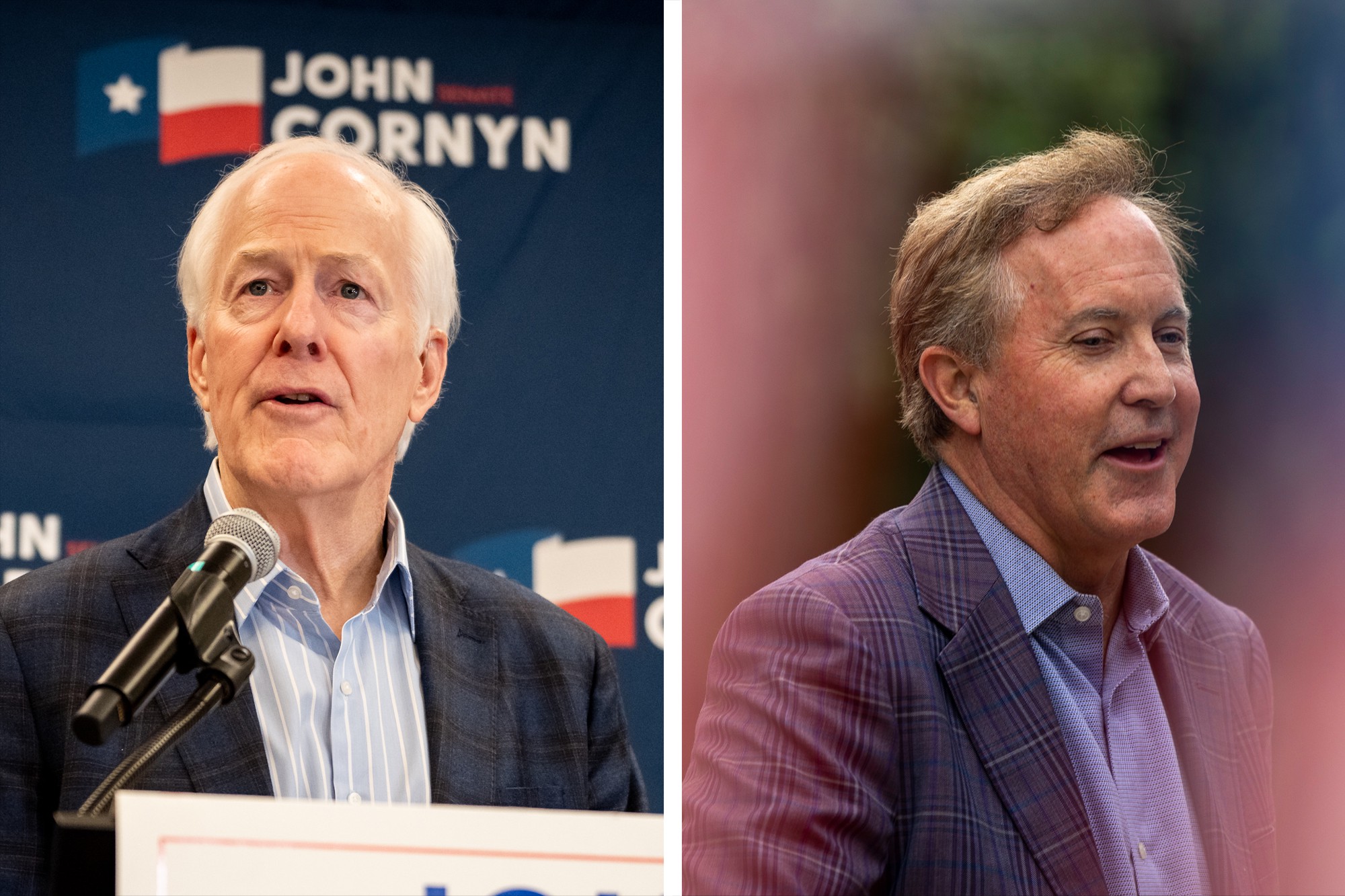
Lt. Gov. Dan Patrick warned last month that the bruising Republican U.S. Senate runoff between incumbent John Cornyn and Texas Attorney General Ken Paxton could fracture the Texas GOP. A month later, the increasingly personal attacks between the two Republicans appear to be proving him right.
Take Cornyn's latest 30-second spot wishing Paxton "a happy Mother's Day." But instead of a heartstrings-tugging message worthy of a Hallmark card, Cornyn repackages his long-running attacks over allegations of Paxton's marital infidelities and pending divorce, while accusing the attorney general of having "the ethics of a strip club owner."
"Texas moms," the voice-over says, "would you want your daughters to marry a man like Ken Paxton?"
Patrick aired his fears before the Texas Public Policy Foundation, an influential conservative think tank, that the Paxton-Cornyn race would cause the worst chasm within the Texas Republican Party since it consolidated power in Austin nearly a quarter-century ago.
The Mother's Day ad is one of a barrage of broadsides fired by the Cornyn camp since Paxton announced his challenge to the four-term incumbent last year. And it came soon after Paxton took aim at Cornyn in an ad by his super PAC targeting the senator's decades-long career as an elected official. The piece takes viewers back to 1984 with images of pop stars from the era, the dawn of the computer generation and Ronald Reagan's presidency.
"That's when John Cornyn was first elected to office, and he's been attacking our values ever since," the announcer says while highlighting examples of the incumbent's efforts toward bipartisanship. "After 42 years, it's time for John Cornyn to go."
Patrick, who since becoming lieutenant governor in 2015 has transformed the Texas Senate into a highly efficient laboratory for conservative policymaking, raised the possibility that the Senate runoff might wound the winning candidate so badly that it would not only set up the Democratic U.S. Senate nominee, state Rep. James Talarico of Austin, to glide to victory in November, but also depress GOP turnout and allow the Texas House to slip from Republican control.
Polling since Patrick's appearance at TPPF on April 8 appears to bear out those fears. A poll last month by the Texas Politics Project showed that Talarico leads both Republicans, albeit by narrow margins. More concerning for Republicans, however, is that while eight in 10 Democrats said they are firmly in the corner of their party's Senate nominee, Republican support for whoever emerges from the runoff is less certain.
Only 62% of Republicans said they'd vote for Paxton over Talarico. And Cornyn fared slightly worse, with just 60% promising to check the box for him.
Heading toward the March 3 primary, it was taken as a given that the race would go to a runoff because a third candidate, U.S. Rep. Wesley Hunt of Houston, presented himself as an alternative to the better-known statewide officeholders. What was not universally foreseen, however, was that Cornyn would finish first in the voting.
That's because even though Paxton was vastly outspent, he has always been seen as closer to the Republican base of conservative voters. Plus, he had never wavered in his loyalty to Donald Trump, from the 2016 presidential campaign to the one in 2024, and that was enough to get his core supporters to the polls.
Trump stayed neutral in the primary, but then signaled that he might endorse someone in the runoff. The speculation was that the president would go with Cornyn because the Senate Republican establishment was solidly in the incumbent's camp and, perhaps more importantly, because he had gotten the most votes in round one.
Trump said he fully expected the non-endorsed candidate to fold his tent. But Paxton made clear he would take his case directly to the voters even if Trump disregarded his years of loyalty. Soon talk of a Trump endorsement faded, and Paxton once again appeared poised to consolidate base conservatives once voting in the runoff starts.
But a poll out last week by the University of Houston suggests anything but a cakewalk for the challenger. Paxton was leading, but by just three percentage points. That suggests that Cornyn's relentless bombardment of negative ads — focusing largely on the challenger's personal life — could be taking its toll. And it helps explain why Paxton's side is now going equally ugly toward Cornyn.
There's still a ways to go before early voting starts May 18 and the actual runoff begins, which likely means the mutual eye-poking and nose-bloodying will continue and intensify. What remains unclear is whether, after months of mutual destruction, Republicans can reunify once the runoff ends.