

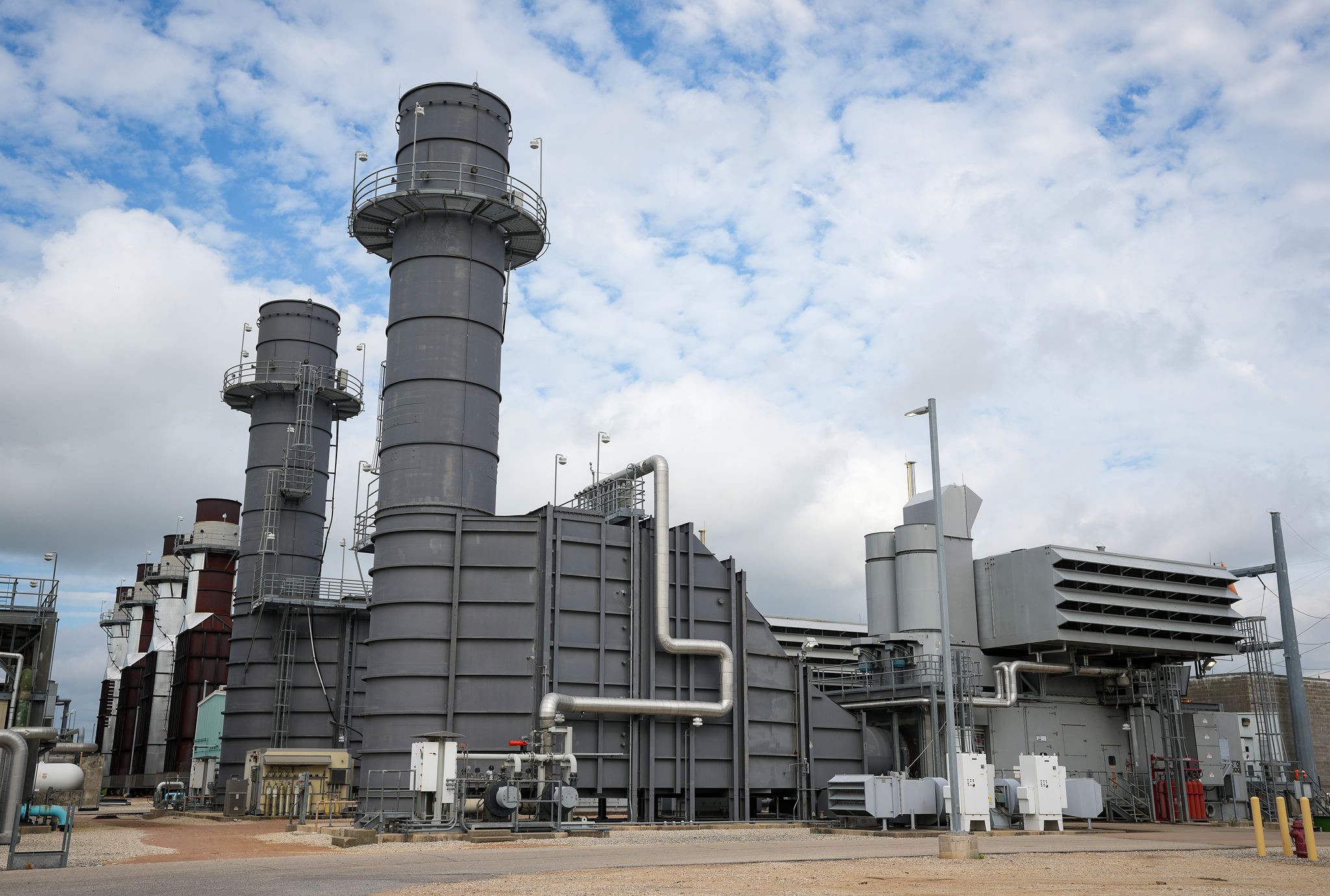
The Austin City Council, acting as the board of Austin Energy, is set to vote Thursday on a controversial proposal to add new natural gas plants that could be turned on when demand for power spikes during extreme weather or other grid emergencies.
The proposal calls for adding 400 megawatts of power from natural gas “peaker” plants.
Austin Energy officials say the deal is necessary to protect residents — and the financially strained city-owned utility — from soaring power costs, while opponents say it flies in the face of Austin’s climate goals and complain that some of the most basic details will not be released publicly before the vote. That is because state law allows public power utilities to discuss certain competitive power matters behind closed doors, including vendor names, pricing and contract amounts.
Kaiba White, a climate and energy policy specialist for the watchdog group Public Citizen who also serves on the Austin Electric Utility Commission, said city leaders are pushing an opaque project through in a rush while failing to consider all the alternatives that could keep the utility’s climate goals intact, like more solar and battery storage.
The new peaker plants, White said, “would lock the city into fossil fuel use for another 40 years, if not longer.”
Austin Energy officials have emphasized that the new gas units would replace aging plants dating back to the 1970s, allowing for cleaner and more efficient power generation during emergency situations.
“I see it as a step forward on reliability that then enables us to take several steps forward on sustainability, as well,” Austin Energy General Manager Stuart Reilly said. The board will also vote Thursday on wind and battery projects to add additional generation capacity.
But perhaps an even bigger reason officials believe the deal is necessary is financial. Austin Energy is already running a deficit, and utility leaders say the new generation is needed to protect it from even more severe strain if another extreme weather event forces the utility to buy expensive power from the wholesale market.
Mayor Kirk Watson and other city leaders have also warned that a financially weakened Austin Energy could become a target for state intervention.
Felix Mormann, a law professor at Texas A&M University, underscored the stakes of Thursday’s choice – for elected officials, the utility and Austin residents.
“I think they're looking to solve a real problem, and a problem that if they don't find a solution to, is going to cause them a lot of heartache,” Mormann said.
‘A crucial tool’
The vote comes as Austin Energy faces rising demand, severe weather risks and mounting financial pressure. Since 2020, the utility has retired 725 megawatts of local generation as part of its transition toward renewable energy, but officials say it has not sufficiently replaced the lost capacity.
That leaves Austin more dependent on electricity imported from elsewhere in Texas during emergencies, Austin Energy officials say. Those purchases can become extremely expensive during periods of high demand, and transmission lines into Austin can become congested, making it harder to bring in power when the city needs it most.
“We wouldn't be bringing this forth if we didn't think this was a crucial tool to protect the community and to protect Austin Energy,” Austin Energy Deputy General Manager Lisa Martin told council at a Tuesday work session.
A recent Austin Energy analysis shows that just one more extreme weather event like 2021’s Winter Storm Uri could put the utility at risk of having to pay the Electric Reliability Council of Texas, the state’s power grid operator, over $1 billion for higher energy costs within a matter of days if the utility doesn’t have locally generated energy.
In the hot summer months, power costs can rise to 100 times their normal levels, with those costs passed directly to customers. A charge that would normally cost a customer about $40 could surge to roughly $5,000 during extreme conditions.
Without the peaker plants, Austin Energy could be vulnerable to outages due to a lack of power for 525 hours on average each year between 2030 and 2035, according to the utility’s projections. With the new plants, the risk is reduced to about 45 hours.
Fears of state intervention
Council Member Marc Duchen and Mayor Kirk Watson hinted at even higher stakes: the potential for state intervention if the utility goes under. That threat looms large for Thursday’s decision as council – acting as the utility’s board of directors – weighs a decision that could very well dictate the future of Austin Energy.
“We should be doing everything we can to be good stewards of the public utilities we’ve got,” Duchen said. “The last thing we want is the genius of the state to restrict our ability to run our own utilities.”
From his years in the Texas Senate, Watson recalls fighting efforts to weaken or privatize the utility and encouraged the City Council to discuss the contract privately rather than risk putting the city at a competitive disadvantage. Typically, proponents of privatizing the utility or changing its board of directors argued that council would make a political decision while governing the utility instead of a decision on behalf of the ratepayers, he said.
“We've been able to stop that over the years,” Watson added. “We should recognize that we're giving certain protections for our ratepayers and we ought to act in that way as we go forward on this. ”
David Spence, a professor emeritus at the University of Texas School of Law, said that a state takeover of Austin Energy is a legitimate threat given the tense relationship between state Republican leaders and Democratic cities.
“Given where the Republican party is in Texas and how they please the members of their base, I think interfering with Austin in all sorts of ways – not just the utility, but immigration, policing, all these other things – is probably a clinical winner for them statewide,” he said.
Debate over climate goals, public access
In addition to concerns about the environmental impacts of the new gas plants, White also blasted the city for what she described as an opaque process devoid of public input.
“Unfortunately, most of the information that we would normally have with any contract spending decision going before the city is being kept out of public view,” White said. “It really hinders the ability for us, other organizations, the public at large to weigh in on this issue.”
Reilly emphasized that in order to get the most competitive deal, the utility could not publicize the negotiations.
Major manufacturers often do not respond to formal requests for proposals because utilities across the country are competing for the same equipment, Reilly said, adding that manufacturers also did not respond to Austin Energy’s RFP for the project.
“If we're telling the world what their current pricing is at this current time, we're going to get their highest pricing because they're not going to want the rest of the market to know if we got a good deal,” Reilly said.
Watson said the state law allowing for public power utilities to meet behind closed doors to discuss and vote on such projects ensures that municipal utilities aren’t disadvantaged when competing with private power utilities, which serve most other major Texas cities.
Mormann, the A&M professor, said a happy medium may be hard to come by.
“Everybody wants reliable electric service, and that usually comes at a price,” he said.
The City Council will take public comments on the proposal ahead of the vote. Speakers must sign up by 9:15 a.m. at City Hall.
The deadline to sign up to address the council virtually was noon on Wednesday.
May 21, 2026