

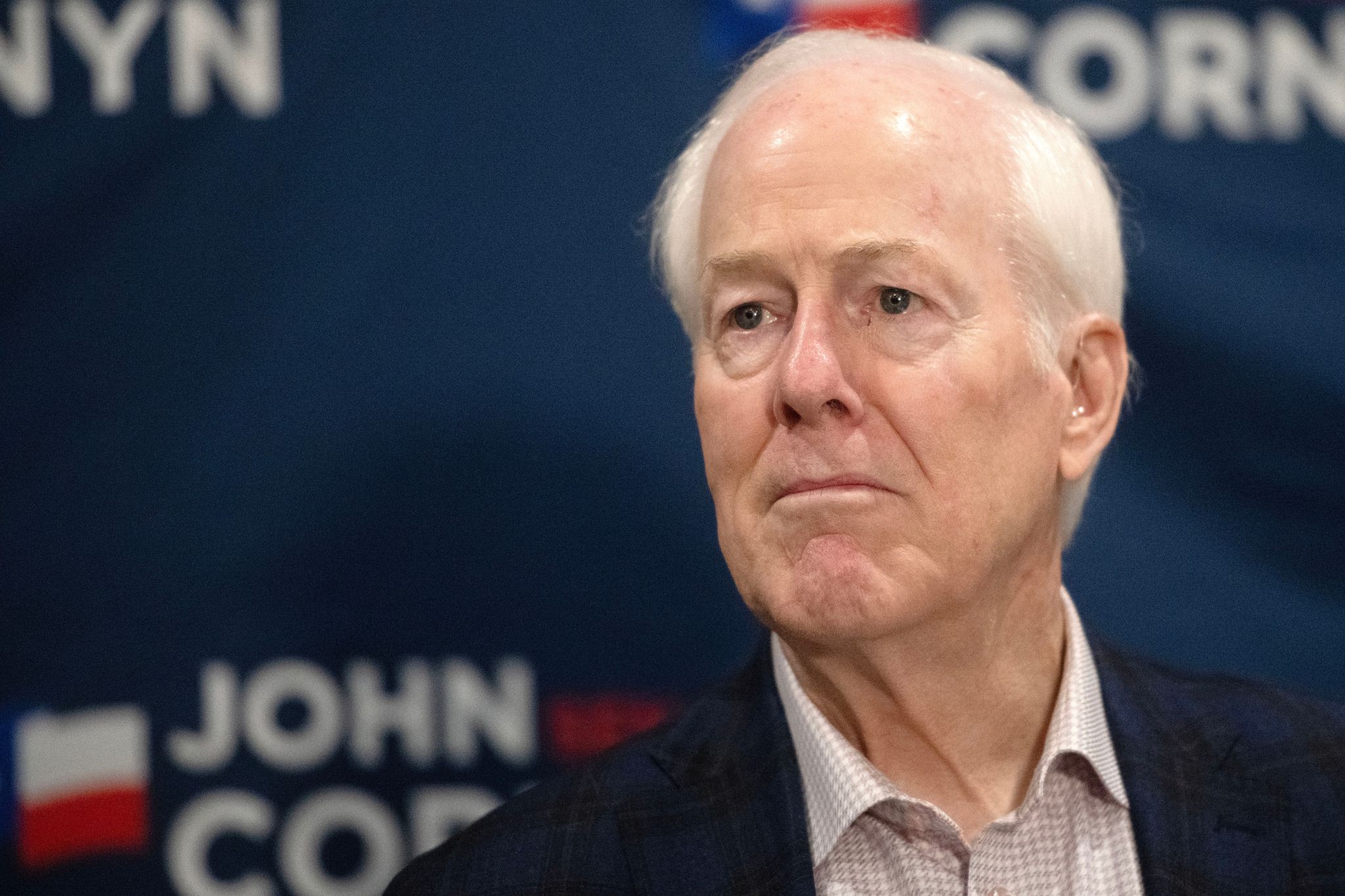
As he approaches perhaps the most anxious election night of his long political career, U.S. Sen. John Cornyn might be hoping for a little magic from the ghost of Harry Truman.
Cornyn, a four-term incumbent who previously served as Texas attorney general and on the state Supreme Court, has trailed narrowly in most polls leading up to Tuesday's Republican Senate primary runoff. But since President Donald Trump's eleventh-hour endorsement of rival Ken Paxton last week, many pundits have all but written off Cornyn's chances of advancing to the general election.
And that's where the Truman comparison comes in.
Students of political history will recall that in the 1948 election, the plainspoken man from Missouri who ascended to the presidency upon the death of Franklin D. Roosevelt three and a half years earlier was seen as heading for certain defeat against Thomas E. Dewey, the Republican governor of New York.
Truman had limped into the fall campaign that year leading a fractured Democratic Party. The progressive wing, believing Truman was an unworthy heir to FDR's New Deal, rallied behind the independent candidacy of former Vice President Henry Wallace, who had been dumped from Roosevelt's ticket in 1944. The segregationists who dominated the Southern Democrats at the time formed what became known as the Dixiecrats and nominated U.S. Sen. Strom Thurmond of South Carolina.
So consistent was the polling that Truman could not win with his party so badly split that pollsters shut down their operations in the campaign's closing weeks. And so confident was at least one big-city newspaper, the Chicago Daily Tribune, that the Republican candidate would romp to victory, it published a front-page, all-caps banner headline reading "DEWEY DEFEATS TRUMAN" for its next-day edition before nearly enough of the votes had been tallied.
That headline — just like the pollsters, pundits and all the rest — was dead wrong. And the iconic photo of the beaming Truman holding aloft perhaps the most famous newspaper blunder in American journalism endures nearly 78 years later as a reminder of the last glimmer of hope for every struggling politician who has ever prayed for an election-night miracle.
None of this should be interpreted as a prediction that Cornyn will replicate Truman's comeback, which occurred just over three years before Texas' senior senator was born. But it might serve to remind the 21st century pundits to resist the urge to report as fact any event that has yet to unfold.
Still, there's no denying that Trump's endorsement carries tremendous clout within the Republican Party. He made his endorsement of Paxton, the current Texas attorney general around lunchtime on Tuesday. Hours later, Republican U.S. Rep. Thomas Massie of Kentucky lost his primary race after Trump backed his opponent. The Saturday before, U.S. Sen. Bill Cassidy of Louisiana went down to defeat at the urging of the president.
Cornyn, who as Trump noted when he announced his support for Paxton, was late to the station when the one-time real estate mogul first entered the race for the 2016 Republican nomination. And then when Trump was mulling his 2024 comeback bid after being ousted by Democrat Joe Biden, Cornyn advised his party to look elsewhere before falling into line once the primaries began.
Still, Cornyn held out hope that he might get Trump's blessing in the runoff even though Paxton has never wavered in his support for the president. Cornyn reminded Texas Republicans that his voting record in the Senate matched the Trump agenda 99.3% of the time. He even went so far as to file a bill that would rename a highway that runs from Port Arthur, Texas, to Teton County, Montana, the "Trump Interstate."
But one day before the Paxton endorsement, Cornyn seemed to acknowledge that no help would be coming from the White House, telling reporters "that ship has finally sailed." His implication appeared to be that it had sailed out to sea, not in Paxton's direction. Cornyn also appeared to acknowledge that the Republican Party's conservative base had slipped out of his reach.
Instead, he reached out to the 75% of all registered voters who did not cast a vote in either the GOP or the Democratic primary.
That cohort, he said, was still eligible to participate in the runoff and he would welcome its support. Also true is that runoffs are typically low-turnout affairs, which makes accurate polling all the more challenging.
Placing one's faith in unreliable polling and a robust turnout by voters who generally don't show up doesn't seem like much to hold on to. But then again, Harry Truman didn't seem to have a whole lot going for him on the eve of the 1948 election, either.